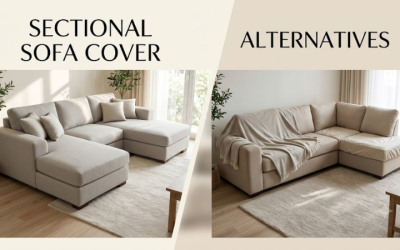
Choose a sectional sofa cover for small spaces by comparing chaise orientation, cushion dimensions, washable fabrics, fitting methods, storage needs, and daily care.
A sectional sofa cover for small spaces should protect furniture without introducing excessive fabric, constant adjustments, or difficult laundry routines. Compact sectionals still come in many configurations, from apartment-sized sofas with chaises to modular corner seating. Choosing the right cover requires more than measuring the overall sofa width. This guide explains fit, fabric, room appearance, storage, and daily maintenance.
Why Small Sectionals Are Difficult to Cover
A compact sectional may occupy less floor space than a conventional large sofa, but its shape can make slipcover selection more complicated.
An L-shaped sofa has two seating directions.
A chaise can extend well beyond the depth of the other seats.
Some cushions detach completely, while others are sewn into the frame.
A cover designed for a conventional straight sofa may leave the chaise uncovered or pull awkwardly across the corner.
In a small room, excess fabric is also more noticeable because the furniture occupies much of the visible seating area.
The correct cover should closely match the sectional’s geometry without requiring constant repositioning.
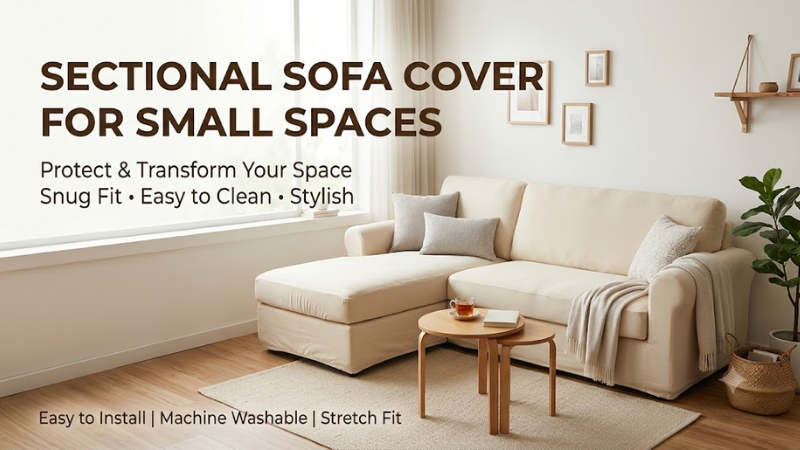
Quick Comparison: Cover Types for Compact Sectionals
| Cover type | Main advantage | Limitation | Best for |
|---|---|---|---|
| Model-specific fitted | Purpose-designed geometry | Limited sofa compatibility | Supported furniture models |
| Universal stretch | Can cover frame and cushions | Fit varies by sofa shape | Compatible L-shaped sectionals |
| Individual cushion covers | Precise high-contact coverage | Does not cover entire frame | Removable cushions |
| Quilted chaise protector | Quick removal and washing | Can shift or expose upholstery | Pets and children |
| Modular fabric panels | Flexible selective coverage | Multiple pieces to manage | Irregular layouts |
| Large decorative throw | Simple and inexpensive | Limited secure fit | Temporary protection |
Step 1: Identify the Exact Sectional Shape
Start by determining whether you own a sofa with a chaise, a corner sectional, or a modular arrangement.
Sofa With Chaise
A chaise sectional has a conventional seating section and an extended lounging area.
The cover must accommodate both.
A product intended for a right-facing chaise may not fit a left-facing arrangement.
Always follow the seller’s orientation diagram.
Corner Sectional
A corner sectional usually has seating that turns through a corner section.
The corner may be a dedicated module.
Covering it with two standard sofa throws can leave gaps at the junction.
Modular Sectional
A modular sectional consists of separate furniture pieces.
If the modules have removable cushions, individual covers may be practical.
However, different modules can require different sizes.
Do not assume a three-seat sectional has exactly three identical cushions.
Step 2: Measure the Sofa Correctly
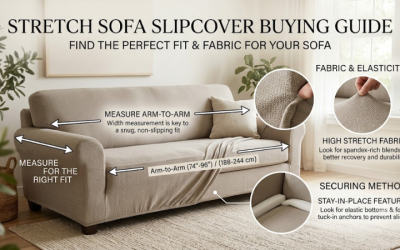
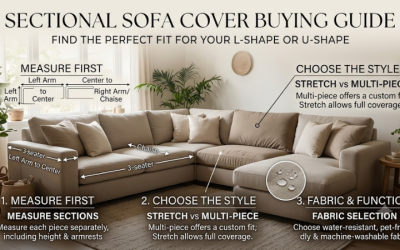
The primary measurements should include the overall width along each side, total depth of the chaise, back height, arm width, and individual cushion dimensions.
Overall Dimensions
Measure both arms of an L-shaped sofa from their outermost points.
This helps identify the appropriate cover category.
However, an overall width alone cannot determine whether a fitted cover will work.
Chaise Measurements
Record the chaise width and its full seating depth.
This is especially important for protective throws, which may leave the front of a long chaise exposed.
Cushion Dimensions
For separate seat covers, measure the width, depth, and thickness of each cushion.
Repeat for the chaise cushion.
An elongated chaise cushion often needs a different cover from a standard square seat cushion.
Cushion Attachment
Check whether cushions can be removed.
Separate covers are not suitable for every attached-cushion sofa.
A cover advertised as compatible with removable cushions may be difficult to install on a tight-back or fixed-seat sectional.
Step 3: Choose the Right Cover for a Small Room
A compact living room benefits from a sofa cover that stays visually neat.
Fitted Covers
A fitted cover can create a coordinated appearance.
It may also hide worn upholstery on the sides and back.
However, removing a large fitted cover for washing can be inconvenient when the sofa is positioned tightly against a wall.
Individual Cushion Covers
Covering the cushions separately can be less intrusive.
The original sofa frame remains visible.
This approach also lets the household wash only the most frequently used cushion cover.
However, matching fabrics and secure fit can be challenging.
Quilted Protectors
A quilted protector can be placed over the main seating surfaces.
It may be especially convenient for pets.
However, it can shift during use and may not cover the outer arms or sofa back.
Decorative Throws
A throw can work for temporary protection.
But it should not be marketed as a full sectional slipcover.
It may offer limited coverage and require frequent adjustment.
Step 4: Understand Why Excess Fabric Matters
A cover that is too large can create loose folds.
These may look untidy, especially in a compact room where the sectional is visually prominent.
Loose fabric can also move when people sit or stand.
However, buying a smaller cover does not solve the problem.
A cover stretched beyond its intended range may pull seams, expose furniture corners, or become difficult to remove.
The correct strategy is to select the product whose published dimensions and geometry match the sofa.
Step 5: Choose Fabrics for Daily Use
Stretch Polyester
Stretch fabrics can conform to a range of cushion and frame shapes.
They are common in fitted slipcovers.
However, fabric composition and elasticity vary.
A high-stretch cover may still fail to fit a sectional with unusual arms or a tall back.
Cotton Blends
Cotton blends can offer a different texture and appearance.
However, laundering instructions matter because certain fabrics may shrink or require air drying.
Microfiber
Microfiber is often chosen for soft touch and everyday cleaning convenience.
However, stain resistance, waterproofing, and washability are separate characteristics.
Quilted Fabrics
Quilted protectors frequently use layered constructions.
These can provide a useful barrier against ordinary contact.
However, seams and fabric edges may still allow moisture through.
Do not assume every quilted product is waterproof.
Step 6: Consider Color and Visual Space
Cover color can influence how large the sectional appears within the room.
A lighter cover may create a softer appearance beside light walls and flooring.
However, light colors can also show certain stains more readily.
Dark colors can create contrast and conceal some marks but may make lint or light-colored pet hair more noticeable.
Patterns may help disguise minor irregularities in fabric placement.
The best color is the one that coordinates with the room and is practical to maintain.
Avoid choosing solely based on the idea that one color always makes a room look larger.
Step 7: Plan Storage for Spare Covers
A small apartment may not have room for several bulky replacement slipcovers.
One Complete Spare Set
A spare fitted cover can be useful when the main cover is being washed.
However, a full sectional set may occupy significant closet space.
Individual Cushion Covers
These can be folded and stored more compactly.
They also allow partial replacement when only one cushion receives heavy use.
Seasonal Covers
If you rotate fabrics by season, check whether the available storage is sufficient.
Avoid buying multiple sets that create a new clutter problem.
Step 8: Make Washing Practical
A washable cover is valuable only when laundering suits the household.
Check Machine Capacity
A large full-sectional cover may be too bulky for a particular home washing machine.
Follow the cover manufacturer’s care label and washer capacity limits.
Check Drying Instructions
Some furniture fabrics prohibit tumble drying.
For example, selected IKEA KIVIK replacement fabrics require machine washing followed by drying methods consistent with their care labels.
Ignoring these instructions can affect fit.
Wash Separate Pieces Carefully
When multiple panels are sold as one coordinated set, follow the manufacturer’s instructions to reduce color or texture differences over time.
Reinstall Properly
A cover may look loose if its seams are not aligned with sofa edges.
Work gradually around the furniture rather than pulling hard on one corner.
Step 9: Plan for Pets and Children
A sectional cover may reduce upholstery exposure to fur, crumbs, and everyday messes.
However, protection varies.
Water resistance does not guarantee leakproof performance.
A cover also cannot prevent all damage from chewing or scratching.
For households with pets, prioritize a product that is easy to remove, fits securely, and can be cleaned according to a realistic routine.
Avoid loose straps or accessories that could create an entanglement hazard.
Small-Room Example: A Sofa With a Left Chaise
Imagine an apartment with an L-shaped sectional measuring 82 inches along the main sofa and 57 inches along the chaise direction.
These are hypothetical measurements.
A universal cover advertised to fit sofas between 70 and 145 inches wide might appear suitable.
However, that alone is insufficient.
The buyer must also check the full depth range, arm shape, back height, and left-facing chaise configuration.
If the product does not fit the sofa’s geometry, a modular cushion-cover approach may be more practical.
Common Buying Mistakes
Choosing by Seat Count Alone
Three-seat sectionals can have different cushion widths and chaise dimensions.
Reversing Chaise Orientation
Left-facing and right-facing configurations are not interchangeable on every cover.
Buying Oversized Fabric to Be Safe
Extra fabric can bunch and shift.
Ignoring Washing Capacity
A complete cover may be inconvenient to launder.
Assuming Every Protector Is Waterproof
Protection claims should be verified for the exact product.
Frequently Asked Questions
What Is the Best Sectional Sofa Cover for Small Spaces?
A fitted, appropriately sized model or individual cushion covers can be practical. The best solution depends on the sectional’s geometry and how often the cover needs washing.
Are Stretch Covers Good for Small Sectionals?
They can be, provided the published dimensions and chaise orientation match. Stretch alone does not guarantee a clean fit.
Should I Cover the Whole Sectional or Only the Cushions?
Cover the entire sofa when appearance transformation is the main goal. Covering individual cushions may be easier when targeted protection is sufficient.
Are Dark Sofa Covers Better for Small Rooms?
Not universally. Color affects visual contrast and maintenance, but fit and fabric quality are more important.
Can I Use a Regular Couch Cover on a Sectional?
Sometimes individual sections can be covered separately, but a conventional straight-sofa cover may not fit the corner or chaise properly.
How Do I Keep a Sectional Cover From Slipping?
Choose the correct size, follow the installation method, and use only the supplied or manufacturer-approved securing components.
Conclusion
A sectional sofa cover for small spaces should protect upholstery without creating excess fabric, awkward installation, or unnecessary storage needs. Measure the main sofa, chaise, cushions, and back before buying. Then select a full fitted cover, separate cushion covers, or removable protective layers according to how the furniture is used. Proper fit and realistic cleaning requirements are more valuable than a generic claim of universal compatibility.