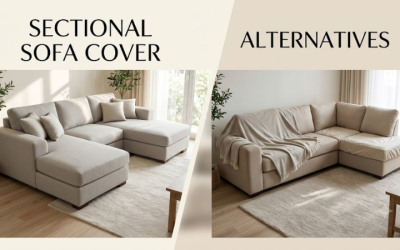
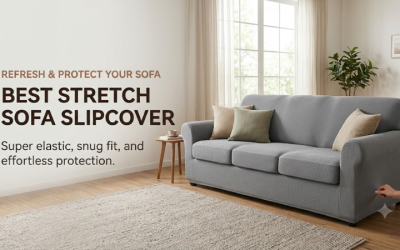
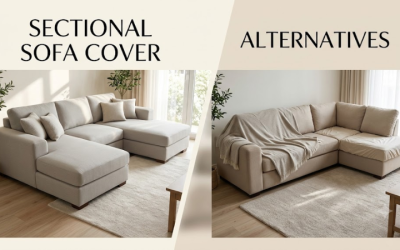
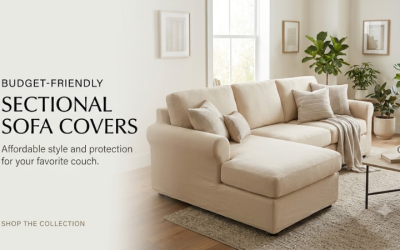
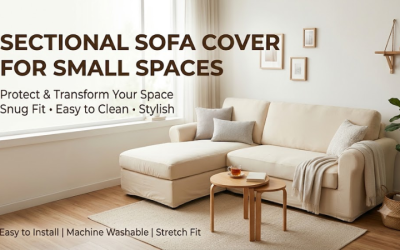
Use this sectional sofa cover buying guide to compare L-shaped fit, chaise orientation, fabrics, cushion measurements, washability, protection, and value.
A sectional sofa cover buying guide should help you avoid the most common slipcover mistake: purchasing fabric that fits the advertised seat count but not the actual furniture shape. Sectionals differ in chaise orientation, modular construction, arm dimensions, and removable cushions. This guide explains how to measure the sofa, compare coverage styles, choose suitable fabrics, and maintain the cover without damaging its fit.
What Is a Sectional Sofa Cover?
A sectional sofa cover is a fitted or loose textile product designed to cover some or all of a multi-section couch.
Its purpose may be to protect upholstery, change the furniture’s appearance, conceal existing wear, or make everyday cleaning easier.
However, different products provide different levels of protection.
A quilted protector may cover only the seat cushions and portions of the back.
A full fitted slipcover can extend around the sofa arms, back, and lower frame.
A manufacturer-specific replacement cover may be constructed from multiple pieces intended for the original sofa modules.
Understanding these differences is the foundation of a good purchase.
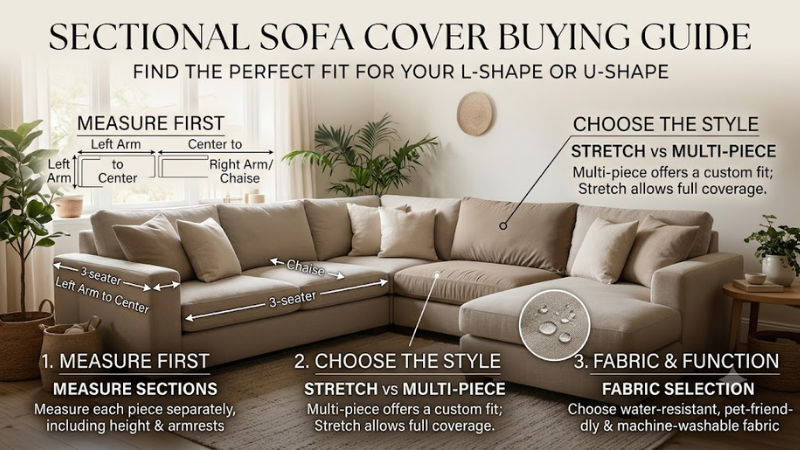
Main Sectional Sofa Cover Types
| Cover type | Primary purpose | Main trade-off |
|---|---|---|
| Universal stretch slipcover | Refresh overall appearance | Fit depends on geometry |
| Model-specific replacement | Restore compatible original upholstery | Limited furniture compatibility |
| Separate cushion covers | Protect high-contact areas | Frame remains exposed |
| Quilted furniture protector | Easy temporary protection | Can move during use |
| Modular panel cover set | Flexible coverage by section | Several pieces to maintain |
| Custom-made slipcover | Tailored fit and fabric choice | Higher cost |
| Decorative throw | Temporary or partial protection | Limited secure attachment |
Step 1: Identify Your Sectional Configuration
Sectional furniture is not standardized.
L-Shaped Sectional With Chaise
This arrangement combines conventional sofa seats with an extended lounging area.
The cover must accommodate the chaise’s longer depth.
The chaise orientation must also match.
Corner Sectional
A corner sectional has a distinct corner unit connecting the two sides.
That corner may have unusual back cushions, wedge-shaped seats, or different upholstery panels.
A conventional straight-sofa cover may not fit it.
U-Shaped Sectional
A U-shaped sectional typically has two projecting sides.
One-piece covers designed for L-shaped sofas may be incompatible.
Multiple cover sections or custom upholstery may be necessary.
Modular Sectional
Modular sofas consist of separate units.
Their dimensions can vary across arms, corner seats, ottomans, and armless sections.
This arrangement may support module-by-module replacement covers, but compatibility must be verified.
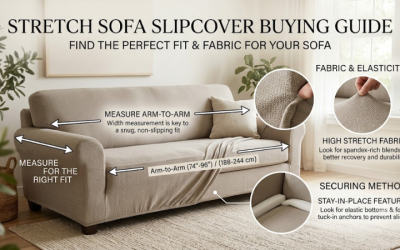
Step 2: Measure the Sofa Accurately
Measurements should describe the furniture’s actual geometry.
Overall Width
Measure the full external width of each sectional side.
Include armrests where required by the cover manufacturer’s instructions.
Overall Depth
Measure from the front of the sofa to the rear.
Then measure the full depth of the chaise separately.
Back Height
Measure from the relevant reference point specified by the manufacturer.
A tall-back sectional may require more fabric than a low-profile design of similar width.
Armrest Dimensions
Wide, rolled, square, and sloping arms create different cover requirements.
A stretch cover designed around narrow arms may fit poorly over a thick rolled-arm sectional.
Cushion Dimensions
For separate covers, measure the actual width, depth, and thickness of every cushion.
Do not use the sectional’s total width divided by the number of seats as a substitute.
Step 3: Understand Chaise Orientation
Left-facing and right-facing terminology commonly describes the chaise position when viewed from the front of the sofa.
However, retailers may use different diagrams or naming conventions.
For that reason, use the product’s actual orientation illustration.
Why Orientation Matters
A cover sewn for a left-chaise layout may place excess fabric or openings in the wrong positions on a right-chaise sofa.
The problem cannot always be solved by stretching the cover.
Reversible Sectionals
Some sectional sofas allow the chaise to be repositioned.
However, that does not mean every cover is reversible.
Confirm whether the cover itself supports both arrangements.
Corner Versus Chaise
A corner seat is not equivalent to a chaise lounge.
An L-shaped corner sectional may require a different cover from a straight sofa with a projecting chaise.
Step 4: Choose Between Full and Partial Coverage
Full Coverage
A fitted cover is useful when the original upholstery is faded, worn, or visually outdated.
It can change the sofa’s overall appearance.
However, a large fitted cover may be more difficult to install and launder.
Cushion-Only Coverage
Separate cushion covers are useful when the main seat surfaces show wear.
They can be easier to replace individually.
However, the sofa frame and arms remain uncovered.
Quilted Protection
A quilted protector is convenient for daily pet use and occasional messes.
It may also be removed quickly.
However, shifting is possible, and the cover may not protect every part of the sofa.
Model-Specific Replacement
A replacement designed for the exact sofa model may provide the most coordinated result.
But it requires the correct furniture collection and component selection.
Step 5: Compare Fabrics
Polyester Stretch Blends
Polyester is common in fitted slipcovers because it can be combined with elastic fibers or constructed in stretchable knits.
It can conform to compatible furniture shapes.
However, fiber composition alone does not establish stain resistance or washability.
Cotton
Cotton offers a familiar textile feel.
However, shrinkage and drying requirements may influence how a fitted cover maintains its shape.
Cotton-Polyester Blends
Blended fabrics can combine different appearance and maintenance characteristics.
Actual performance depends on the weave, finishing, and care instructions.
Microfiber
Microfiber can provide a soft surface and may be marketed for easy maintenance.
However, it should not automatically be described as waterproof.
Chenille
Chenille provides a textured decorative appearance.
It may be attractive for coordinating furniture with rugs and curtains.
However, snagging, shedding, and cleaning depend on the construction.
Velvet
Velvet can provide a more decorative appearance.
However, cleaning, nap direction, and marks from pressure require attention.
Step 6: Understand Fabric Protection Claims
Marketing terms should be interpreted carefully.
Water-Resistant
A water-resistant cover may slow the passage of some liquids.
However, seams, extended exposure, and fabric saturation may allow moisture through.
Waterproof
Waterproof claims should be supported by the actual product’s construction and instructions.
An outer textile layer may repel moisture while seams or edges remain vulnerable.
Stain-Resistant
Stain resistance does not mean a cover cannot become dirty.
Cleaning should still follow the care label.
Pet-Friendly
Pet-friendly generally refers to suitability for everyday use around animals.
It does not guarantee resistance to claws, chewing, or all accidents.
Abrasion Testing
Published abrasion-test figures can provide information about fabric durability under standardized test conditions.
However, they do not predict an exact number of years of service.
Step 7: Check Washability
A sectional cover often consists of a considerable amount of fabric.
Washing Machine Capacity
A bulky fitted cover may exceed the practical load capacity of a domestic washing machine.
Check both the textile care label and machine instructions.
Water Temperature
Follow the approved washing temperature.
Using hotter water than specified can damage certain fabrics or affect fit.
Drying
Some covers prohibit tumble drying.
For example, selected IKEA KIVIK replacement fabrics require washing followed by drying consistent with their label instructions.
Color Separation
Some fabrics should be washed separately.
Follow the instructions to avoid unwanted dye transfer.
Reinstallation
Reinstall the cover carefully, aligning seams with the furniture.
Do not pull hard enough to damage stitches or fasteners.
Step 8: Evaluate How the Cover Stays in Place
Elastic Edges
Elastic edges can help hold a fitted cover around compatible furniture.
However, worn elastic or poor sizing may allow movement.
Tuck-In Foam or Cardboard Components
Some covers use insertable accessories to secure extra material between cushions.
These must be used according to the manufacturer instructions.
Straps
Straps can help secure a cover.
However, they must not be arranged where they create hazards or interfere with reclining mechanisms.
Separate Cushion Covers
Individual covers may stay more consistently aligned when they fit the exact cushion shape.
However, each piece must be compatible with the cushion dimensions.
Step 9: Choose a Suitable Color and Pattern
Color affects room appearance and maintenance.
A neutral cover may blend into many interiors.
A darker fabric may provide contrast.
Patterns can make small wrinkles less noticeable.
However, light pet hair may show more on dark upholstery, while certain spills may be more visible on pale fabrics.
The best choice balances appearance with realistic cleaning needs.
Step 10: Calculate Total Cost
The cost of covering a sectional can include more than one listed product.
Model-Specific Components
An IKEA sectional may require separate sofa, chaise, and corner-section covers.
The final cost is the sum of the required components.
Universal Fitted Covers
A complete universal product may be sold as one large piece or several connected sections.
Check whether the listed price includes all pieces.
Custom Covers
Custom upholstery may involve fabric upgrades, shipping, and made-to-order terms.
Laundry
Large covers may require professional laundering if the home machine is unsuitable, even when the care label permits washing.
Replacement Availability
A discounted fabric may become difficult to replace later.
Step 11: Know When Not to Buy a Cover
A slipcover does not repair structural furniture problems.
If a sofa has broken springs, damaged framing, severe cushion collapse, or unsafe reclining components, covering it will not correct those issues.
Similarly, a sofa with significant moisture damage or persistent contamination may need professional assessment rather than cosmetic coverage.
Evaluate the condition of the furniture before investing in expensive replacement upholstery.
Buying Checklist
| Criterion | What to verify |
|---|---|
| Sectional layout | L-shaped, U-shaped, corner, or modular |
| Chaise orientation | Matches exact cover diagram |
| Overall dimensions | Inside the advertised fit range |
| Cushion sizes | Suitable for individual covers |
| Arm dimensions | Compatible with cover pattern |
| Coverage | Full sofa or selected surfaces |
| Fabric | Appropriate for household use |
| Water protection | Actual claim and construction |
| Laundry | Washer and drying requirements |
| Attachment | Correct securing method |
| Complete cost | Includes every required piece |
| Return policy | Covers compatibility and customization |
Frequently Asked Questions
How Do I Choose the Correct Sectional Sofa Cover?
Identify the sectional shape, measure both sides and the chaise, check arm and cushion dimensions, and compare them with the product’s full fit guide.
Are Universal Sectional Covers Really Universal?
No. They fit only a range of furniture geometries and sizes.
What Is the Best Fabric for a Sectional Sofa Cover?
There is no universal best fabric. Stretch polyester can suit fitted designs, while quilted textiles may be practical for removable protective layers. Cleaning requirements and fit matter most.
Are Waterproof Sectional Covers Better?
They can be useful for liquid protection when the product’s claims are supported. However, waterproof construction does not guarantee better comfort or appearance.
Can I Cover a Reclining Sectional?
Only with a cover specifically compatible with the sofa’s moving sections. Never allow fabric or straps to interfere with the reclining mechanism.
Can Covers Fix a Worn-Out Sofa?
They can conceal cosmetic wear but cannot repair structural damage, broken supports, or collapsed cushions.
Conclusion
A sectional sofa cover should be chosen according to the sofa’s actual configuration, dimensions, upholstery condition, and cleaning needs. Model-specific replacements can provide a coordinated appearance, while stretch slipcovers offer broader compatibility and quilted protectors provide simpler everyday coverage. Verify chaise orientation, fabric claims, installation methods, and complete cost before purchasing. The correct fit is more important than the advertised number of seats.