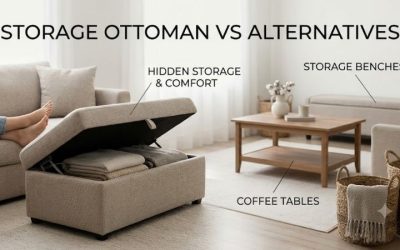
An ottoman with storage for small spaces can replace separate clutter containers while adding a footrest or occasional seat. However, an oversized bench or poorly positioned lid can make a compact room less functional. This guide explains how to compare exterior dimensions, usable storage, lid access, seat height, and practical layouts before buying.
Why a Storage Ottoman Works in a Small Home
A compact apartment often needs one piece of furniture to perform several functions.
A storage ottoman can provide a place for resting the feet, holding everyday household items, and supporting occasional seating when the design permits it.
Its concealed compartment also reduces visible clutter.
However, multifunctional furniture saves space only when those functions are genuinely useful.
A large upholstered ottoman placed in front of a small sofa may occupy more valuable floor area than a narrow cabinet or a few baskets on a shelf.
The correct buying decision begins with the items you need to store and the activity the ottoman will support.
Quick Comparison: Best Storage Ottoman Shapes for Compact Rooms
| Type | Typical advantage | Main drawback | Best placement |
|---|---|---|---|
| Small round ottoman | Compact visual footprint | Limited capacity | Beside armchair |
| Square storage cube | Efficient placement | Modest interior volume | Sofa corner |
| Folding storage ottoman | Easy to relocate when empty | Less substantial construction | Dorm or temporary apartment |
| Narrow storage bench | Longer compartment | Uses more wall length | Foot of bed |
| Large upholstered ottoman | Footrest and substantial storage | Can dominate living room | In front of sectional |
| Tray-top ottoman | Combines storage and surface use | Tray must be managed | Sofa and coffee-table area |
Measure the Exterior Footprint First
An ottoman can appear compact in a product photograph because the surrounding room is unusually spacious.
Actual measurements are more reliable.
For example, the Room Essentials Folding Round Storage Ottoman measures approximately 18 inches in diameter.
The Threshold Upholstered Storage Cube occupies an 18-by-18-inch footprint.
By contrast, IKEA VIMLE measures approximately 38.6 inches long and 28.8 inches wide.
All three products provide concealed storage, but they serve very different room sizes.
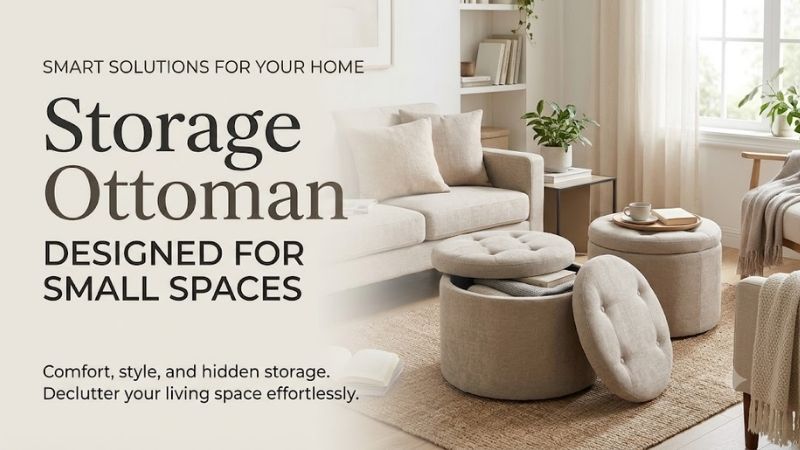
Round Versus Square
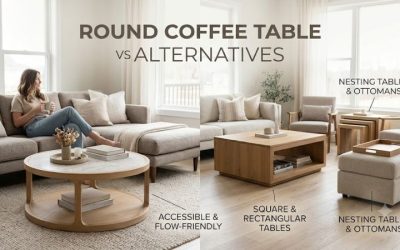
A round ottoman may feel less visually intrusive because it lacks projecting corners.
It can work particularly well beside a chair or between angled furniture.
A square cube may be easier to position tightly along a wall or beside a rectangular sofa.
Neither shape is universally more space-efficient.
The layout determines which uses available floor area better.
Rectangular Benches
A narrow bench can provide storage along a wall without occupying the center of a room.
This may be useful at the foot of a bed.
However, the bench must leave sufficient clearance for accessing drawers, walking around the bed, and opening its lid.
Measure Usable Interior Capacity
The exterior volume of an ottoman is not the same as its storage volume.
A padded lid, internal supports, thick upholstery, and raised legs reduce the space available inside.
For example, an 18-inch cube has an exterior bounding volume of approximately 3.38 cubic feet.
However, its actual internal capacity will be lower.
It would be misleading to advertise that entire calculated volume as usable storage.
Whenever possible, look for manufacturer-published interior dimensions.
Soft Items Versus Rigid Items
Blankets, throws, and cushion covers can fit into irregular spaces more easily than rigid objects.
A storage compartment may hold several soft items but still be too short for a board-game box.
Check the longest object you plan to store.
Avoid Overfilling
Overfilling can prevent the lid from closing properly or place pressure on the lid mechanism.
Do not force the top closed.
Store items within the manufacturer’s intended weight and volume requirements.
Choose the Right Lid for a Tight Room
The lid determines how easily the storage can be accessed.
Removable Lids
A removable lid is common on compact cubes and round ottomans.
The advantage is mechanical simplicity.
The drawback is that the lid needs a temporary resting place every time the compartment is opened.
In a very small room, that may be inconvenient.
Hinged Lids
A hinged lid remains attached to the frame.
This can be easier for frequent access.
However, the lid may need additional clearance behind or above the ottoman.
Not all hinges provide controlled closing.
Lift-Off Tray Tops
Some ottomans have reversible or tray-style tops.
These can function as firm surfaces for suitable items when correctly oriented.
However, a tray should not be treated as a guaranteed substitute for a stable coffee table.
Its stability, permissible loading, and any objects placed on it must be evaluated.
Choose a Useful Seat Height
A storage ottoman may also function as a footrest.
For that use, the height should coordinate with the nearby sofa or chair.
A footrest substantially higher than the sofa seat may feel uncomfortable to some users.
A much lower footrest can provide less leg support than expected.
For occasional seating, the height must also permit comfortable sitting and standing.
However, a suitable height does not establish that the product is structurally rated for seating.
Always confirm intended use first.
Small-Room Layout Example
Imagine a living room measuring 10 by 11 feet.
A sofa occupies one wall, and the area between the sofa and television is relatively narrow.
A large rectangular ottoman could provide more storage, but it may block access to the sofa or obstruct the main walking route.
Two small 18-inch storage cubes could offer a more flexible arrangement.
They might be placed beside the sofa or moved when extra floor space is needed.
However, two cubes also create two lids, two separate compartments, and potentially more visual clutter.
The best arrangement depends on whether you prefer one consolidated storage location or several smaller movable units.
Consider a Storage Ottoman Instead of a Coffee Table
In a compact living room, an ottoman can sometimes replace a coffee table.
This can reduce the total number of furniture pieces.
However, the functional trade-off matters.
A padded ottoman is more comfortable for resting the feet but less suitable for placing drinks directly on the upholstery.
A tray may improve surface usefulness, but it can also create an obstacle when the storage lid needs opening.
If your household frequently works, eats, or uses laptops at the coffee table, a conventional hard surface may be more practical.
Upholstery and Cleaning
Small homes tend to use furniture intensively.
An ottoman may experience contact from feet, pets, food, and everyday accessories.
Removable Fabric Covers
Machine-washable covers can be useful, but care instructions differ by fabric.
Check whether the entire cover is removable or only selected components.
Polyester Upholstery
Polyester is common in affordable ottomans.
Its cleaning requirements depend on the weave and product construction.
A polyester label does not automatically mean machine washable.
Faux Leather
Faux leather can permit straightforward surface wiping when allowed by the manufacturer.
However, coatings can age and may be damaged by unsuitable cleaners.
Wicker and Woven Materials
Woven storage ottomans provide decorative texture.
However, openings in the weave and natural-fiber finishes may require careful cleaning.
Avoid soaking unless the product instructions allow it.
Child and Pet Safety
Storage ottomans can attract children because the compartment resembles a box or hiding place.
Children should not climb inside storage compartments, and the lid should not be closed with a person or animal inside.
Do not assume a storage ottoman has ventilation or entrapment protection appropriate for play.
For hinged designs, check whether the lid can fall unexpectedly and whether the hardware remains secure.
Keep small children and pets clear when opening or closing the lid.
Common Buying Mistakes
Buying the Largest Capacity That Fits
A large ottoman may technically fit while making the room difficult to navigate.
Ignoring Lid Clearance
A hinged lid needs space to open, and a removable lid needs somewhere to rest.
Assuming the Ottoman Is Safe for Sitting
Not every storage product is rated for seating.
Using Exterior Dimensions as Internal Capacity
Frame and upholstery reduce actual storage volume.
Choosing Upholstery Without Checking Cleaning
Fixed covers may require spot cleaning rather than machine washing.
Frequently Asked Questions
What Is the Best Ottoman With Storage for Small Spaces?
A compact square or round ottoman is a practical starting point. Products around 18 inches wide can provide concealed storage without the footprint of a large upholstered bench.
Are Round Ottomans Better for Small Rooms?
They can make movement around corners easier in certain layouts. However, square cubes may fit more efficiently against walls. Choose according to the room rather than shape alone.
Can a Storage Ottoman Replace a Coffee Table?
Yes, when foot support and concealed storage matter more than having a permanently firm tabletop. A suitable tray may help, but it must be used within the product’s limitations.
Is a Folding Storage Ottoman Worth Buying?
It can be useful for dorms or renters who move frequently. However, it must be emptied before collapsing, and the construction may differ from permanent upholstered furniture.
What Should I Store Inside a Small Ottoman?
Throws, magazines, accessories, and other suitable lightweight items are common options. Check internal dimensions and avoid overfilling.
How Much Space Should I Leave Around an Ottoman?
Enough to walk comfortably, access nearby furniture, and open the lid without interference. Required clearance depends on the room and the exact product; there is no single universal measurement.
Conclusion
An ottoman with storage for small spaces should reduce clutter without compromising everyday movement. Compare external dimensions, actual interior volume, lid operation, appropriate seat height, upholstery, and intended loading. Compact cubes and round ottomans offer flexible placement, while benches and larger upholstered models provide more storage at the cost of floor area. Choose the smallest design that meets your actual storage and furniture needs.