Key takeaways
- A round coffee table is an appealing choice when seating surrounds the table from several directions and the household wants to avoid projecting corners.
Round coffee table vs alternatives is a comparison of living-room layouts, surface area, access, and everyday functionality. Circular, rectangular, oval, square, and nesting tables each solve different furniture problems. This guide explains how shape affects circulation, seating reach, storage, maintenance, and value so you can choose the right design for your space.
Quick Verdict: Is a Round Coffee Table Better?
A round coffee table is an appealing choice when seating surrounds the table from several directions and the household wants to avoid projecting corners.
It can work particularly well with compact conversation groups, curved sofas, and certain L-shaped sectionals.
However, a rectangular table may offer better reach along a long sofa while taking up less room depth.
A square table can suit a large sectional arrangement, while an oval table provides a compromise between an elongated surface and softened corners.
Nesting tables offer flexible placement, and storage coffee tables solve organization needs that basic round designs may not address.
No shape is universally better. The correct selection depends on the room’s proportions and the activities the table needs to support.

Quick Comparison Table
| Table type | Primary advantage | Main drawback | Strongest use |
|---|---|---|---|
| Round coffee table | No projecting corners | Large diameter can consume depth | Conversation areas |
| Rectangular coffee table | Long surface with controlled depth | Projecting corners | Straight sofas |
| Square coffee table | Broad shared surface | Substantial footprint | Large sectionals |
| Oval coffee table | Elongated surface with curved ends | Fewer compact configurations | Narrow sofa groupings |
| Nesting coffee tables | Flexible movable surfaces | Often limited storage | Multipurpose rooms |
| Lift-top coffee table | Adjustable work surface | Moving mechanism | Laptop and casual meals |
| Storage coffee table | Shelves or compartments | Added bulk or access requirements | Clutter management |
| Ottoman coffee table | Foot support and soft surface | Less stable for drinks | Relaxed living rooms |
Round Coffee Table vs Rectangular Coffee Table
The round-versus-rectangular comparison is particularly important because these shapes use floor space differently.
Surface Area
Consider a round table measuring 30 inches in diameter.
Its surface area is approximately 707 square inches.
A rectangular table measuring 40 × 20 inches provides 800 square inches.
The rectangular table therefore offers slightly more surface area while requiring only 20 inches of front-to-back depth, compared with the round table’s 30 inches.
However, the rectangle uses 10 additional inches along its longer axis.
The better shape depends on which dimension the room can accommodate.
Reach From the Sofa
A long rectangle may be more accessible to occupants sitting across a three-seat sofa.
A round table can concentrate the surface in the center of the seating group.
That can be useful when several chairs surround the table.
However, people seated at the far ends of a long sofa may find a small circle difficult to reach.
Circulation
Round tables lack sharp projecting corners.
That can make movement feel smoother where people frequently pass around the table.
Rectangular tables can occupy a narrower strip of floor, which may be more efficient in a long, shallow room.
Which Is Better?
Choose a round table for compact conversation groupings and circulation around a central centerpiece.
Choose a rectangle for long seating arrangements and limited room depth.
Round Coffee Table vs Square Coffee Table
A square table provides similar dimensions in two directions, as does a circle.
However, the occupied area differs.
Comparing Equal Width
A 30-inch square table occupies 900 square inches.
A 30-inch round table occupies approximately 707 square inches.
The square offers roughly 27% more tabletop area within the same maximum width and depth.
However, that extra surface comes from its corners.
Those corners can affect movement around the table.
Seating Layout
Square tables can suit large sectionals or balanced seating groups where people sit on multiple sides.
Round tables also work well in these arrangements.
The difference depends on how much usable tabletop area is needed and how closely the seating surrounds the center.
Visual Appearance
A circle softens furniture arrangements dominated by straight lines.
A square reinforces a geometric appearance.
Neither style is inherently superior.
Which Is Better?
Choose a square table when maximum surface area within a defined width and depth matters.
Choose a round table when curved edges and easier movement around the corners are priorities.
Round Coffee Table vs Oval Coffee Table
An oval table combines an elongated shape with curved ends.
It can provide an effective compromise between a long rectangle and a circle.
Room Geometry
A narrow oval table may provide good reach along a long sofa while taking up less depth than a large round table.
Its curved ends can also reduce the prominence of corners.
Surface Distribution
An oval concentrates more usable length along one direction.
That can be practical for spreading out drinks, books, or board-game accessories across several seating positions.
However, the exact surface area depends on its proportions.
An elongated oval may offer less surface area than a rectangle with the same bounding width and length.
Style and Balance
Oval tables can complement curved furniture without requiring a circular floor footprint.
They may also work well in narrow rooms.
Which Is Better?
Choose an oval table when the room requires a long but relatively shallow tabletop.
Choose a round table when the seating arrangement is more evenly distributed around the center.
Round Coffee Table vs Nesting Tables
Nesting tables use several compatible surfaces that can be placed together or separated.
They are particularly interesting for small or multipurpose living rooms.
Flexibility
A nesting set can provide a compact arrangement when not in use.
The smaller table can be pulled out when more surface space is needed.
This is useful during gatherings or when several people need individual surfaces.
Daily Convenience
A fixed round coffee table stays in one location and does not require rearrangement.
Nesting tables may need to be moved or returned to their original positions.
The best solution depends on whether the room’s needs change frequently.
Stability and Loading
Nesting tables can vary substantially in size and structure.
Smaller surfaces may have lower weight limits or different stability characteristics.
Follow the manufacturer specifications for each table.
Which Is Better?
Choose nesting tables when the furniture needs to be rearranged regularly.
Choose a single round table when the room benefits from one permanent central surface.
Round Coffee Table vs Lift-Top Coffee Table
A lift-top coffee table includes a surface that raises or moves toward the user.
This adds a function that an ordinary fixed-height round table generally does not provide.
Laptop Use
A lifting top can move a work surface closer to the seated person.
This may be useful for occasional laptop use.
However, a lift-top coffee table is not automatically a substitute for a properly designed ergonomic desk.
The keyboard, screen, and seating arrangement must still be appropriate.
Eating and Activities
Some people use lift-top tables for casual meals or hobbies.
The firm adjustable surface can be more useful for these activities than a low stationary table.
However, the mechanism has loading and movement limits.
Storage
Some lift-top tables include concealed compartments beneath the moving surface.
This can reduce clutter.
However, objects may need to be removed before the mechanism is operated.
Which Is Better?
Choose a lift-top table when adjustable surface height provides genuine value.
Choose a traditional round coffee table when appearance, simple construction, and ordinary tabletop use are sufficient.
Round Coffee Table vs Storage Coffee Table
A storage coffee table may have drawers, shelves, lifting compartments, or other organizational features.
A standard round table may focus primarily on surface and appearance.
Open Storage
An open lower shelf provides easy access to magazines, remotes, and books.
IKEA BORGEBY and Threshold Castalia illustrate round-table options with accessible storage features.
However, shelves do not conceal clutter completely.
Hidden Storage
Drawers and enclosed compartments keep objects out of sight.
However, they can add mechanical components and require opening clearance.
Floor-Space Efficiency
A coffee table with useful storage may eliminate the need for another cabinet or basket.
However, a large storage-heavy table can occupy more room than a simple compact design.
Which Is Better?
Choose a storage coffee table when the organization function is important.
Choose a simpler round table when the household already has sufficient storage.
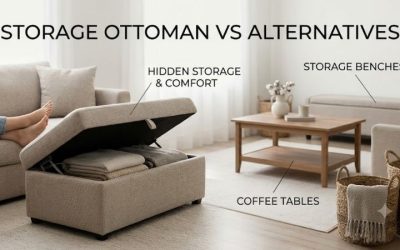
Round Coffee Table vs Ottoman Coffee Table
An upholstered ottoman can sometimes serve as a coffee-table substitute.
It usually provides a padded surface and may include storage.
However, its main function differs from that of a conventional hard table.
Foot Support
An ottoman can support the legs more comfortably than a hard tabletop.
That is useful for relaxed lounging.
Drinks and Food
A padded surface is generally less suitable for placing drinks directly.
A compatible tray may help, but it should remain stable and be used according to the product’s limitations.
Storage
A storage ottoman may conceal blankets and accessories.
A standard round coffee table may provide a larger stable surface but less hidden capacity.
Maintenance
Upholstery requires different care from glass, wood, or metal.
Spills and repeated foot contact may affect cleaning needs.
Which Is Better?
Choose an ottoman when foot support and soft seating are priorities.
Choose a round coffee table when a stable hard surface matters more.
Which Option Is Best for Different Rooms?
| Living-room situation | Recommended starting option | Reason |
|---|---|---|
| Compact conversation area | Round coffee table | Accessible from multiple directions |
| Long sofa in a narrow room | Rectangular or oval table | Elongated surface with less depth |
| Large sectional | Square or suitably sized round table | Broad central surface |
| Room used for different activities | Nesting tables | Flexible arrangement |
| Frequent laptop use | Suitable lift-top table | Adjustable surface |
| Living room with clutter | Storage coffee table | Built-in organization |
| Relaxed lounge seating | Ottoman coffee table | Foot support |
| Minimalist room | Simple round or pedestal table | Less visual complexity |
Compare Space Efficiency With Real Measurements
Shape labels can be misleading.
A round table does not always occupy less space than a rectangular one.
Consider three examples:
| Table shape | Dimensions | Approximate surface area |
|---|---|---|
| Round | 30-inch diameter | 707 sq in |
| Rectangular | 40 × 20 in | 800 sq in |
| Square | 30 × 30 in | 900 sq in |
These examples show how different shapes distribute surface area.
However, surface area alone does not determine practical room fit.
A table with a small top but an oversized pedestal may obstruct the same space as a larger table.
Likewise, a glass top may look lighter but retain the same floor dimensions.
Choose based on the complete furniture arrangement.
Comparing Materials Across Table Types
The shape does not determine the material.
Round, oval, square, and rectangular tables are available in wood, veneer, glass, metal, and stone.
The buying decision should therefore separate geometry from construction.
Wood
Wood offers warmth and varied styling, but its finish needs appropriate maintenance.
Glass
Glass provides a transparent appearance but shows fingerprints and requires careful use.
Metal
Metal can create lightweight-looking frames or substantial sculptural forms.
Stone
Stone tables can be heavy and may require specialized cleaning.
Upholstery
Ottoman-style coffee tables offer soft surfaces but different maintenance and stability characteristics.
The right material depends on the household’s actual use rather than the table’s shape.
Price and Long-Term Value
A simple round table can be less expensive than a lift-top or heavily constructed storage table.
However, prices vary widely within each category.
An inexpensive rectangular table may be better value than an expensive round centerpiece when the living room is narrow.
A nesting set may reduce the need for multiple separate side tables.
A storage coffee table may eliminate an extra cabinet.
A lift-top table may be worthwhile when its adjustable function is used often.
The best value comes from avoiding furniture that duplicates functions or obstructs the room.
Common Comparison Mistakes
Assuming Round Always Means Safer
Curved edges remove corners but do not eliminate risks from unstable furniture, hard materials, or glass.
Ignoring Surface Area
A large circle may occupy more floor space than expected.
Choosing an Ottoman for Frequent Laptop Work
A soft surface is not equivalent to a firm workstation.
Buying Storage Features Without Needing Them
Extra shelves or mechanisms can add cost and bulk.
Selecting Shape Without Measuring the Sofa
The table must complement the seating arrangement, not just the room’s decorative style.
Frequently Asked Questions
Is a Round Coffee Table Better Than a Rectangular One?
A round table can work well in conversation areas and reduce projecting corners. A rectangle may provide better reach along a long sofa while occupying less room depth.
Is a Round Coffee Table Better for Small Spaces?
Sometimes. It depends on the diameter and surrounding layout. A narrow rectangular or oval table may be more efficient in a long, shallow room.
Is an Oval Coffee Table Better Than a Round Table?
An oval can be more practical when the seating arrangement is long but the room has limited depth. A circle may fit a more balanced conversation grouping.
Is a Square Coffee Table Better for a Sectional?
It can be, particularly when a large sectional surrounds the table on multiple sides. A round table may also work when its diameter is appropriate.
Are Nesting Tables Better Than One Coffee Table?
They can offer more flexibility when surface needs change. A single table is simpler when a permanent central surface is preferred.
Is a Storage Coffee Table Worth the Extra Cost?
It may be when drawers or compartments eliminate the need for separate storage furniture. If the household already has enough storage, a simpler design may be better value.
Conclusion
A round coffee table is a strong option when curved edges, balanced proportions, and access from several seating directions matter. Rectangular and oval tables can be better in narrow rooms, square tables suit certain sectional layouts, and nesting tables add flexibility. Lift-top, storage, and ottoman-style alternatives provide other functions. Choose by actual room dimensions, daily activities, material requirements, and long-term cost rather than assuming one shape is universally superior.