Our Top Picks
 120 Pint Dehumidifier for Basement 6000 Sq. Ft120 Pints 6000 Sq. Ft.13.86 x 10.71 x 19.49 inches31.8 poundsCheck on Amazon
 Yaufey 70 Pints Energy Star Commercial Dehumidifier with70 Pints12.99 x 16.54 x 11.81 inches41.29 PoundsCheck on Amazon
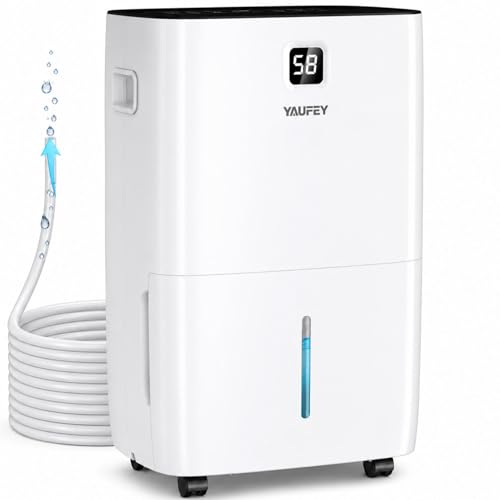 Yaufey 150 Pint Dehumidifier with Pump for Basement150 Pints 8500 Sq. Ft.15.47 x 11.73 x 24.37 inches39.68 poundsCheck on Amazon
 Yaufey 150 Pint Dehumidifier for Basement Home 8000150 Pints 8000 Sq. Ft.15.47 x 11.73 x 24.37 Inches38.45 PoundsCheck on Amazon
 Yaufey 125 Pints Commercial Dehumidifier with Drain Hose125 Pints12.44 x 19.37 x 13.39 inches51.92 poundsCheck on Amazon
A 120 pint dehumidifier with a 1.06 gallon tank is a mathematical joke if you leave the drain hose in the box. That tank holds about 8.5 pints. At the stated 120 pints a day, it would fill in under two hours and shut the machine off. Every Yaufey title in this lineup pairs a very large capacity with a hose or a pump for exactly that reason, and the buying question is less about how many pints you want than whether your space can use that many.
This page compares eight Yaufey listings, from 70 to 216 pints and from 5,000 to 8,500 claimed square feet. Everything stated about a model comes from its title; where the title is silent, the entry says to check the listing. Nobody on the team used or measured these units, so all capacity and cost figures are labeled estimates, and the page makes no claims about brand history, warranty terms or reliability.
First question: do you need this much machine?
120 Pint Dehumidifier for Basement 6000 Sq. Ft with Drain Hose, ENERGY STAR | Continuous Drain & Water Tank 1.06 Gal, Intelligent Humidity Control, Quiet Operation, Auto Shut Off, 24H Timer for Home
One of the moisture-control product options compared in this guide.
View on Amazon80 Pint Dehumidifier for Basement 5500 Sq. Ft. with Drain Hose, ENERGY STAR | Continuous Drain & Water Tank 1.06 Gal, Intelligent Humidity Control, Quiet Operation, Auto Shut Off, 24H Timer for Home
One of the moisture-control product options compared in this guide.
View on AmazonYaufey 70 Pints Energy Star Commercial Dehumidifier with Drain Hose for 5000 Sq. Ft. Crawl Space, Basement, Industrial, 10-90% RH Humidity Control, 24/7 Continuous Drainage,TUV Certified,5-Yr Coverage
One of the moisture-control product options compared in this guide.
View on AmazonYaufey 150 Pint Dehumidifier with Pump for Basement 8500 Sq. Ft. | Continuous Drain & Large Water Tank 1.85 Gal, Intelligent Humidity Control, Quiet Operation, Auto Shut Off, Timer for Home
One of the moisture-control product options compared in this guide.
View on AmazonYaufey 150 Pint Dehumidifier for Basement Home 8000 Sq. Ft. with Drain Hose | Continuous Drain & Large Water Tank 2.11 Gal, Intelligent Humidity Control, Quiet Operation, Auto Shut Off, Timer for Home
One of the moisture-control product options compared in this guide.
View on AmazonYaufey 125 Pints Commercial Dehumidifier with Drain Hose for Crawl Space, Basement, Industrial, 10-90% RH Humidity Control,6500 Sq.Ft. 24/7 Running Continuous Drainage, TUV Certified, 5-Yr Coverage
One of the moisture-control product options compared in this guide.
View on Amazon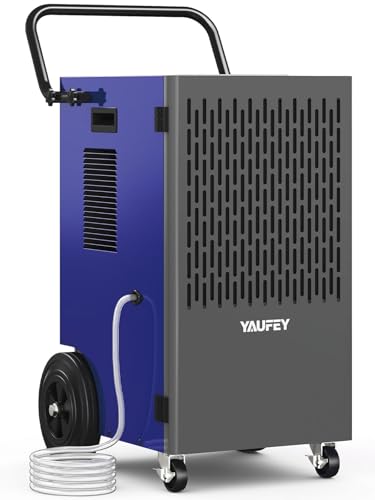
Yaufey 155 Pints Commercial Dehumidifier with Pump, for Basement up to 8000 Sq. Ft, Large Capacity Industrial Dehumidifier for Large Room with Intelligent Humidity Control
One of the moisture-control product options compared in this guide.
View on Amazon
Yaufey 216 Pints Commercial Dehumidifier with Pump for Crawl Space, Basement, Industrial Space, 8000 Sq.Ft., 10-90% RH Humidity Control, 7/24 Running Continuous Drainage, TUV Certified, 5-Yr Coverage
One of the moisture-control product options compared in this guide.
View on AmazonMost residential problems do not need 100 pints or more. A sizing chart for a very damp 2,000 square foot basement suggests something in the range of 19 pints on the current rating scale. These Yaufey units start at 70 pints. That does not make them wrong; it means they are aimed at a different job.
- Under about 1,500 square feet, mildly damp: skip this class. A standard portable fits better.
- 1,500 to 4,000 square feet, damp: the 50 to 70 pint class is usually enough. Our best 50 pint dehumidifier guide covers that range, and the Yaufey 70 pint commercial is the closest match here.
- Wet crawl space, flood recovery, workshop or warehouse: the commercial class is the right territory.
- Very large open space of 5,000 square feet or more: the larger Yaufey models, or two smaller units in separate zones.
A simple home calibration helps. Run a small dehumidifier for 24 hours with a hose into a bucket and measure the water. If it collects close to the unit’s rated pints, your space is wetter than the unit can handle, and a larger machine may be warranted. If it collects a few pints and the unit keeps cycling off, a large machine would be wasted.
Tank math: why every model needs a drain plan
Three tank sizes appear in the titles: 1.06, 1.85 and 2.11 gallons. A gallon is 8 pints, so those hold about 8.5, 14.8 and 16.9 pints. Divide by the daily pint rating and you get the time to fill at full output, which is a ceiling.
| Model (tank in title) | Tank in pints | Rated pints a day | Hours to fill at full output |
|---|---|---|---|
| 120 pint (1.06 gal) | 8.5 | 120 | 1.7 |
| 80 pint (1.06 gal) | 8.5 | 80 | 2.5 |
| 150 pint with pump (1.85 gal) | 14.8 | 150 | 2.4 |
| 150 pint with hose (2.11 gal) | 16.9 | 150 | 2.7 |
In practice output falls as the air dries, but even at a quarter of the rated figure the tanks fill in under eleven hours. The conclusion: treat the tank as a backup. Plan a gravity hose to a floor drain, or use one of the pump models if the water has to rise. The four commercial titles (70, 125, 155 and 216 pints) do not mention a tank at all, and three of them mention continuous drainage.
The eight models at a glance
| Model | Key spec from the title | Price tier | Best for |
|---|---|---|---|
| Yaufey 70 Pint Commercial | 5,000 sq ft, hose, 10-90% RH, Energy Star | Mid-range | Crawl space, smaller wet areas |
| 80 Pint for Basement | 5,500 sq ft, hose, 1.06 gal tank, Energy Star | Budget | Large damp basement |
| 120 Pint for Basement | 6,000 sq ft, hose, 1.06 gal tank, Energy Star | Budget | Very large basement |
| Yaufey 125 Pints Commercial | 6,500 sq ft, hose, 10-90% RH | Mid-range | Industrial or crawl space |
| Yaufey 150 Pint with Hose | 8,000 sq ft, 2.11 gal tank | Mid-range | Large home basement |
| Yaufey 150 Pint with Pump | 8,500 sq ft, pump, 1.85 gal tank | Budget | Large basement, uphill drain |
| Yaufey 155 Pints Commercial with Pump | 8,000 sq ft, pump, industrial | Premium | Large industrial space |
| Yaufey 216 Pints Commercial with Pump | 8,000 sq ft, pump, 10-90% RH | Premium | Extreme moisture loads |
Price tiers are relative to the eight. One surprise: tier does not follow pint count. The 150 pint with pump sits in Budget, below the 70 pint commercial in Mid-range. The titles do not explain the gap, so possible reasons include the rating method, build quality, certifications or marketing. Do not read the stated pints as a clean measure of value.
Claimed square feet per pint: a reality check
| Model | Pints | Claimed sq ft | Pints per 1,000 sq ft |
|---|---|---|---|
| 70 Pint Commercial | 70 | 5,000 | 14.0 |
| 80 Pint | 80 | 5,500 | 14.5 |
| 150 Pint with Pump | 150 | 8,500 | 17.6 |
| 150 Pint with Hose | 150 | 8,000 | 18.8 |
| 125 Pints Commercial | 125 | 6,500 | 19.2 |
| 155 Pints Commercial | 155 | 8,000 | 19.4 |
| 120 Pint | 120 | 6,000 | 20.0 |
| 216 Pints Commercial | 216 | 8,000 | 27.0 |
Compare with an approximate sizing guide of roughly 7.5 to 13 pints per 1,000 square feet on the current scale, from moderately damp to extremely wet. The Yaufey claims run 14 to 27, above even the extremely wet band. Either the sellers assume very high moisture loads, or the pint figures were rated at a warmer, wetter condition than the current standard, which would inflate them. The titles do not say. The safest reading is that real output in a cool basement is a fraction of the headline, which is also why the large claimed areas are best treated as upper limits.
Running cost and power, with assumptions
No title lists wattage. As an estimate, units in the 70 to 80 pint class might draw 600 to 900 watts, 120 to 155 pint units 900 to 1,400 watts, and the 216 pint model more. Read the nameplate on the listing and compare it with the circuit you plan to use, because a big unit on a shared 15 amp circuit with a freezer can trip a breaker.
| Scenario | Assumed draw | Hours a day | kWh a month | Approx. cost a month |
|---|---|---|---|---|
| Mid-size unit, damp season | 750 W | 10 | 225 | 36 dollars |
| Large unit, wet season | 1,100 W | 14 | 462 | 74 dollars |
| Large unit, shoulder season | 1,100 W | 5 | 165 | 26 dollars |
All three use 30 days and 16 cents per kilowatt hour. The takeaway: oversizing is costly only if the unit runs long hours. A larger machine may reach the target faster and rest, but a space sealed poorly will keep it running whatever the size.
The eight Yaufey models, smallest to largest
Yaufey 70 Pints Energy Star Commercial Dehumidifier (5,000 sq ft)
Title says: 70 pints, Energy Star, commercial, with a drain hose, for a 5,000 square foot crawl space, basement or industrial space, 10 to 90 percent RH control, 24/7 continuous drainage, TUV certified and 5-year coverage. The title does not say what the coverage includes; read the terms on the listing.
Claim math: 14.0 pints per 1,000 square feet, the lowest in the group, so this is the most conservative claim. At 70 pints, the rating equals about 8.75 gallons a day at the rating point.
Drain: hose only. No pump is mentioned, so the drain has to be at or below the unit. A crawl space often sits below the nearest drain, so confirm the route before ordering.
Cost estimate: a mid-size unit at 750 watts, 10 hours a day, costs about 36 dollars a month.
The 10 to 90 percent range shows that the control covers the whole spectrum, which a household dehumidifier typically does not. For a home, the practical setting is 45 to 55 percent. The wide range matters for storage and industrial use more than for comfort.
Crawl space installation has its own rules. Hang or raise the unit so it sits off wet soil, keep the intake clear of insulation and ductwork, and make sure the access hatch is large enough to carry the unit through. Most crawl spaces also need a sealed vapor barrier on the ground; without one, soil moisture can overwhelm a dehumidifier of any size. Treat the 5,000 square foot claim as the ceiling for a well-sealed space, not the starting point for a bare-dirt one.
Pros
- Most conservative pints-to-area claim of the eight
- Energy Star and TUV certification named in the title
- Continuous drainage and wide humidity range
Cons
- No pump, so an uphill drain needs extra equipment
- Mid-range tier despite the lowest capacity
- Noise and wattage not in the title
Who it’s for: a wet crawl space or workshop where a hose drain is possible and 70 pints is enough.
Yaufey 80 Pint Dehumidifier for Basement (5,500 sq ft)
Title says: 80 pints, basement, 5,500 square feet, drain hose, Energy Star, continuous drain and a 1.06 gallon tank, intelligent humidity control, quiet operation, auto shut off and a 24 hour timer. It sits in the Budget tier, the lowest priced of the eight.
Claim math: 14.5 pints per 1,000 square feet. The tank holds about 8.5 pints, so at full output it would fill in 2.5 hours. The hose is therefore not an extra; it is how the unit is meant to be run.
Quiet claim: The title says quiet operation without a decibel number. A compressor moving that much air and water is rarely silent, so read the listing for the sound level at each fan speed, especially if the unit sits below a bedroom.
Estimate: an 80 pint unit may draw around 700 to 900 watts, about 34 to 43 dollars a month at 10 hours a day and 16 cents per kilowatt hour.
It is the model to consider if you want residential-style features such as a timer and auto shut off without paying for the commercial label. Verify the Energy Star claim on the official product list, since an 80 pint figure is above the range of most Energy Star portables.
A practical way to judge whether 80 pints is right is to look at the floor. A damp stain pattern covering a quarter of a slab suggests a modest load. Standing water, a sump pit that runs often or white mineral crust on walls suggests a heavy one. The first case is more likely to be satisfied by a smaller unit; the second is where an 80 pint class machine earns its place, especially if you also dry laundry or have a bathroom without a good exhaust fan.
Pros
- Lowest price tier of the eight
- Timer, auto shut off and a quiet claim
- Hose and tank both listed
Cons
- Small tank relative to output, so the hose is mandatory
- No pump for uphill drains
- Noise level not given in decibels
Who it’s for: a large, wet basement with a floor drain where the buyer wants the cheapest capable unit.
Yaufey 120 Pint Dehumidifier for Basement (6,000 sq ft)
Title says: 120 pints, 6,000 square feet, drain hose, Energy Star, continuous drain with a 1.06 gallon tank, intelligent humidity control, quiet operation, auto shut off and a 24 hour timer. The Budget tier again, a step above the 80 pint.
Claim math: 20.0 pints per 1,000 square feet and a tank that fills in 1.7 hours at the headline rate. This is where the tank math is starkest: the same small tank as the 80 pint, with 50 percent more water to move. A gravity hose is not optional.
Rating caution: 120 pints is far above the capacity of residential portables rated on the current scale. If it was rated at warm, saturated air, the figure could be roughly double what you would see in a 65 degree basement. That is an editorial caution, not a finding. Look for the rating condition on the listing.
Cost estimate: around 1,000 watts, which is about 48 dollars a month at 10 hours a day and 16 cents per kilowatt hour.
For many homes, the 120 pint offers headroom that will rarely be used. It pays off after a leak or in a very wet season, when you want the humidity down fast.
One more consideration is how the unit will be stored. A machine this size is not something to carry up and down stairs each season. If you plan to run it year round, place it where it can stay, near an outlet and the drain, and give it a clean path for air. If you plan to run it only in the wet months, check the weight on the listing before you commit, because a heavy unit tends to stay where it was left, and the filter gets cleaned less often.
Pros
- High stated capacity at a Budget tier
- Continuous drain, timer and auto shut off
- Energy Star named in the title
Cons
- Tank is far too small for the stated output
- No pump for uphill drains
- Rating condition and noise are not stated
Who it’s for: owners of a very large wet basement who have a floor drain and want fast recovery.
Yaufey 125 Pints Commercial Dehumidifier (6,500 sq ft)
Title says: 125 pints, commercial, with a drain hose for crawl space, basement and industrial use, 10 to 90 percent RH, 6,500 square feet, 24/7 continuous drainage, TUV certified and 5-year coverage. No tank is mentioned.
Claim math: 19.2 pints per 1,000 square feet. It costs more than the 120 pint in tier and offers 5 more pints, so the commercial wording and certifications are what you pay for. The title does not describe what differs inside.
Use case: a continuous-drain commercial unit is meant to run without attention. That suits a vented crawl space, a storage building or a restoration job where no one will empty a tank. The 10 to 90 percent range offers a wider control band than the household models.
Cost estimate: at an assumed 1,000 watts, about 48 dollars a month at 10 hours a day.
The question to ask is whether you need the commercial label. If the space is a home basement that you walk through daily, the 120 pint residential-style model offers a timer and quiet claim for less. If it is a place you visit rarely and want to leave running, the commercial class is the better fit.
Maintenance matters more in unattended spaces. A unit left running for months in a crawl space needs a periodic look at its filter, its coil and its drain line, because a clogged hose is the failure that causes the most trouble. Put a reminder in your calendar for the start of the wet season and again at the end. If the listing mentions a drain-line alarm or an automatic shutoff for clogs, count it as a real advantage for a space you rarely visit.
Pros
- Continuous drainage and wide humidity range
- TUV certified and 5-year coverage named in the title
- Suited to unattended spaces
Cons
- Mid-range tier for 5 pints more than the 120 pint
- No pump mentioned
- Likely louder and heavier than residential models
Who it’s for: a crawl space, shop or storage building that runs unattended.
Yaufey 150 Pint Dehumidifier with Drain Hose (8,000 sq ft)
Title says: 150 pints, basement and home, 8,000 square feet, with a drain hose, continuous drain and a large 2.11 gallon tank, intelligent humidity control, quiet operation, auto shut off and a timer. Mid-range tier.
Claim math: 18.8 pints per 1,000 square feet. The 2.11 gallon tank holds about 16.9 pints, the largest in the group, and still fills in 2.7 hours at the headline rate. It is a better backup than the 1.06 gallon tanks, but it is still a backup.
Home use: the title uses home and basement together, which makes it the large model most clearly aimed at a house, as opposed to a commercial space. It also adds the quiet claim and a timer.
Cost estimate: an assumed 1,100 watts at 14 hours a day in a wet season is roughly 74 dollars a month, and about 26 dollars at 5 hours a day in the shoulder season.
Compare it with the 150 pint with pump, which has the same stated pints at a Budget tier. If your drain is below the unit, the hose version works. If not, the pump version is the better value on paper.
Think about zoning in a large basement. Even a big machine will treat the air it can reach, and a basement divided by walls, a furnace room and a finished area behind a door will not behave as one volume. Place the unit in the largest open area, leave interior doors open and consider a small fan to push air toward the far rooms. If a far room stays above 60 percent after a week, a second, smaller unit there beats pushing a larger machine harder.
Pros
- Largest tank in the group
- Home-oriented title with timer and quiet claim
- Hose and tank both available
Cons
- Mid-range tier for the same pints as the pump model
- No pump for uphill drains
- Power draw and noise are not in the title
Who it’s for: a large home basement with a floor drain where a high-capacity unit is warranted.
Yaufey 150 Pint Dehumidifier with Pump (8,500 sq ft)
Title says: 150 pints, with a pump, basement, 8,500 square feet, continuous drain and a large 1.85 gallon tank, intelligent humidity control, quiet operation, auto shut off and a timer. Budget tier, one of the cheapest in the group.
Claim math: 17.6 pints per 1,000 square feet, lower than most of the large units, and the largest claimed area in the lineup. The tank holds 14.8 pints and fills in 2.4 hours at the headline rate, so the pump does the real work.
Why it stands out: a pump, a big capacity and a Budget tier together. That combination is unusual in the group, where the pump models are otherwise the Premium commercial units. If the title is accurate, this is the lowest-cost way to get both capacity and uphill drainage. Check pump lift height and hose length on the listing before relying on it.
Cost estimate: at an assumed 1,100 watts, around 74 dollars a month in the wettest season and much less when the basement is dry.
Plan the hose route first, with a steady climb and no sags. A pump that fights a trapped hose will short-cycle.
Weigh the pump against a simpler alternative. A gravity hose has no moving parts, so if your drain is below the unit, it is the most reliable choice. A pump is worth having only when the water must rise. Many basements have a sump pit that can accept discharge, which gives you a downhill-free drain without lifting water up a wall; check local rules and sump capacity first, since adding a steady flow to a pit that already runs often can create its own problem.
Pros
- Pump and large capacity at a Budget tier
- Largest claimed area in the group
- Timer, auto shut off and quiet claim
Cons
- Lift height and hose length not in the title
- Rating condition not stated
- Pump adds a part to maintain
Who it’s for: a large basement where the water must go up and out, and the buyer wants the best value on paper.
Yaufey 155 Pints Commercial Dehumidifier with Pump (8,000 sq ft)
Title says: 155 pints, commercial, with a pump, for a basement up to 8,000 square feet, a large-capacity industrial dehumidifier for a large room, with intelligent humidity control. Premium tier. The title does not mention a hose, a tank, TUV certification or coverage terms.
Claim math: 19.4 pints per 1,000 square feet. Compared with the 150 pint with pump, it offers 5 more pints and an industrial label at a much higher price, and the title lists fewer features. That makes the premium harder to justify from the title alone.
What to check: why this model costs more. Possible reasons include build quality, a different compressor, a larger coil or a different rating condition; none appears in the title. Read the specifications for wattage, dimensions, weight and operating range.
Cost estimate: an assumed 1,200 watts, about 58 dollars a month at 10 hours a day.
The title says it is for a large room, so think about the room. A single big space with a pump discharge fits well. Several closed rooms do not, however large the unit.
A price tier this high deserves a direct question: what do you get that a cheaper pump model lacks? Ask the product page for the number of coils, the refrigerant, the housing material, the handle design, the filter type and the stated operating range. If the answers are not on the page, you are paying for a label. If they are, compare the figures with the Budget 150 pint with pump before deciding, and ask whether the extra five pints are worth the premium.
Pros
- Pump and industrial positioning
- Large claimed area and capacity
- Suited to a single big space
Cons
- Premium tier with fewer listed features than cheaper models
- No tank, timer or certification in the title
- Likely heavy and loud; verify on the listing
Who it’s for: a large industrial-style space where the buyer has confirmed the specifications justify the price.
Yaufey 216 Pints Commercial Dehumidifier with Pump (8,000 sq ft)
Title says: 216 pints, commercial, with a pump, for crawl space, basement and industrial space, 8,000 square feet, 10 to 90 percent RH, 7/24 continuous drainage, TUV certified and 5-year coverage. The highest capacity and, with the 155 pint, the highest price tier.
Claim math: 27.0 pints per 1,000 square feet, double the typical wet allowance on the current scale, which suggests the seller assumes a severe moisture load or a warm, saturated rating condition. 216 pints is about 27 gallons a day at the headline rate, which is a lot of water to route.
Where it makes sense: post-flood drying, a very wet crawl space with groundwater intrusion, or an industrial process that adds moisture continuously. For ordinary household dampness it is far beyond what is needed.
Practical issues: weight, noise, power draw and heat output. A big compressor unit adds heat to the room, and some of the benefit is lost if the space is small. Check the plug type, since some large units need a dedicated or higher-amperage circuit.
Cost estimate: if it draws around 1,500 watts, 12 hours a day costs about 86 dollars a month.
If you are drying after a flood, remember that equipment alone is not enough. Remove wet carpet and padding, open walls where moisture is trapped, run fans to move air across surfaces, and keep the dehumidifier area closed so it does not pull in outside humidity. Drying a structure is a process measured in days, and a unit like this one is one part of it. Monitor with a moisture meter, not just a humidity reading, and bring in a professional for anything beyond a small event.
Pros
- Highest capacity of the eight
- Pump, continuous drainage and wide humidity range
- TUV certification and 5-year coverage named in the title
Cons
- Premium tier and the largest running cost
- Oversized for nearly any ordinary home
- Weight, noise and power draw not in the title
Who it’s for: severe moisture situations such as flood recovery or a very wet crawl space.
Drain plan, placement and the one-room limit
With these units the drain is the main installation task. Find the lowest point of the discharge route and compare it with the unit. If the drain is lower, use the hose. If it is higher, use a pump model, or add a separate condensate pump. Keep the hose in a steady slope, clip it to a joist and keep the discharge end above any sink water level so water cannot siphon back.
Placement matters as much as capacity. Put the unit in the open area, a hand’s width from walls, and keep doors open. Our guide to the best place to place a dehumidifier covers the basics, and the 2 story house placement guide explains why a basement unit does not dry the floors above. A big machine in a closed-off corner of a basement will not fix a far room.
The humidity setting matters too. Most homes do well between 45 and 55 percent. A target set near 30 makes a big compressor run all day for nothing; our guide to the best setting for a dehumidifier goes through how to pick the number.
What commercial means in these titles
Four titles use the word commercial, and four others describe a basement or home. Three of the four commercial titles also mention continuous 24/7 drainage, a 10 to 90 percent humidity range, TUV certification and 5-year coverage. The residential-style titles mention a timer, quiet operation and auto shut off. These are marketing categories, not a standard, so the best approach is to compare specification pages, not labels.
For a home basement you visit regularly, the residential-style features have everyday value. For a crawl space, shop or storage building, continuous drainage and a wide control range matter more. The word commercial does not tell you the unit is more durable, and this page makes no claim either way.
How we picked these
This guide is built on published specifications, manufacturer documentation and buyer reviews, gathered by the Editorial team. Nobody on the team used or measured these units. With machines this large, that gap matters most for noise, weight and the real output in a cool room, so those are flagged for you to check on the listings.
All eight supplied Yaufey listings are covered and none was dropped. The tank conversions, pints per 1,000 square feet and monthly bills are calculations from title data and stated assumptions. Where a title does not give wattage, dimensions or a rating condition, the entry says so.
The page steers clear of brand history, warranty terms and reliability claims. Cost is shown as a tier because listing prices change from week to week.
Checklist before you order
- Measure the space and decide how wet it is before choosing a pint size.
- Plan the drain route and decide hose or pump before ordering.
- Check wattage, plug type and circuit capacity against the outlet.
- Look for the rating condition behind the pint figure and verify Energy Star on the official list.
- Read the 5-year coverage terms if the title mentions them.
- Fix the moisture source: grading, gutters, vapor barrier, dryer vent.
Frequently asked questions
Which Yaufey dehumidifier is best for a basement?
For most homes, one of the three smaller units is enough: the 70 pint commercial (5,000 sq ft claim), the 80 pint (5,500) or the 120 pint (6,000). Bigger units suit very large, very wet or flood-prone spaces. All eight titles claim 5,000 to 8,500 square feet, and no title says how the pint figure was rated, so size from how wet your basement is, not from the largest number.
Why do these Yaufey units have such high pint numbers?
The titles give pint figures from 70 to 216, far above typical home portables, but do not state the rating conditions. Large figures are often rated at warm, nearly saturated air, where a coil removes much more water than in a 65 degree basement. Treat the pints as a ceiling, expect less in cool air, and check the product page for the rating condition and for Energy Star verification.
Do I need a drain hose or pump with a Yaufey dehumidifier?
Yes, for practical purposes. Tanks in the titles are 1.06, 1.85 and 2.11 gallons, which hold roughly 8.5, 15 and 17 pints. A 120 pint unit at full output could fill a 1.06 gallon tank in under two hours. A gravity hose works if the drain is below the unit; the three pump models handle uphill discharge. Measure the rise and run before you order, and check the pump’s stated lift on the product page.
Is a commercial dehumidifier too much for a house?
It can be. Commercial units in these titles mostly claim continuous 24/7 drainage and 10 to 90 percent humidity control, which suits crawl spaces, workshops and restoration work. In a normal house they may be louder, heavier and costlier to run than needed. If your space is under about 1,500 square feet, a smaller portable is a closer fit; if it is a wet crawl space or large basement, the commercial class makes sense.
How much power does a large Yaufey dehumidifier use?
No title lists wattage, so check the product page. As an estimate, units in this class might draw 600 to 1,500 watts depending on capacity. A 1,000 watt unit running 12 hours a day for 30 days at 16 cents per kilowatt hour costs about 58 dollars a month. Also confirm the plug and amperage against the outlet or circuit you plan to use.