Key takeaways
- Bedrooms: Aim for 45 %–50 %. Sleep quality improves in slightly drier air, and keeping it above 40 % prevents dry nasal passages that lead to morning congestion.
- Basements: Target 45 %–55 %. Unfinished concrete walls constantly wick groundwater, so your unit here will work harder. A model with a continuous-drain hose saves you from hauling buckets every two days.
- Living areas and bathrooms: 45 %–50 % works well. Bathrooms spike after showers, so if your unit has an automatic humidistat — like the one found on the KNKA Energy Star 4500 Sq.Ft. Dehumidifier — it will ramp up on its own and then idle back down without you lifting a finger.
- Closets and storage rooms: Push toward 40 % to keep mould off leather, wool, and paper goods.
What's inside
A home that hovers above 60 % relative humidity breeds dust mites, warps wooden furniture, and turns laundry day into a guessing game. Getting your dehumidifier’s target setting right is the single cheapest upgrade you can make to your indoor comfort this year — cheaper than new bedding, faster than a ventilation overhaul, and something you can dial in within minutes of unboxing.
In this guide we’ll walk through the practical steps: choosing the right target percentage for each room, understanding the controls that actually matter, matching unit capacity to your square footage, and picking from several standout models we recommend. By the end you’ll know exactly where to set the dial — and why.
As an Amazon Associate we earn from qualifying purchases.


Understand What the Numbers Actually Mean
Most dehumidifiers display a relative humidity (RH) percentage. That number tells you how much moisture the air currently holds compared to how much it could hold at that temperature. Think of it like a glass of water: 100 % means the glass is full and condensation is forming on every cool surface. The sweet spot for human comfort and furniture preservation sits between 30 % and 55 %, depending on the room. Below 30 % and you get dry skin, static shocks, and cracking wood. Above 55 %, mould spores become active. Before you touch any setting, spend two dollars on a basic hygrometer and measure each room — your intuition about “muggy” is often off by 10 points or more.
Set Different Targets for Different Rooms
One common mistake is using a single setting for the whole house. Each space has its own moisture load and usage pattern, so treat them individually.
- Bedrooms: Aim for 45 %–50 %. Sleep quality improves in slightly drier air, and keeping it above 40 % prevents dry nasal passages that lead to morning congestion.
- Basements: Target 45 %–55 %. Unfinished concrete walls constantly wick groundwater, so your unit here will work harder. A model with a continuous-drain hose saves you from hauling buckets every two days.
- Living areas and bathrooms: 45 %–50 % works well. Bathrooms spike after showers, so if your unit has an automatic humidistat — like the one found on the KNKA Energy Star 4500 Sq.Ft. Dehumidifier — it will ramp up on its own and then idle back down without you lifting a finger.
- Closets and storage rooms: Push toward 40 % to keep mould off leather, wool, and paper goods.
Match Capacity to Square Footage
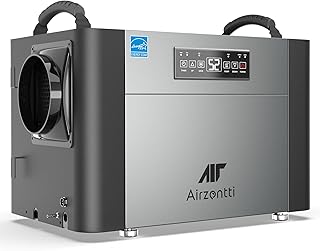
A unit rated for 1,000 sq. ft. won’t keep up with a 2,000-sq.-ft. basement — it’ll run non-stop, hike your electric bill, and still lose the battle. As a rule of thumb, choose a dehumidifier whose coverage rating meets or slightly exceeds the room’s floor area. For moderately damp spaces under 1,000 sq. ft., compact units like the Dehumidifier 95OZ for Home 1000 Sq Ft or the ToLife Dehumidifier 1000 Sq Ft handle the job quietly and fit on a nightstand. For larger basements or whole-floor situations, step up to a compressor unit rated for 3,000–5,500 sq. ft. — models such as the Waykar 34 Pint 2000 Sq. Ft. or the 5500 Sq.Ft. Energy Star Most Efficient unit give you the muscle and the drain hose you need.
Know the Controls That Matter
Not every button on the panel is useful. Focus on these three features. First, a programmable humidistat lets you lock in a target RH and the machine maintains it automatically — this is the core of “set it and forget it.” Second, auto shut-off prevents overflow when the tank fills; essential for any unit you can’t hook to a drain. Third, a sleep or quiet mode lowers compressor noise below roughly 48 dB, which makes a real difference if the dehumidifier lives near your bed. The 4500 Sq.Ft Quilt Compressor Dehumidifier specifically markets noise reduction, and owners consistently note how little it disrupts a conversation.
Placement Amplifies (or Wastes) Your Settings
Even the best setting fails if the unit is tucked in a corner behind a sofa. Dehumidifiers need open airflow to pull moisture from the room. Place the unit at least six inches from any wall, on a flat and stable surface, and in the area where you notice the most dampness — usually the lowest point of a basement or the centre of a large room. If you’re using continuous drainage, gravity-feed the hose downward into a floor drain; a hose that slopes upward will cause water to back up into the tank regardless of your settings.
Tips
- Run the unit with the room’s doors closed so it works a smaller, contained air volume instead of chasing moisture through open doorways.
- Clean the air filter every two weeks during heavy-use months; a clogged filter drops efficiency by up to 15 % and forces the compressor to work harder.
- During winter, re-evaluate your target — outdoor air is naturally drier, so you may only need the dehumidifier running for a few hours each day rather than continuously.
- Place a separate hygrometer two metres away from the dehumidifier to verify that the unit’s built-in sensor isn’t reading the pocket of dry air it just created around itself.
Frequently Asked Questions
Should I set my dehumidifier to 30 % or 50 %?
For most homes, 50 % RH is the better starting point. Dropping all the way to 30 % strains the compressor, drives up energy use, and can make the air uncomfortably dry. Reserve the 30 % target only for enclosed storage areas protecting sensitive materials like musical instruments or archival paper.
Does a higher fan speed lower humidity faster?
A higher fan moves more air across the evaporator coils, so it can pull moisture from a room more quickly in the short term. However, it also generates more noise. Many units — including the ToLife and the KNKA — let you toggle between a turbo setting for fast pull-down and a lower speed for maintenance; start on high, then switch to low once you hit your target.
Is it safe to leave a dehumidifier running overnight?
Yes, provided the unit has auto shut-off and was tested by a recognised safety listing. Compressor-based models are designed for continuous duty. Using sleep mode or a quieter setting keeps noise to a gentle hum while the machine holds your chosen RH through the night.
How do I know when to use the continuous-drain hose instead of the tank?
If you find yourself emptying the tank more than once a day, or if the dehumidifier lives in a basement with a floor drain, switch to continuous drainage. It eliminates overflow risk and means the unit never pauses to wait for you to come downstairs with a bucket.
Conclusion
Set each room’s dehumidifier to its own target — generally 45 %–50 % for living spaces and closer to 40 % for storage — and let an accurate humidistat hold that number for you. Pair the right capacity to your square footage, place the unit where air can flow freely, and maintain it with regular filter cleaning. Do those few things and your furniture, your air quality, and your energy bill will all thank you.