Key takeaways
- Seat depth of 20–22 inches, or plan to use a firm back cushion to reduce it.
- A backrest tall enough to support the shoulder blades (at least 18–20 inches above the seat).
- Seat height around 17–19 inches so standing up does not strain the knees.
- Arms at a height where you can rest a book without hunching.
The most comfortable chairs for good posture are ones whose seat height, seat depth and backrest angle fit your body, so you can sit with feet flat, hips slightly above or level with your knees, and your lower back supported at a backrest angle of roughly 100–110 degrees, instead of chairs that hold you rigidly upright. Comfort and posture stop fighting each other once the dimensions are right; a chair that feels like it “forces” good posture usually becomes uncomfortable within an hour.
Why “Chairs That Force Good Posture” Usually Disappoint
Many people search for a chair that will make them sit correctly. In practice, the body does not hold one position for long. Chairs with a very upright 90-degree back, no recline and a hard seat do keep the spine vertical, but the muscles tire and people start slumping forward or perching on the edge. Research-informed ergonomic guidance generally favors a slightly reclined backrest, support in the lumbar curve, and the freedom to shift position. A chair that supports good posture lets you move between a few healthy positions; one that forces it tends to be abandoned for the couch.
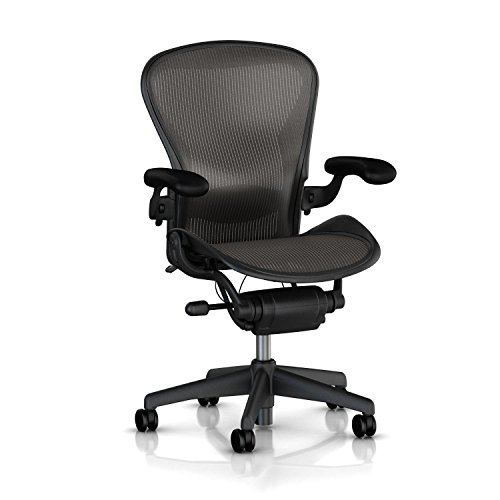
Herman Miller Aeron Executive Office Chair-Stainless Steel, Size B-Fully Adjustable Arms-lumbar Support Open Box
Included for 'Comfortable Chairs for Good Posture: Seat Dimensions That Support You Without Feeling Rigid' because the listing specifies Size B-Fully Adjustable Arms-lumbar Support Open Box, details this guide uses to compare options.
View on Amazon
Herman Miller Aeron Ergonomic Chair - Size B, Graphite
Included for 'Comfortable Chairs for Good Posture: Seat Dimensions That Support You Without Feeling Rigid' because the listing specifies Size B and Graphite, details this guide uses to compare options.
View on Amazon
Herman Miller Classic Aeron Chair - Size B, Posture Fit
Included for 'Comfortable Chairs for Good Posture: Seat Dimensions That Support You Without Feeling Rigid' because the listing specifies Size B and Posture Fit, details this guide uses to compare options.
View on Amazon
Herman Miller Embody Ergonomic Office Chair | Fully Adjustable Arms and Carpet Casters | Black Rhythm
Included for 'Comfortable Chairs for Good Posture: Seat Dimensions That Support You Without Feeling Rigid' because the listing specifies Fully Adjustable Arms and Carpet Casters and Black Rhythm, details this guide uses to compare options.
View on AmazonThe Dimensions That Matter Most
Use these numbers as a fit check for any chair in the house, not only office chairs:
| Measurement | What to look for | Typical good range | Sign it is wrong |
|---|---|---|---|
| Seat height | Feet flat, thighs level or sloping slightly down | Your lower-leg length plus about 1 in for shoes; 16–20 in for most adults | Pressure under thighs or feet dangling |
| Seat depth | 2–4 finger widths between seat edge and back of knee | 16–19 in for most adults; 15–16 in for shorter people | You cannot reach the backrest without a gap at the knees |
| Backrest angle | Slight recline that keeps the head over the shoulders | 100–110 degrees for work; 110–120 degrees for reading | You lean forward to stay upright or the head drops back |
| Lumbar support height | Fills the curve just above the belt line | About 6–10 in above the seat | Pushes into mid-back or sits on the tailbone |
| Armrest height | Shoulders relaxed, elbows near 90 degrees | 7–10 in above the seat | Shoulders shrug or elbows hang |
| Seat cushion firmness | Supportive but not hard | Medium-firm foam, roughly 1.8–2.5 lb/ft3 density | Sitting bones feel the frame, or you sink and tilt back |
Comfortable Posture-Friendly Chairs by Room
The right chair depends on what you do while sitting. These are the main types and what makes each one posture-friendly.
Desk and home-office chairs
For more than two hours a day at a desk, an adjustable task chair is the most reliable option because it can match all six measurements above. Look for adjustable seat height, a seat depth slider, adjustable lumbar support and a synchro-tilt mechanism that reclines the back slightly faster than the seat. Brands such as Steelcase, Herman Miller and Humanscale build chairs to these principles, with prices usually ranging from about $600 to $1,800 new; many good mid-range chairs sit in the $250–$500 range.
Reading chairs and armchairs
Living room armchairs are where posture usually goes wrong, because many have seat depths of 22–25 inches and a soft, sloping back. For a posture-friendly lounge chair, look for:
- Seat depth of 20–22 inches, or plan to use a firm back cushion to reduce it.
- A backrest tall enough to support the shoulder blades (at least 18–20 inches above the seat).
- Seat height around 17–19 inches so standing up does not strain the knees.
- Arms at a height where you can rest a book without hunching.
Recliners
A recliner can support good posture if the lumbar area is filled and the headrest does not push the head forward. Wall-hugger designs need only 4–6 inches of wall clearance; standard recliners need 12–24 inches. Power recliners with independent headrest and lumbar adjustments offer the most posture control.
Dining and kitchen chairs
For meals and short work sessions, a dining chair with a seat height of 17–19 inches against a 28–30 inch table and a backrest with a slight 5–10 degree rearward tilt is more comfortable than a dead-straight back. A sculpted or lightly padded seat helps more than you might expect.
Kneeling, saddle and balance chairs
Kneeling chairs open the hip angle to about 110–120 degrees and encourage a natural spinal curve, but most people find them comfortable only for 30–60 minutes at a time. They work best as a second chair you alternate with, not as the only one.
Decision Matrix: Which Chair Type Fits Your Situation
| Your situation | Best chair type | Key spec to prioritize |
|---|---|---|
| Desk work 4+ hours a day | Fully adjustable task chair | Adjustable lumbar and seat depth |
| Lower back discomfort | Task chair or recliner with lumbar adjustment | Lumbar support 6–10 in above seat |
| Shorter than 5 ft 4 in | Chair with seat depth 15–17 in | Seat height down to 15–16 in or a footrest |
| Taller than 6 ft 2 in | Chair with tall back and deeper seat | Seat depth 19–21 in, back height 22+ in |
| Reading and TV in the evening | Armchair with firm back or recliner | Seat depth 20–22 in and shoulder support |
| Small apartment, one chair does everything | Mid-range task chair with fabric finish | Height adjustment and slim base |
| Older adults | Firm armchair or lift recliner | Seat height 18–20 in and sturdy arms for standing |
Cushion and Upholstery Trade-Offs
The material under you affects comfort over hours more than the look of the chair:
- High-resilience foam keeps its shape and support; low-density foam (under 1.5 lb/ft3) flattens and lets the pelvis tilt backward within a year or two.
- Mesh seats and backs stay cooler and spread pressure, but cheap mesh can sag and create a ridge at the front edge.
- Memory foam feels plush at first but can make shifting position harder, which encourages staying still too long.
- Leather and faux leather are easy to clean but warm in summer; a thinly padded seat can feel hard after an hour.
Simple Fixes for a Chair You Already Own
Before replacing a chair, try these low-cost adjustments:
- Add a small lumbar roll or a rolled towel 6–10 inches above the seat.
- Use a footrest if your feet do not rest flat after setting seat height for your desk.
- Place a firm cushion behind your back to shorten a seat that is too deep.
- Raise a low armchair with furniture risers of 1–3 inches if standing up is difficult.
- Get up every 30–45 minutes; no chair replaces movement.
FAQ
Is a chair with a straight back better for posture?
Not usually. A slight recline of 100–110 degrees with lumbar support reduces pressure on the spinal discs compared with a strictly upright position and is easier to maintain comfortably.
Can a cheap chair support good posture?
Yes, if its seat height and depth fit you. Adding a lumbar cushion and a footrest can make an inexpensive chair work well. Durability and adjustability are what you mainly pay for in pricier chairs.