Key takeaways
- Front-mounted buttons are accessible without reaching behind a pot rack
- LED panel provides even task lighting across the full burner span
- Motor produces noticeable vibration at the highest speed
What's inside
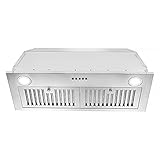
An insert hood sits inside a custom cabinet box, so the entire look of your cooking zone depends on what you hide behind that wood enclosure. The visible portion is a slim stainless panel with controls and a light bar, which means the real performance lives in the CFM rating, the noise level at each speed, and whether the filter system actually traps grease before it coats your kitchen surfaces. Buyers searching for best insert kitchen hoods are usually replacing an older unit, upgrading from a microwave vent, or building a custom range surround from scratch, and the right choice depends on stove size, cooking intensity, and whether your ductwork can handle a high-CFM pull.
What separates a worthwhile insert from a mediocre one in 2026 comes down to three things: consistent airflow at the speed you actually use daily, filter design that does not require weekly deep cleaning, and a control layout that works with wet hands. A hood rated at 900 CFM that runs at a jet-engine volume on speed two is less useful than one rated at 600 CFM with a quiet, steady first speed. Spec sheets tell part of the story, but owner feedback reveals whether the LED panel dims over time, whether the push buttons stay tactile after a year of greasy fingers, and whether the motor survives the first heavy frying session without rattling.
As an Amazon Associate we earn from qualifying purchases at no extra cost to you. Product prices and availability are accurate as of the date shown and are subject to change.


Quick Picks
| Product | Best for | Price |
|---|---|---|
| Zomagas 30″ 600 CFM | Tight budgets, light cooking | $141.25 |
| IKTCH 30″ 900 CFM | Gas ranges, frequent searing | $299.00 |
| IKTCH 36″ 900 CFM | Wide pro-style cooktops | $339.00 |
| Zomagas 36″ 700 CFM | Large stoves, moderate budgets | $188.95 |
| FIREGAS 30″ 600 CFM | Balanced value, daily cooking | $158.99 |
| Broan-NuTone PM300SS | Quiet kitchens, electric ranges | $171.11 |
| VEVOR 30″ 800 CFM | High CFM without premium pricing | $158.31 |
| Lumin Collection 380 CFM | Designer cabinets, light use | $252.99 |
How We Picked
We narrowed this category by comparing published airflow ratings against price, checking whether each model supports both ducted and ductless configurations, confirming filter type (baffle versus mesh), and scanning long-term owner reports for motor reliability, control durability, and LED panel longevity. A hood that excels on paper but accumulates complaints about rattling or short-lived lighting gets flagged rather than featured.
The 8 Best Insert Kitchen Hoods in 2026
Zomagas Range Hood Insert 30 inch, 600 CFM
This is the entry point for anyone who needs functional ventilation without spending over $150. The 600 CFM rating handles everyday sautéing and boiling, and the convertible duct design means you can run it ductless through a charcoal filter if your kitchen layout does not allow exterior venting. Baffle filters are dishwasher-safe, which matters when you are cleaning weekly rather than monthly.
- Front-mounted buttons are accessible without reaching behind a pot rack
- LED panel provides even task lighting across the full burner span
- Motor produces noticeable vibration at the highest speed
Skip this if you cook with a commercial-grade burner or fry frequently at high heat; the airflow ceiling will feel insufficient on those days.
IKTCH 30 inch Insert Range Hood, 900 CFM
For gas ranges up to 30 inches with two or three burners in active use, 900 CFM gives you genuine headroom. Owners consistently note that the first speed clears moderate steam within two minutes, which is the practical number that matters when you are mid-recipe and do not want to blast the fan. The build feels heavier than its price suggests, with solid stainless panels that resist fingerprinting better than thinner competitors.
- Three-speed fan delivers usable airflow at the lower settings
- Convertible duct design handles both exterior and recirculating setups
- Premium pricing relative to the 600 CFM options that cover lighter cooking
Pass on this if your stove is electric and you rarely trigger the high-speed setting; the extra CFM becomes unused overhead.
IKTCH 36 inch Insert Range Hood, 900 CFM
The 36-inch width matches pro-style ranges and cooktops with five or six burners spread across a wider footprint. Airflow at 900 CFM across 36 inches is tighter than at 30 inches, so capture efficiency matters here: the canopy shape must pull from the outer burners without creating dead zones. This model handles that geometry well enough for most layouts, though owners with very wide ranges sometimes report needing to position pots toward center during heavy output.
- Full-width coverage for large cooktops without visible gaps
- Same reliable motor platform as the 30-inch sibling
- Heaviest unit in this roundup, requiring solid cabinet framing
Not ideal for compact kitchens where a 36-inch cabinet surround would overwhelm the wall.
Zomagas Range Hood Insert 36 inch, 700 CFM
At $188.95, this is the most affordable way to get 36-inch coverage with respectable airflow. The 700 CFM sits in the middle ground: enough for a busy dinner with multiple burners going, not so aggressive that low-speed operation becomes impractical. The front button layout mirrors the smaller model, keeping the control experience consistent if you are outfitting two kitchen zones.
- Best price-to-width ratio for large-stove buyers on a budget
- Stainless finish resists warping better than budget painted alternatives
- First-speed noise level is higher than similarly rated competitors
Consider the IKTCH 36-inch instead if your cabinet budget allows, since the build quality and noise profile justify the gap.
FIREGAS Range Hood Insert 30 inch, 600 CFM
This unit targets the buyer who wants clean aesthetics and moderate airflow without stepping into premium pricing. The 600 CFM rating matches the Zomagas sibling but at a slightly higher price, and owners note a smoother motor feel and better fit-and-finish on the trim edges. If you are pairing this with a mid-range cabinet and want the hood to disappear visually, the proportions work well.
- Trim design sits flush inside standard cabinet openings with minimal gaps
- Baffle filters remove and reseat cleanly without flexing the surrounding frame
- Control buttons feel less tactile than push-style alternatives
Look elsewhere if your primary cooking involves wok work or pan-frying at high temperatures; the airflow ceiling is limiting.
Broan-NuTone PM300SS Custom Power Pack, 300 CFM
At 300 max CFM, this is the quietest and least aggressive option here, and that is its purpose. Broan-NuTone has a long service history, and parts availability means a failed motor or filter frame is not an orphaned problem five years out. The two-speed fan is simple, the 21-inch built width fits standard cabinet openings, and the stainless housing matches most modern ranges without standing out.
- Reliable brand with documented parts and support availability
- Two-speed layout eliminates the confusion of multi-setting controls
- CFM rating is too low for gas ranges or high-heat cooking
Not suitable for any kitchen where frying, searing, or ethnic cooking with heavy oil and spice produces real smoke loads.
VEVOR Insert Range Hood 800 CFM 30 inch
At $158.31 for 800 CFM with three speeds, this is arguably the best raw-spec value in the lineup. The ETL listing confirms third-party electrical safety verification, which not every budget option carries. Baffle filters are dishwasher-safe, and the push-button controls survive repeated contact with wet and oily hands better than membrane-style panels. Owners praise the airflow output but note that the housing finish is slightly thinner than IKTCH equivalents.
- Highest CFM per dollar in this comparison
- ETL certification provides independent safety validation
- Stainless gauge is thinner, so dents are more visible during cabinet installation
Consider skipping if the finish imperfections bother you in a high-visibility kitchen or if you need a unit that will survive contractor-level rough handling.
Lumin Collection 30 inch, 380 CFM Ducted Insert
This is a designer-focused insert, and the price reflects that priority. At 380 CFM, airflow is modest, and the ducted-only limitation means you must have exterior venting at the cabinet location. The LED panel and stainless trim carry a refined look that pairs with high-end custom cabinetry, and owners who chose it specifically for visual integration report no regrets. It is not a performance hood; it is a cabinet component that happens to ventilate.
- Refined finish that complements premium cabinet interiors
- LED lighting delivers even, dimmable task illumination
- Ducted-only design eliminates flexibility for recirculating setups
If you need more than 380 CFM during normal cooking, this unit will not keep up regardless of how good it looks behind your hood surround.
Buying Guide
Match CFM to Your Stove, Not Your Ambition
A gas range with four or more active burners benefits from 600 CFM as a floor and 800 to 900 for real headroom during simultaneous searing. Electric ranges and induction cooktops produce far less airborne grease and particulate, so 300 to 400 CFM is sufficient and avoids oversizing a system that runs at an audible hum on its lowest speed. Wider cooktops (36 inches) distribute smoke across a larger capture area, so airflow must be higher than a 30-inch equivalent to achieve the same capture efficiency at the edges.
Filter Type Determines Your Maintenance Reality
Baffle filters (stainless channels that trap grease by forcing airflow through sharp turns) are dishwasher-safe and last the life of the hood if you clean them every two to four weeks. Mesh or charcoal filters for ductless recirculation must be replaced on a schedule, which adds ongoing cost and a supply-chain dependency. If your kitchen cannot vent externally, confirm whether the model supports charcoal conversion and how often replacement cartridges are recommended.
Control Layout and Lighting Are Daily-Use Friction Points
Front-mounted push buttons beat membrane panels and remote-mounted switches for in-the-moment usability, especially when your hands are wet or oily. Verify that the LED panel spans the full width of your burner array; a light bar that covers only the center two burners leaves the outer cooking zone in shadow, which undermines the task-lighting function of the hood. Check owner reviews for dimming or discoloration complaints after six to twelve months of regular use.
Our Verdict
The IKTCH 30-inch 900 CFM is the overall top pick: it covers the widest range of cooking styles, earns its price through build quality and low-speed usability, and offers the convertible duct option that keeps it viable across different kitchen layouts. The budget pick is the VEVOR 800 CFM at $158.31, which delivers near-premium airflow with ETL certification at a price that undercuts units offering half the power. If your primary constraint is a 36-inch pro-style range and your budget cannot stretch to the IKTCH, the Zomagas 36-inch at $188.95 is the logical fallback.
FAQ
What is the difference between an insert hood and an under-cabinet hood?
An insert hood is installed inside a custom-built cabinet box, so only the bottom trim, filters, and control panel are visible. An under-cabinet hood is a complete enclosure that hangs beneath an existing cabinet. Inserts cost more to install because you must build or buy the surrounding cabinet, but they produce a seamless built-in look that matches high-end kitchens.
Can I run an insert hood without ducting to the outside?
Many models listed here (Zomagas, IKTCH, VEVOR) support both ducted and ductless operation. Ductless mode requires a charcoal filter cartridge that absorbs grease and odor before recirculating air back into the room. The Lumin Collection is ducted-only, and the Broan-NuTone does not specify ductless conversion in its documentation.
Is 900 CFM overkill for a home kitchen?
It depends on your cooking. For a gas range used three or four times weekly with moderate heat, 900 CFM means the fan can handle peak loads on its second speed while running quietly on the first. For an electric range with light use, 600 CFM is adequate and the 900 models may never exceed their lowest setting, wasting airflow headroom.
How often should I clean baffle filters?
Every two to four weeks for most home cooking, more often if you fry frequently or use heavy oils. Baffle filters are typically dishwasher-safe, so the cleaning itself is minimal effort. Skipping filter cleaning forces the motor to work harder and can reduce airflow by 15 to 20 percent, which negates the CFM rating you paid for.