Our Top Picks
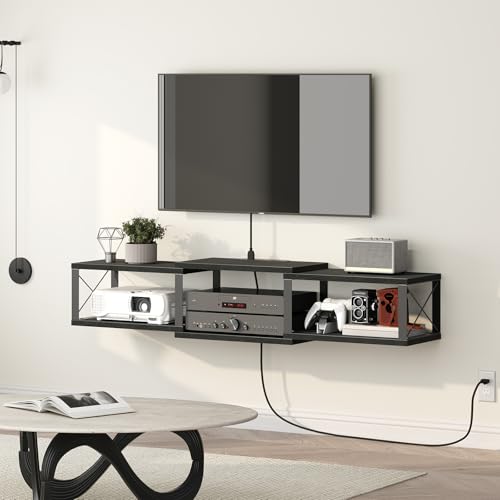 MAHANCRIS 43.7” Floating TV Stand with Power Outlet43.7"L x 11.0"W x 8.9"H14.1 PoundsCheck on Amazon
A TV stand under a mounted TV should be a low console, roughly 16 to 24 inches tall, at least as wide as the screen (ideally 3 to 12 inches wider on each side), with a visible gap of about 6 to 12 inches between the top of the stand and the bottom edge of the TV. Get those three numbers right and the stand reads as a grounded base for the screen rather than a piece of furniture that happens to sit nearby.
Below are the measurements that matter, how to work backward from your eye height, and what kind of console suits a wall-mounted setup better than a traditional stand.
MAHANCRIS 43.7” Floating TV Stand with Power Outlet, Wall-Mounted Entertainment Center, Floating Metal Frame Media Console Shelf for Under TV Storage, for Living Room, Bedroom, Black TVHB101E01
One of the home product options compared in this guide.
View on Amazon
LED TV Stand for 55 Inch TV, 8 Drawers, Black | Fits TVs up to 55 inch, 8 fabric drawers, LED Entertainment center, Built-in power outlet, Living room or bedroom
Chosen because it lists an explicit depth/thickness.
View on Amazon
IBUYKE Floating TV Stand Wall Mounted with Power Outlet,Modern Wood Wall Mounted Media Console Shelf,Floating Entertainment Center for Under TV Storage for Living Room Bedroom Office,Black WST001B-
One of the home product options compared in this guide.
View on Amazon
MAHANCRIS 43.7" Floating TV Stand with Power Outlet, Modern Media TV Shelf | Wall-Mounted Entertainment Center, Floating Metal Frame Media Console Shelf for Under TV Storage, Living Room, Rustic Brown
One of the home product options compared in this guide.
View on AmazonStart With the Screen Height, Not the Stand
Once a TV is on the wall, the stand no longer holds anything up, so its height is set by the TV position, not the other way around. The usual target is the center of the screen at or slightly below seated eye level. For most sofas with a seat height of 17 to 19 inches, seated eye level lands around 40 to 42 inches from the floor.
To find where the bottom of the TV sits, subtract half of the screen’s physical height from that center point. Then subtract your preferred gap. What remains is the maximum console height.
| TV size (diagonal) | Approx. screen height | Bottom edge if center is at 42 in | Max console height with 8 in gap | Suggested console width |
|---|---|---|---|---|
| 43 in | 21 in | 31.5 in | 23.5 in | 48–55 in |
| 50 in | 25 in | 29.5 in | 21.5 in | 55–60 in |
| 55 in | 27 in | 28.5 in | 20.5 in | 60–65 in |
| 65 in | 32 in | 26 in | 18 in | 70–78 in |
| 75 in | 37 in | 23.5 in | 15.5 in | 80–90 in |
| 85 in | 42 in | 21 in | 13 in | 90–100 in |
The pattern is the useful part: the bigger the TV, the lower the console needs to be if you want the screen at a comfortable height. With a 75 or 85 inch screen, a standard 24 inch media cabinet forces the TV up toward the ceiling, which is the most common cause of neck strain in wall-mounted setups. Many people mount large TVs higher because of a fireplace or soundbar; if that is your situation, a very low floating shelf or a 12 to 16 inch console keeps the wall from feeling top-heavy.
The Gap Between Stand and TV
The gap is a visual and practical decision. Here is how the common choices behave:
- 4–6 inches: Looks tight and intentional, like the TV and console are one unit. Leaves just enough space for a slim soundbar of 2.5 to 3 inches tall, but blocks it from tilting.
- 6–12 inches: The safe default. Room for a soundbar, a small decor piece, or a center-channel speaker without crowding the screen. Works for nearly every size.
- 12–18 inches: Fine for very large walls or high ceilings, but the TV starts to look disconnected. Usually a sign the TV is mounted too high.
- Over 18 inches: Reads as two separate pieces. Only makes sense if the console has its own job, such as a sideboard in a dining-living combo.
If you use a soundbar on the console, check its height plus any IR sensor area on the TV’s lower bezel. Many TVs place the remote receiver at the bottom center, and a tall soundbar placed too close can block it.
Width: Wider Than the Screen, Shorter Than the Wall
A console narrower than the TV looks like it is struggling under the screen, even though it carries no weight. Aim for a stand that extends at least 3 inches beyond the TV on each side, and up to about 12 inches for a balanced, anchored look. On the other end, leave at least 12 to 18 inches of open wall on each side of the console so it does not look jammed between corners or doorways.
On a 10 ft wall (120 in) with a 65 inch TV, a 70 to 78 inch console leaves about 21 to 25 inches on each side, which is comfortable. Put the same TV on an 8 ft wall (96 in) and a 72 inch console still works, but anything over 78 inches starts to crowd the corners.
Depth and Walkway Clearance
Because the TV is on the wall, the console does not need the 16 to 20 inch depth of a stand that supports a TV base. A depth of 12 to 16 inches is enough for a cable box, a game console lying flat, and a streaming device. Deeper units only make sense if you store a receiver, which usually needs 15 to 18 inches including rear cables.
Keep at least 30 to 36 inches of clear walking space between the console and the nearest furniture, and if a coffee table sits in front of the sofa, the standard 16 to 18 inches between sofa and table still applies. Shallower consoles are the easiest way to recover a few inches in a narrow living room.
Which Type of Stand Works Best Under a Wall-Mounted TV
| Console type | Typical height | Typical depth | Best for | Watch out for |
|---|---|---|---|---|
| Low media console (floor) | 16–22 in | 14–18 in | Most living rooms, storage needs | Too tall with 75 in+ TVs |
| Floating wall shelf / console | Mounted 10–20 in off floor | 10–16 in | Small rooms, robot vacuums, clean look | Needs studs; load usually 50–150 lb |
| Credenza / sideboard | 28–32 in | 16–20 in | Dining-living combos, high mounts | Pushes TV too high for seated viewing |
| Open-shelf bench | 14–18 in | 12–16 in | Gaming, devices that need airflow | Visible cable clutter |
| Ultra-low platform | 8–14 in | 12–18 in | 85 in TVs, modern minimal rooms | Limited storage, bending to reach |
Price-wise, flat-pack low consoles in engineered wood usually run $100 to $300, solid-wood or veneered consoles $400 to $1,200, and floating units fall anywhere from about $80 for a simple shelf to $600 or more for cabinet-style designs with doors.
What Size TV Stand for a 65 Inch Wall-Mounted TV?
For a 65 inch wall-mounted TV, choose a console about 70 to 78 inches wide, 12 to 16 inches deep and 16 to 20 inches tall. A 65 inch screen is roughly 57 inches wide and 32 inches tall, so that console extends 6 to 10 inches past each edge and leaves the TV bottom near 26 inches off the floor when the screen center sits at 42 inches.
Use these quick pairings as a starting point, then adjust for your sofa height and wall:
| TV size | Approx. screen width | Console width | Console height | Gap to aim for |
|---|---|---|---|---|
| 43 in | 38 in | 48-55 in | 18-24 in | 6-10 in |
| 55 in | 48 in | 60-65 in | 16-21 in | 6-10 in |
| 65 in | 57 in | 70-78 in | 16-20 in | 6-12 in |
| 75 in | 65 in | 80-90 in | 14-16 in | 6-10 in |
| 85 in | 74 in | 90-100 in | 12-14 in | 6-8 in |
Competing guides often quote a tighter 4 to 6 inch gap for a clean, one-unit look and 8 to 12 inches when a soundbar and decor share the space. Both are valid. The tighter gap suits a minimal console with nothing on top, while the wider one gives a soundbar room to breathe.
What to Put in the Gap Between the Console and the TV
The space under a mounted screen is the most visible shelf in the room, so decide what lives there before you pick a gap. Three setups cover most homes.
- Nothing on top: Keep 4 to 6 inches and let the console top stay clear. This is the cleanest look and works best with closed doors or drawers that hide every device.
- Soundbar only: Allow the soundbar height plus 3 to 4 inches. Most soundbars are 2 to 3 inches tall, so a 6 to 8 inch gap clears the TV’s lower bezel and its remote sensor.
- Soundbar and decor: Plan 8 to 12 inches, then keep decor low and off-center, such as a short vase, a plant or a stack of books, so nothing crosses the screen’s edge from the sofa.
If you mount a soundbar to the wall instead of setting it on the console, measure from the bottom of the soundbar, not the TV, when you check the gap. A bar hung directly under the screen effectively becomes the top of your stack.
Special Cases: Fireplaces, Bedrooms and Open Floor Plans
TV above a fireplace
A mounted TV over a mantel usually sits 50 to 60 inches to its center, which is higher than ideal. Skip a tall console here. A low, shallow bench or no console at all keeps the wall from stacking three layers of furniture, and a tilting or pull-down mount helps with the viewing angle.
Bedroom TVs
Bedroom viewing happens from a bed whose mattress top is often 24 to 30 inches off the floor, so seated eye level is closer to 44 to 50 inches. That is the one situation where a taller 24 to 30 inch dresser under a mounted TV works well, provided you recalculate the bottom edge with your own measurements.
Open floor plans and walkway walls
When the console sits against a wall that people walk past, pick a depth of 12 inches or less and rounded corners, and keep at least 36 inches of clear path. In a room with a glass door beside the TV wall, check that an open door does not strike the end of the console.
Common Mistakes With Consoles Under Mounted TVs
- Mounting first, measuring later: A TV bolted at 60 inches to center forces a very low console. Mark the wall with painter’s tape at the planned screen outline before drilling.
- Choosing a console narrower than the screen: Even a 2 inch overhang on each side reads better than a console that is 4 inches too small.
- Ignoring drawer clearance: A 16 inch deep console with pull-out drawers needs about 30 inches of front clearance, so check how far the sofa sits from the wall.
- Forgetting airflow: Game consoles and receivers vent heat. Leave at least 2 inches of open air above and behind a hot device, or pick an open-shelf or slatted-door design.
- Buying by look alone: A beautiful credenza at 30 inches tall can leave the TV too high for comfortable viewing from a sofa.
Cable Routing Between Stand and TV
A console under a mounted TV turns the wall into one composition, so loose cables between the two show up immediately. The cleanest options:
- In-wall power and cable kit: A recessed outlet behind the TV paired with a pass-through plate behind the console. These kits are designed to meet electrical code for running power in the wall; a regular extension cord should never be fished through drywall.
- Surface raceway: A paintable channel running from the TV down to the console. Easier for renters and removable later.
- Console with a rear cutout: Most modern media consoles have 2 to 3 inch grommets in the back panel. Line the cutout up with the wall plate before you settle the final position.
Plan the console location before you mount the TV if you can. Centering both on the same line is easier than shifting a heavy console later, and the wall plate needs to sit behind, not beside, the console.
Material Choices for a Console That Carries No TV
Since a console under a mounted TV holds only devices and decor, load ratings matter less than surface durability and how the unit handles heat from electronics.
- Engineered wood (particleboard or MDF with laminate): Lightest and least expensive. Shelves can sag over 30 inches of span under heavy receivers. Edges chip during moves.
- Solid wood or hardwood veneer over plywood: Holds screws well for repeated assembly, resists sag, and can be refinished. Heavier boxes, often 80 to 150 lb.
- Metal frame with wood or glass top: Open design keeps devices cool; glass shows dust and fingerprints quickly.
Whichever material you choose, anchor tall or top-heavy consoles to the wall with an anti-tip kit, especially in homes with children who may climb toward the screen.
Quick Checklist Before You Buy
- Measure the planned bottom edge of the TV, then subtract 6 to 12 inches. That is your maximum console height.
- Confirm console width is at least the TV width, and ideally 6 to 24 inches wider in total.
- Leave 12 to 18 inches of open wall on each side.
- Choose 12 to 16 inches of depth unless you need room for a receiver.
- Line up the cable pass-through with the console’s rear cutout.
- For floating units, confirm stud locations and the rated load before ordering.
FAQ
Should a TV stand be wider than a wall-mounted TV?
Yes. A console at least as wide as the screen, and ideally a few inches wider on each side, gives the wall a stable visual base. A stand narrower than the TV looks undersized even though it supports no weight.
Can I use a tall dresser or sideboard under a mounted TV?
You can, but a 30 inch piece pushes the bottom of a 55 inch TV to around 38 inches and its center to about 52 inches, which is above comfortable seated eye level. It works better in bedrooms viewed from a raised bed than in living rooms viewed from a sofa.
Do I still need a stand if the TV is mounted?
Not strictly, but most households need somewhere to keep a streaming box, game console, router or soundbar. A low console or floating shelf hides those devices and keeps cables short.
How far below a wall-mounted TV should the TV stand be?
Leave about 4 to 12 inches between the top of the stand and the bottom edge of the TV. Use 4 to 6 inches for a tight, minimal look and 8 to 12 inches if a soundbar or decor sits on the console.
What size TV stand do I need for a 65 inch wall-mounted TV?
A console 70 to 78 inches wide, 12 to 16 inches deep and 16 to 20 inches tall works for most rooms. That keeps the screen near seated eye level and extends past both edges of the 57 inch-wide screen.
How tall should a console be under a wall-mounted TV?
Most living rooms suit 16 to 24 inches, with larger screens needing lower consoles. Work backward: find the TV’s bottom edge from your eye height, then subtract your chosen gap.
Can I put a soundbar on the console under a mounted TV?
Yes. Allow the soundbar’s height plus a few inches of clearance, and keep it clear of the TV’s lower bezel, where many models place the remote sensor.