Key takeaways
- Pull-out platform: Add 25 to 35 inches in front of the seat. Leave another 18 to 24 inches to walk around the bed.
- Fold-out mechanism: Plan on about 90 inches from the back wall to the foot of the open mattress. In a 12 ft (144 in) deep room that leaves around 54 inches, enough for a path but not for a coffee table that stays put.
- Chaise lift clearance: The lid needs 20 to 30 inches of open air above it, so do not put the chaise under a wall shelf or window sill that blocks it.
- Left or right facing: Stand facing the couch. If the chaise is on your right, it is right-arm facing (RAF). Many storage models let you swap sides; fold-out sleepers usually cannot, because the mechanism is fixed in the main section.
An L shaped couch with storage and a pull out bed almost always splits the jobs between its two sections: the pull-out sleeper lives under the long sofa side, and the storage lives in the chaise, usually as a lift-up seat with gas struts. Knowing that split matters, because it decides how much you can store, how big the bed gets, how much floor you need when it is open and which part will wear out first.
This guide looks at the four designs you will see, what each one gives you in sleeping space and storage volume, and the real-world limits that product photos tend to hide.
The four ways storage and a pull-out share one frame
1. Pull-out platform under the seat + lift-top chaise
The most common budget-to-midrange layout. A wheeled platform slides out from under the main seat and rises (or stays low) level with the seat deck, and the seat cushions fill the gap to make a bed. The chaise lid lifts on one or two gas struts to reveal a storage box. Because the pull-out takes the space under the seat, the chaise is the only storage.
2. Pull-out ottoman with its own storage
Here the “pull out” is a separate ottoman that slides out from under the chaise or stands on its own, and its top lifts for storage. You get two storage compartments, but the sleeping area is smaller and the ottoman can shift apart from the sofa at night unless it has connector clips.
3. Fold-out metal mechanism + storage chaise
A true sleeper: you remove the seat cushions and unfold a metal frame with a thin mattress. The mechanism fills the entire seat cavity, so storage is only in the chaise. Best sleep surface of the four, but the heaviest and least flexible.
4. Click-clack or fold-down back + storage under the seat
The backrest drops flat to make a bed and the seat deck lifts to reveal storage under it, sometimes with a separate chaise compartment as well. Simple and spacious, but the bed surface has a seam where the back meets the seat.
How the designs compare in numbers
| Design | Typical sleep surface | Storage volume | Floor depth needed when open | What wears first |
|---|---|---|---|---|
| Pull-out platform + lift-top chaise | About 50–58 x 70–76 in | Chaise only: about 5–10 cu ft | Roughly 60–70 in from the wall | Platform casters, chaise gas struts |
| Pull-out ottoman with storage | About 45–55 x 65–75 in | Chaise + ottoman: about 7–14 cu ft | Roughly 55–65 in | Ottoman hinges, gap between pieces |
| Fold-out metal mechanism | Full (54 x 72 in) or queen (60 x 72 in) mattress | Chaise only: about 5–10 cu ft | Roughly 85–95 in | Mattress, cross-bar support, mechanism springs |
| Fold-down back + under-seat storage | About 55–62 x 72–80 in | Under seat + chaise: about 8–16 cu ft | Roughly 50–60 in plus wall gap | Hinge brackets, seam between back and seat |
A chaise storage box is typically 20 to 26 inches wide inside, 45 to 60 inches long and 7 to 11 inches deep. That is enough for two sets of twin or full bedding, a comforter and two pillows, or a stack of board games, but not for bulky items like a folded queen down duvet plus pillows plus throws all at once.
Room fit: measure for the open bed, not the couch
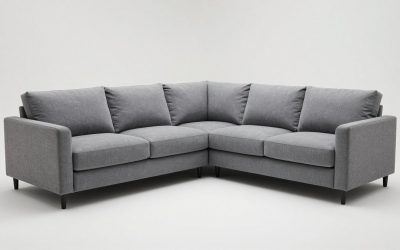
Most L shaped couches in this category run 95 to 110 inches on the long side, 60 to 70 inches on the chaise side and 33 to 38 inches deep. Closed, that fits a 10 x 12 ft living room comfortably. Open, it is a different story.
- Pull-out platform: Add 25 to 35 inches in front of the seat. Leave another 18 to 24 inches to walk around the bed.
- Fold-out mechanism: Plan on about 90 inches from the back wall to the foot of the open mattress. In a 12 ft (144 in) deep room that leaves around 54 inches, enough for a path but not for a coffee table that stays put.
- Chaise lift clearance: The lid needs 20 to 30 inches of open air above it, so do not put the chaise under a wall shelf or window sill that blocks it.
- Left or right facing: Stand facing the couch. If the chaise is on your right, it is right-arm facing (RAF). Many storage models let you swap sides; fold-out sleepers usually cannot, because the mechanism is fixed in the main section.
Which design fits your home
| Your situation | Best design | Why |
|---|---|---|
| Guests stay 2+ nights several times a year | Fold-out mechanism with a 4.5–5 in memory foam mattress | Proper mattress, no seams under the hips |
| Small apartment, overnight guests are rare | Pull-out platform + lift-top chaise | Smallest open footprint per sleep inch, decent storage |
| You need maximum storage | Fold-down back with under-seat storage | Up to twice the volume of chaise-only designs |
| Kids use it for sleepovers and play | Pull-out ottoman with storage | Ottoman doubles as a toy box and a footrest |
| Walk-up apartment, narrow stairs | Modular pull-out or ottoman type shipped in 3–4 boxes | No single heavy sleeper section to carry |
Delivery, assembly and weight realities
Storage sleepers are heavier than plain sectionals because they add a box, a lid, a platform or a steel mechanism. Typical totals run 150 to 300 lb for pull-out and click-clack designs and 250 to 400 lb for fold-out sleepers. Most ship in two to four boxes; the main sleeper section is usually the heaviest, often 90 to 160 lb for a pull-out platform type and more for a fold-out.
Check three openings before ordering: the front door (most are 32 to 36 in wide), interior doorways (often 30 to 32 in) and any stairwell turn. A sleeper section that is 36 to 40 inches deep usually has to go through on its side or at an angle. Assembly for boxed models is mostly bolting the sections together and attaching legs, typically 30 to 90 minutes with two people.
Durability checks that matter more than fabric color
- Frame: Kiln-dried hardwood or a hardwood-and-plywood frame resists racking better than particleboard, which can loosen at the joints after repeated pull-outs.
- Gas struts on the chaise: These lose force over several years. Look for standard bolt-on struts so you can replace them with generic parts rated to the same force (often 100 to 150 N).
- Pull-out casters: Hard plastic casters scratch wood floors and drag on deep carpet. Rubber-coated wheels roll more quietly.
- Seat foam: Cushions that form part of the bed need to be dense; a foam density of 1.8 lb per cubic foot or higher holds up to both sitting and sleeping. Low-density foam flattens first at the corner seat.
- Storage lining: A fabric-lined or melamine box bottom resists moisture and snags better than bare particleboard.
- Connector brackets: The metal clips joining the chaise to the main sofa should be steel, not plastic; the sections pull apart when the bed is opened often.
Price ranges to expect
Basic pull-out platform designs with a lift-top chaise usually sell for around $600 to $1,300. Fold-down back styles with under-seat storage sit in a similar range. Fold-out sleeper sectionals with a storage chaise and a real mattress usually start near $1,200 and run past $3,000 for hardwood frames and performance fabrics.
If the bed is for occasional nights and storage is the main draw, a pull-out platform with a lift-top chaise gives the best balance. If guests stay often, prioritize a fold-out mechanism with a good mattress, and accept that the chaise will be your only storage.