Buying a swivel rocker recliner is less straightforward than it looks. A chair can feel wonderfully padded in a product photo yet lack the back support, reclining clearance, or smooth gliding motion needed for everyday use. Size is another common surprise: an “oversized” model may be ideal for stretching out but overwhelming in a nursery or compact apartment.
This guide focuses on practical home comfort rather than showroom appeal. We look at seating feel, swivel and rocking movement, reclining convenience, useful extras such as heat and massage, upholstery, and where each chair is most likely to work well. Whether you need a nursery glider, a living-room reading chair, or a compact recliner for a small space, these are the details worth checking before you buy.
Our top picks
 Korser 360° Swivel Rocker Recliner for Adults
- Rotating Rocking Recliner: The Korser recliner chair is…
- Massage and Heating: The rocking chair from Korser…
- High-Quality Materials: The materials used in the swivel…


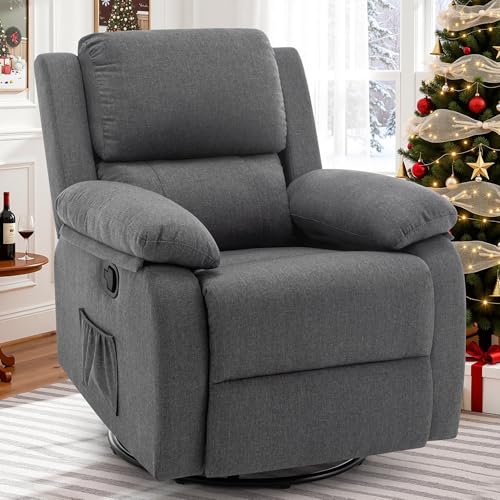 Korser Recliner Chair
- 【Swivel & Relaxtion】The recliner features a 360° swivel,…
- 【Rocking Chair for Any Space】This small recliner for…
- 【Excellent Safety and Stability】This reclining chair combined with…

As an Amazon Associate we earn from qualifying purchases at no extra cost to you.
🛒 Best Price Today on Amazon
Prime members get fast, free shipping on everything above, plus member-only deals. New members get a 30-day free trial — cancel anytime.
How to Choose a Recliner Swivel Rocker (2026)
- Fit: Compare the chair’s overall width and depth with your room, then check that the seat supports your height and leg length. Oversized chairs need particularly careful measuring.
- Motion: A good swivel rocker should turn smoothly without feeling loose and rock without scraping nearby furniture. Consider whether you want a full 360-degree swivel or simply a gentle gliding range.
- Recline: Manual handles and push-back mechanisms are simple and dependable, but they need enough clearance to operate comfortably. Confirm that the footrest locks securely before relying on it for daily lounging.
- Support: Look for a high back, adequately padded arms, and a seat that does not leave your lower back unsupported. Removable pillows can help fine-tune comfort, though they may shift during use.
- Extras: Heat, massage, USB charging, cup holders, and side pockets are convenient, but they should supplement—not replace—solid construction and comfortable upholstery.
The Best Recliner Swivel Rocker (2026)s Reviewed
Korser 360° Swivel Rocker Recliner
This dark-gray Korser is a versatile choice for adults who want a nursery-friendly glider with more than basic reclining. Its 360-degree swivel, massage, heat, and cup holder make it especially appealing for long evening feeds or relaxed television watching, while the fabric finish feels more welcoming than glossy faux leather.
Harkawon Swivel Rocker Recliner
The Harkawon keeps things simple with a beige fabric exterior, high back, and deep seat. It is a sensible pick for buyers who prioritize a soft, supportive place to sit over electronic features, and its understated styling should suit a living room, bedroom, nursery, or home office.
Oversized Swivel Rocker Recliner with Massage and Heat
This beige barrel-style recliner is designed for people who prefer generous room and a more enveloping seat. The adjustable headrest and two removable pillows offer useful ways to adjust support, while heat and massage add a relaxation-focused feel; measure carefully before choosing it for a smaller room.
Leathaire Swivel Rocker Recliner
The brown Leathaire model brings a more sofa-like appearance to the swivel glider category. Its soft backrest and manual reclining design suit a living room or bedroom where wipe-clean upholstery and a traditional recliner silhouette matter more than massage or charging features.
Oversized Swivel Rocker Recliner with Massage, Heat, and USB
This gray oversized chair is built around convenience, combining massage and heat with a cup holder, USB charging port, and side pocket. It is a strong lounging option for a media room or spacious bedroom, though its generous proportions and feature-packed design may be excessive if you mainly need a compact reading chair.
What to Look For in a Swivel Rocker Recliner
Most buying mistakes with this furniture type come down to skipping the mechanical details in favor of the fabric swatch. A swivel rocker recliner has three moving systems working together — the swivel base, the rocking glide, and the recline mechanism — and each one can fail independently of how the chair looks in a photo. The checklist below covers the specs that actually predict how the chair performs after the first few months of daily use.
Swivel Range and Locking Positions
Swivel rockers typically turn 360 degrees, but the mechanism underneath varies in quality. Cheaper bases rely on a single plastic bearing ring that can develop a wobble within a year of regular use, while sturdier models use a steel ball-bearing swivel plate rated for a specific weight range. Look for a model that lists its swivel mechanism material, and check whether the base locks in place for reading or rocking versus free-spinning at all times, since a chair that never locks can feel unstable for anyone getting in or out.
Weight Capacity and Frame Construction
Reclining Angle and Footrest Travel
Not every recliner reclines the same amount. Some swivel rockers only tilt back a shallow 15 to 20 degrees for a lounging position, while others extend into a near-flat position for napping. The footrest travel matters just as much: a short footrest that stops a few inches from full extension will leave taller users with their feet hanging off the end. If the listing gives a seated height and overall reclined length, compare that reclined length against the user’s own height plus a few inches of clearance.
Upholstery Fabric and Cleaning Needs
Fabric choice changes the maintenance routine more than most buyers expect. Faux leather wipes clean in seconds but can crack at stress points like the headrest fold after a few years, especially in dry climates. Woven fabrics and microfiber blends resist pet claws better but trap spills unless treated, and heavier textured weaves show less wear in high-traffic rooms. Matching the fabric to the household — pets, kids, direct sunlight exposure — avoids a replacement purchase sooner than expected.
Base Design: Pedestal vs. Platform
Two base styles dominate this category, and they behave differently on real floors. A pedestal base concentrates all the weight on a single central column, which concentrates pressure on carpet padding and can leave an indentation if the chair stays in one spot for months. A wider platform base spreads that same weight across a larger footprint, reducing floor marking and generally offering a more stable feel during the swivel motion, though it also takes up more visible floor space around the chair. Hard-flooring households tend to notice base-related issues less than carpeted ones, since there is no padding underneath to compress unevenly.
Assembly and Delivery Expectations
Most swivel rocker recliners ship in one or two large boxes and require attaching the base to the seat unit with a handful of bolts, a step most owners complete in under half an hour with a household tool kit. Oversized models add weight rather than complexity, so delivery access is usually the bigger hurdle: confirm the box dimensions against stairwells, elevators, and front door width before the chair ships, since a box that will not turn a corner often costs more to return than it would have to measure in advance. Curbside delivery is standard for larger units, which means getting the box from the curb to the living room is the buyer’s responsibility unless white-glove delivery is purchased separately.
Why the Rocking Motion Changes How the Chair Feels
A swivel rocker is not simply a recliner on a turntable. The rocking action runs on a separate spring or glider mechanism beneath the seat, and the resistance of that mechanism determines whether the motion feels smooth or jerky. A well-tuned glider offers light resistance that a gentle push can sustain, similar to a glider nursery chair, rather than requiring a hard shove to get moving. This distinction matters most for anyone planning to use the chair for extended sitting, such as nursing, reading, or recovering from a procedure that limits mobility, since a stiff or uneven rocking motion becomes tiring well before a smooth one does. Owners commonly report that the rocking feel is the detail they notice first when a chair feels cheap, even when the upholstery and recline function seem fine, so it is worth factoring into the decision alongside the more commonly discussed specs like capacity and fabric.
Which Swivel Rocker Recliner Should You Buy?
Match the chair to how the room and the household actually use it rather than to the most feature-dense option on the list.
- If you want an all-around option with the widest range of sizing and color choices — choose the Korser 360° Swivel Rocker Recliner.
- If your priority is a simpler mechanism with fewer moving parts to maintain — choose the Harkawon Swivel Rocker Recliner.
- If you specifically want built-in massage and heat for sore backs or cold climates — choose the Oversized Swivel Rocker Recliner with Massage and Heat.
- If breathable, easy-to-wipe upholstery is the top concern — choose the Leathaire Swivel Rocker Recliner.
- If you want massage, heat, and a USB charging port for phones and devices in one chair — choose the Oversized Swivel Rocker Recliner with Massage, Heat, and USB.
Common Mistakes When Buying a Swivel Rocker Recliner
These errors show up repeatedly in return and complaint patterns for this category, and most are avoidable before the chair ever arrives.
- Measuring only the chair’s footprint, not its reclined length. A swivel rocker needs extra clearance behind it for the recline and in front for the extended footrest, which can add well over a foot to the chair’s resting dimensions.
- Ignoring doorway and hallway width during delivery planning. Oversized models with wide arms and high backs sometimes cannot pass through standard interior doors without tilting, which can scuff walls or damage the frame.
- Buying based on capacity alone without checking the seat width. A chair rated for a high weight capacity can still have a narrow seat pan that feels cramped for a broader frame.
- Skipping the swivel lock feature for households with small children. An unlocked swivel base can spin unexpectedly when a child climbs on or off, which is avoidable with a model that locks in a fixed position.
- Assuming all massage and heat features draw the same amount of power. Some units need a dedicated outlet or extension cord placement planned in advance, which is easy to overlook until setup day.
- Choosing fabric based on appearance in a photo rather than the household’s actual wear pattern. Light-colored fabrics and plush textures look appealing online but show stains and pet hair far faster than darker, tighter weaves.
How the Five Models Stack Up at a Glance
Scanning five product listings back to back makes it hard to keep the differences straight, so here is a quick side-by-side before the full breakdown. Think of this as a starting filter: narrow the field to one or two names, then read the detailed sections below for the reasoning behind each pick.
| Model | Best For | Notable Trait | Footprint |
|---|---|---|---|
| Korser 360° Swivel Rocker Recliner | Open floor plans where you want to turn toward a window, TV, or conversation without getting up | Continuous rotating base | Standard single-seat |
| Harkawon Swivel Rocker Recliner | Smaller rooms or secondary seating where a bulky chair would crowd the walkway | Lighter overall frame | Compact |
| Oversized Swivel Rocker Recliner with Massage and Heat | Taller or larger-bodied sitters who also want warmth on cold evenings | Built-in massage and heat modules | Oversized |
| Leathaire Swivel Rocker Recliner | Households with kids, pets, or anyone who wants a quick wipe-down instead of fabric upkeep | Faux-leather (leathaire) shell | Standard |
| Oversized Swivel Rocker Recliner with Massage, Heat, and USB | Anyone who wants to charge a phone or tablet without reaching for an outlet across the room | Massage, heat, and a built-in USB port | Oversized |
None of these traits replace trying the chair’s reclining range or swivel radius for your specific room, but they do help you skip the listings that were never going to fit your space in the first place.
Matching a Swivel Rocker Recliner to Where It Will Live
The same chair can feel perfect in one room and wrong in another, so it helps to think about placement before upholstery or color. In a nursery, a swivel rocker earns its keep by letting a caregiver turn toward a crib, a changing table, or a doorway without standing up mid-feed; a narrower, lighter-weight frame like a compact build is usually easier to angle in a tight corner than an oversized one. In a living room shared by several people, swivel range matters more than footprint, since the chair needs to rotate toward a television, a fireplace, and a conversation area at different times of day without being dragged across the floor.
Apartments add a second constraint: clearance behind the chair for the footrest to extend. A recliner that needs close to a foot and a half of open wall space behind it will not work pushed against a window or a radiator, no matter how comfortable the cushion is. Multi-user households should also weigh weight capacity against who actually uses the chair most; a frame built for a single average-sized adult will wear out faster under rotating use by several family members of different sizes than one built with a more generous capacity margin.
Finally, consider sightlines. A swivel rocker is often the one chair in a room not fixed in place, so its ideal spot is wherever someone wants to redirect attention throughout the day — near a reading lamp in the morning, angled toward a screen in the evening, and back toward the door when guests arrive.
Keeping Fabric and Faux-Leather Recliners Looking New
Upholstery choice changes the maintenance routine more than most buyers expect going in. Fabric swivel rockers generally need a weekly vacuum with an upholstery attachment to keep dust and pet hair from working into the weave, plus prompt blotting (never rubbing) of spills with a dry cloth before they set. Manufacturer cleaning codes printed on furniture tags typically indicate whether a water-based or solvent-based cleaner is appropriate; using the wrong one can leave rings or stiffen the fibers.
Faux-leather and leathaire surfaces, like the shell used on the Leathaire Swivel Rocker Recliner, trade fabric’s softness for easier upkeep: a damp microfiber cloth handles most daily grime, and a small amount of mild soap lifts oils from hand contact around the armrests. The trade-off is that faux leather can crack over time if it sits too close to direct heat sources, including a space heater or a sunny window, so rotating the chair slightly away from direct afternoon sun helps the surface age more evenly.
Whatever the material, the recliner mechanism itself benefits from an occasional check: a soft brush through the base track removes crumbs and pet hair that can otherwise make the swivel feel gritty, and manufacturers generally recommend against spraying lubricant directly onto fabric-adjacent moving parts, since overspray can stain the upholstery.
Myths and Facts About Swivel Rocker Recliners
- Myth: Bigger is always more comfortable. Fact: an oversized frame only helps if the sitter’s proportions call for the extra width and seat depth; a smaller adult in an oversized chair often loses lower-back support because the cushion was contoured for a larger frame.
- Myth: Massage and heat features require special wiring. Fact: these modules are built around a standard household outlet; the only real planning requirement is making sure the cord can reach without stretching across a walkway.
- Myth: A swivel base means the chair can’t rock. Fact: swivel and rocking motion are independent mechanisms in these designs — a chair can rotate in place and still glide back and forth once it is facing the direction you want.
- Myth: Faux leather always feels cold or plasticky. Fact: modern leathaire blends use a textured, slightly padded surface layer specifically to avoid the stiff, cold feel of older vinyl upholstery.
- Myth: All swivel rockers need a professional to assemble. Fact: most ship with the back, base, and seat as separate pieces meant for household assembly with basic tools; the base and swivel mechanism are usually the only parts requiring careful alignment.
When a Swivel Rocker Recliner Isn’t the Right Choice
A swivel rocker is not automatically the right seat for every living room. Anyone who needs firm, orthopedic-grade back support for a medical condition may find the softer, cushioned construction common in this category less supportive than a dedicated lift chair or a firmer upright recliner built around a rigid frame. People furnishing a very small room where the chair cannot fully swivel without hitting a wall or a side table lose the main advantage of the design and might be better served by a stationary rocker that takes up a smaller footprint.
Households that need a chair to double as an everyday dining or desk seat should also look elsewhere, since the reclining mechanism and rocking base are optimized for lounging, not for sitting upright at a table for long stretches. And for anyone planning to move the chair between rooms often, the added weight of a motorized or massage-equipped model can make repositioning a two-person job rather than a quick push-and-turn.
In short, a swivel rocker recliner earns its place when a room benefits from a chair that can turn to face different activities throughout the day; it is a poor fit when the space is too tight for a true swivel, when firm medical-grade support is the priority, or when the chair needs to function as general-purpose seating rather than a dedicated relaxation spot.
It’s also worth weighing how the chair will be used over its lifespan rather than just on day one. A household that expects to rearrange furniture frequently should favor a model that is easier for one person to reposition, since an oversized massage-equipped frame can be awkward to shift alone. Buyers furnishing a long-term primary seat, on the other hand, can justify the added weight and features of a larger build because the chair is unlikely to move once it finds its spot. Thinking through this before ordering avoids the common regret of a chair that performs well in isolation but fights the room it ends up in.
Recliner Mechanism Types: Manual Lever, Push-Back, and Power
Swivel rocker recliners use one of three reclining mechanisms, and the type affects both cost and how the chair behaves day to day. A manual lever mechanism uses a side handle to release the back and footrest, giving the most direct control but requiring a reach to the side each time. A push-back mechanism reclines when body weight shifts backward against the seat, which feels more natural for casual use but can engage unintentionally if someone leans back while reaching for something. A power mechanism uses a motor and a control pad to move the back and footrest independently, adding stepless positioning and often a wider recline range than manual designs can match, at the cost of needing a nearby outlet and periodic motor upkeep.
Clearance From the Wall and Ceiling: Measuring Before You Buy
A swivel rocker recliner needs more than its footprint in the upright position; most designs require several inches to over a foot of clearance behind the chair so the back can tilt without hitting a wall, unless the model is specifically built as a wall-hugger design. Ceiling height matters too for taller users, since a fully reclined chair with the footrest extended changes the overall length of the piece and can leave someone with their feet past the footrest or their head close to a sloped ceiling in an attic or converted space. Measuring the actual room, including the swing radius for the swivel base, before ordering avoids the common surprise of a chair that looks right in a photo but does not recline fully once placed against a real wall.
Mechanism Noise and Wear After Months of Daily Use
A swivel base and rocking mechanism that feels smooth at first can develop a faint squeak or catch after months of daily reclining and rocking, usually from dry metal-on-metal contact points inside the base rather than a structural problem. Most of these mechanisms are designed to be lubricated periodically, and a light application of a dry or silicone-based lubricant to the pivot points, following the manufacturer’s guidance, resolves the great majority of noise complaints. A mechanism that develops a loose or wobbly feel rather than just noise is a different issue, usually traced to bolts that worked loose under repeated motion and that a periodic check with the included hardware can tighten before the wear gets worse.
Pet- and Kid-Friendly Upholstery Considerations
Households with pets or young children put different stress on upholstery than a quiet adult living room does: claws snag woven fabric threads, spills happen on a schedule nobody controls, and a recliner’s footrest and armrests take more direct impact. Faux-leather and performance-fabric covers resist scratches and wipe clean faster than woven fabric, which makes them a practical default for pet owners, though faux leather can feel warmer against skin in summer than a breathable fabric weave. Darker, patterned upholstery hides occasional stains and pet hair more effectively than light solid colors, a small detail that matters more in daily life than it does in a showroom.
Returning or Exchanging an Oversized Recliner: What Sellers Actually Allow
Large upholstered furniture is one of the categories where return policies vary the most between sellers, and an oversized recliner that does not fit a room is a common enough issue to check the policy before ordering rather than after. Some sellers charge a restocking fee or require the buyer to cover return freight on large furniture, while others offer free returns within a limited window specifically because the item ships in a large box. Reading the specific return terms attached to a listing, rather than assuming a general store-wide policy applies to oversized furniture, avoids an unpleasant surprise if the chair turns out to be too large for the intended spot.
How Swivel Rockers Compare to Standard Recliners and Gliders
A standard recliner only moves between upright and reclined positions on a fixed base, a glider rocks forward and back on a fixed track without the ability to rotate, and a swivel rocker combines rotation with a rocking motion on top of its reclining function. That combination makes a swivel rocker more versatile for a living room where the chair needs to face different directions throughout the day, such as toward a television and then toward a conversation area, while a glider’s smoother, more linear motion is often preferred for soothing a baby in a nursery. Buyers choosing between the two should weigh how often they actually want to reposition the chair against how much they value a gliding motion’s smoothness over a swivel base’s flexibility.
Fabric Grain, Nap, and Color Matching Between Panels
Woven and velvet-style upholstery has a visible grain or nap that reflects light differently depending on which direction the fabric panel was cut, which is why a recliner’s back, seat, and armrests can look like subtly different shades of the same color under certain lighting even on a well-made chair. This is normal fabric behavior rather than a manufacturing defect, and it tends to be most noticeable on solid, light-colored velvet-style covers and least noticeable on patterned or textured weaves that already break up the surface visually. Buyers who are sensitive to this effect are generally better served by a textured or patterned upholstery than a smooth solid color, since the grain shift is far less visible once the surface already has pattern variation built in.
Assembling and Positioning a Swivel Base Without Damaging Flooring
Most swivel rocker recliners ship with the swivel base and seat shipped separately and require only a handful of bolts to join them, but the base’s feet or glides are the part most likely to scuff hardwood or vinyl flooring if the chair is dragged into position rather than lifted. Felt or rubber floor protectors under the base’s contact points, either included or added separately, prevent both scuffing and the faint squeak some bases develop against hard flooring when they swivel. Checking that all bolts are tightened to the torque the manufacturer specifies, rather than just snug, also prevents the wobble that loose assembly bolts are more often responsible for than any defect in the mechanism itself.
Power Cord Placement When Reclining Near Outlets
A power recliner’s cord needs to reach a wall outlet without running across a walkway, and because the chair itself can swivel, the cord has to tolerate some rotation without pulling taut or kinking against the base. Placing the chair so the cord runs along a wall rather than across open floor reduces trip hazards and wear on the cord’s strain relief at the plug. Buyers planning to use a swivel rocker in the center of a room rather than against a wall should check the cord length listed for the model and consider whether a floor cord cover is needed, since most power recliners are not designed to be used far from an outlet.
Frequently Asked Questions
Are swivel rocker recliners suitable for a nursery?
Yes, provided the chair has a stable base, smooth motion, supportive arms, and upholstery that is easy to clean. Measure the space around the chair carefully so the reclined footrest does not block a doorway, crib, or changing area.
What is the difference between a swivel rocker and a glider recliner?
These terms often overlap in furniture listings. A swivel rocker usually turns from side to side and rocks through a curved base or mechanism, while a glider typically moves in a smoother, more level forward-and-back path. Product descriptions can use the names inconsistently, so check the stated range of motion.
Do massage and heat features make a recliner more comfortable?
They can make relaxing more enjoyable, particularly after a long day, but they do not correct poor seat support or an awkward fit. Treat them as useful extras and prioritize the back angle, cushion firmness, arm height, and footrest position first.
How much space does a recliner need?
Allow room for the chair to swivel, rock, and extend its footrest without striking a wall or table. The exact clearance varies by design, so use the assembled dimensions and any listed wall-clearance measurement rather than estimating from the chair’s closed position.
Final Thoughts
The Korser 360° Swivel Rocker Recliner is the most broadly useful option for shoppers who want comfort features and nursery-friendly movement. The Harkawon is a quieter, simpler choice for everyday seating, while the oversized gray model stands out for feature-rich lounging in a larger room. For compact homes, also consider the Korser Small Recliner with Side Pockets in Chenille Beige, whose reduced footprint may be more practical than a full-size chair.