Key takeaways
- Cooling method: Confirm whether the unit is an evaporative cooler or a compressor AC. Evaporative models need no window vent but perform best in dry climates; true portable ACs generally need an exhaust hose.
- Room conditions: Consider humidity, room size, sunlight, and airflow. A ventless cooler is most useful in bedrooms, offices, and personal cooling zones rather than as a whole-home replacement.
- Water capacity: Larger tanks reduce refilling, while dual-tank designs may extend cooling time. Check whether the reservoir is easy to remove and clean.
- Controls and movement: Remote controls, timers, oscillation, multiple fan speeds, and caster wheels make a noticeable difference when moving the unit between rooms.
- Noise and maintenance: Look for sleep settings and clear filter or water-tank access. Empty and dry the tank regularly to reduce odors and buildup.
What's inside
Shopping for a ventless portable air conditioner can be confusing because many products use “AC” in the name while actually working as evaporative coolers. That distinction matters: a swamp cooler can make a dry room feel cooler without a window hose, but it will not lower room temperature in the same way as a compressor-based air conditioner.
This guide focuses on practical home comfort—where each style works best, how much water and attention it needs, and which features make everyday use easier. I also flag the important difference between genuinely vent-free evaporative units and portable air conditioners that still require exhaust ventilation.
As an Amazon Associate we earn from qualifying purchases.


How to Choose a Portable Air Conditioner Ventless (2026)
- Cooling method: Confirm whether the unit is an evaporative cooler or a compressor AC. Evaporative models need no window vent but perform best in dry climates; true portable ACs generally need an exhaust hose.
- Room conditions: Consider humidity, room size, sunlight, and airflow. A ventless cooler is most useful in bedrooms, offices, and personal cooling zones rather than as a whole-home replacement.
- Water capacity: Larger tanks reduce refilling, while dual-tank designs may extend cooling time. Check whether the reservoir is easy to remove and clean.
- Controls and movement: Remote controls, timers, oscillation, multiple fan speeds, and caster wheels make a noticeable difference when moving the unit between rooms.
- Noise and maintenance: Look for sleep settings and clear filter or water-tank access. Empty and dry the tank regularly to reduce odors and buildup.
The Best Portable Air Conditioner Ventless (2026)s Reviewed
Best for Personal Cooling: Windowless 3-in-1 Evaporative Air Cooler
This compact white unit is a sensible choice for a desk, bedside table, or small office where a window hose is impractical. Its four ice packs, seven-hour timer, and 70-degree oscillation add useful flexibility, although the smaller format means it is better for targeted airflow than for cooling an entire room.
Best for Longer Run Time: 24-Inch Windowless Portable AC
With a two-gallon tank, 15-hour timer, remote control, and broad 120-degree oscillation, this taller cooler is designed for users who do not want to refill constantly. It offers three modes and three speeds, making it adaptable for daytime circulation or gentler overnight use; as with other evaporative models, results depend heavily on low indoor humidity.
Best for Overnight Use: Windowless Portable AC with Dual Tanks
The dual-tank design is the main attraction here, promising longer operation between fills and making the unit appealing for bedrooms or extended evening use. A 24-hour timer, 28-foot remote range, three modes, three speeds, and 120-degree oscillation give it a comfortable feature set for hands-off cooling.
Best for Flexible Airflow: 4-in-1 Evaporative Air Cooler
This model provides six speeds, three modes, a three-gallon tank, and a remote control rated for indoor use from up to 16 feet away. The larger reservoir suits family rooms and longer sessions, while the wide speed range helps users fine-tune airflow instead of relying on one harsh fan setting.
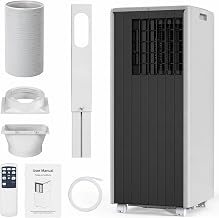
Best for Buyers Needing True AC Capability: 8000 BTU Portable Air Conditioner
Despite the “ventless” wording, an 8000 BTU compressor-style portable AC should be checked carefully for its exhaust requirements; most units in this category need a hose to remove hot air. Its four-in-one design, sleep mode, fan speeds, and dehumidifier function make it more capable in humid weather than an evaporative cooler, provided it can be vented correctly.
Frequently Asked Questions
Do ventless portable air conditioners really cool a room?
Evaporative coolers can make air feel noticeably cooler, especially in dry climates, but they do not operate like compressor air conditioners. They add moisture while cooling, so performance can decline as humidity rises.
Can I use a ventless cooler in a bedroom overnight?
Yes, provided the room is not already humid and the tank is clean. A timer, sleep mode, quiet fan setting, and automatic oscillation are particularly useful for overnight comfort.
How often should I refill an evaporative cooler?
It depends on tank size, fan speed, ambient temperature, and whether you use ice packs. Smaller tanks may need daily attention, while two- or three-gallon models can run substantially longer at moderate settings.
Is an 8000 BTU portable AC truly ventless?
Usually not. Compressor air conditioners generate heat that must be expelled, commonly through a window kit and exhaust hose. Read the installation requirements rather than relying on “ventless” wording in a listing title.
Final Thoughts
For dry-climate, hose-free cooling, the 24-Inch Windowless Portable AC and the Dual-Tank Windowless Portable AC are the strongest all-around picks, while the compact 3-in-1 cooler suits personal spaces. If your home is humid or you need genuine temperature reduction, choose the 8000 BTU model only when proper exhaust installation is possible.