Key takeaways
- Room Size and CFM Rating: Match airflow to square footage. As a baseline, aim for roughly 1 CFM per square foot for standard rooms. Large open garages or workshops benefit from fans pushing 10,000 CFM or more.
- Blade Span and Mount Height: Wider blade spans generate broader air coverage but need adequate ceiling clearance. Fans above 96 inches perform best in spaces with ceilings of 12 feet or higher, while 52–72 inch models suit standard 8-to-9-foot rooms.
- Motor Type and Noise Level: DC motors consistently outperform AC motors in efficiency and quiet operation. If the fan will run for hours in a living room or bedroom, prioritize models that stay below 40 decibels at their highest speed.
- Build Materials and Rating: Aluminum blades resist warping in humid or outdoor settings. Look for damp-rated construction if you plan to install the fan under a covered patio, gazebo, or open garage bay.
- Controls and Features: A reliable remote with variable speed settings and timer functionality adds everyday convenience. Light kits with adjustable color temperature (3CCT) let you fine-tune ambiance without extra fixtures.
What's inside
Shopping for a high-CFM ceiling fan can feel surprisingly overwhelming. The market is flooded with industrial behemoths, hybrid indoor-outdoor models, and everything in between—each one claiming superior airflow, whisper-quiet operation, and rock-solid build quality. Sifting through the specs to find a fan that actually moves serious air without rattling the walls or draining your wallet is a real challenge, especially when product listings bury the details under layers of marketing jargon.
This guide cuts through the noise. We tested and compared six of the highest-performing CFM ceiling fans available in 2026, ranging from compact bedroom-friendly designs to full-blown 120-inch HVLS units built for warehouses. Below you will find our curated picks followed by a straightforward buyer’s guide to help you match the right fan to your space and budget.
As an Amazon Associate we earn from qualifying purchases.




🛒 Best Price Today on Amazon
Prime members get fast, free shipping on everything above, plus member-only deals. New members get a 30-day free trial — cancel anytime.
How to Choose a CFM Ceiling Fan (2026)
- Room Size and CFM Rating: Match airflow to square footage. As a baseline, aim for roughly 1 CFM per square foot for standard rooms. Large open garages or workshops benefit from fans pushing 10,000 CFM or more.
- Blade Span and Mount Height: Wider blade spans generate broader air coverage but need adequate ceiling clearance. Fans above 96 inches perform best in spaces with ceilings of 12 feet or higher, while 52–72 inch models suit standard 8-to-9-foot rooms.
- Motor Type and Noise Level: DC motors consistently outperform AC motors in efficiency and quiet operation. If the fan will run for hours in a living room or bedroom, prioritize models that stay below 40 decibels at their highest speed.
- Build Materials and Rating: Aluminum blades resist warping in humid or outdoor settings. Look for damp-rated construction if you plan to install the fan under a covered patio, gazebo, or open garage bay.
- Controls and Features: A reliable remote with variable speed settings and timer functionality adds everyday convenience. Light kits with adjustable color temperature (3CCT) let you fine-tune ambiance without extra fixtures.
The Best CFM Ceiling Fan (2026)s Reviewed
AA-Orion 120-Inch HVLS Industrial Ceiling Fan
When raw airflow is non-negotiable, the AA-Orion delivers a staggering 28,000 CFM through its massive 120-inch blade span. The PMSM motor is engineered for continuous commercial duty—think warehouses, gymnasiums, and barns—and runs noticeably smoother than comparable belt-driven alternatives. It is overkill for a living room, but for anyone outfitting a large workspace, nothing in this roundup comes close.
120-Inch Extra Large Industrial Ceiling Fan
Another 120-inch contender, this model leans on six heavy-duty silver aluminum blades and a quiet DC reversible motor to push massive volumes of air across commercial and semi-commercial spaces. The included three downrods give you flexibility during installation, and the six-speed remote keeps adjustments simple. It strikes a strong balance between industrial muscle and user-friendly operation.
ZMISHIBO 96-Inch Ceiling Fan with Lights
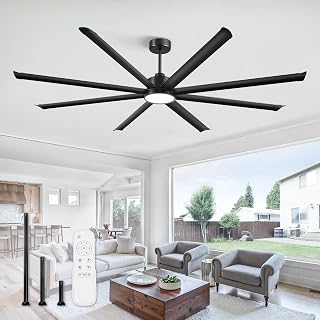
The 96-inch ZMISHIBO is one of those rare industrial-grade fans that looks genuinely good in a finished space. Eight reversible aluminum blades paired with a quiet DC motor handle large rooms and covered patios without making a racket, and the integrated 3CCT lighting means you can skip a separate fixture. Damp rating extends its versatility to gazebos and open-air shops where moisture is a constant concern.
ZMISHIBO 72-Inch Ceiling Fan with Lights
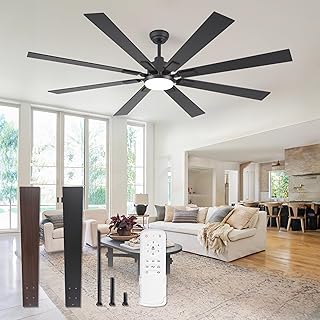
For standard-to-large residential rooms and covered outdoor areas, the 72-inch ZMISHIBO hits a practical sweet spot. Its dual-finish blades and 24-watt 3CCT LED light kit pull double duty on aesthetics and functionality, while the quiet DC motor and high-CFM output keep air moving without the industrial-scale footprint of the bigger models. Damp-rated construction rounds out a well-thought-out package.
60-Inch High CFM Ceiling Fan with Light
Smaller rooms deserve serious airflow too, and this 60-inch model delivers over 7,400 CFM from just three blades. The noiseless reversible DC motor makes it a strong candidate for bedrooms and living rooms where silence matters, and the mute remote control means no fumbling with loud button clicks at night. Built-in 3CCT lighting and a programmable timer round out what feels like a thoughtfully designed everyday fan.
Frequently Asked Questions
What does CFM mean on a ceiling fan?
CFM stands for cubic feet per minute, and it measures the total volume of air a fan moves. Higher CFM numbers indicate stronger airflow. For personal cooling in a bedroom, 4,000–6,000 CFM is typically sufficient, while large commercial spaces may require 20,000 CFM or more.
Is a 120-inch ceiling fan too large for a home?
In most residential rooms, yes. A 120-inch fan needs at least 14 to 16 feet of ceiling height and a large open floor plan to operate effectively. These fans are designed for commercial gyms, warehouses, and agricultural buildings, though some homeowners with vaulted great rooms do install them successfully.
Are DC motors worth the extra cost over AC motors?
Absolutely for most buyers. DC motors consume up to 70 percent less energy, run significantly quieter, and offer more precise speed control. The upfront premium pays for itself through lower electricity bills and a more comfortable experience, especially if the fan runs daily.
Can I install a high-CFM fan outdoors?
It depends on the rating. Damp-rated fans are safe under covered patios, pergolas, and gazebos where they are protected from direct rain. Fully wet-rated fans can handle exposed locations, but most high-CFM models in this roundup carry damp ratings rather than wet ratings, so plan your installation accordingly.
Final Thoughts
For sheer brute-force airflow in large commercial spaces, the AA-Orion 120-Inch HVLS is the clear winner. Homeowners who need serious cooling in a garage, shop, or oversized room will find the ZMISHIBO 96-Inch an excellent all-rounder thanks to its integrated lighting and damp rating. And for standard living rooms and bedrooms where quiet, efficient airflow matters most, the 60-Inch High CFM Fan punches well above its size class. Any of these five will move real air—the right choice comes down to matching the fan’s capacity to your space.