Key takeaways
- CFM and PSI ratings: Most framing nailers need around 2.5 CFM at 90 PSI. Look for a compressor that comfortably exceeds that number so the motor isn’t constantly cycling to keep up with demand.
- Tank size: A 6-gallon pancake tank suits solo framers doing moderate runs, while 8 gallons or a twin-stack design reduces recovery pauses during heavy back-to-back nailing.
- Weight and mobility: Consider whether you’ll carry the unit up ladders and across joists or mostly roll it on a subfloor. Wheels and a lower center of gravity matter more than most spec sheets admit.
- Noise level: Jobsite noise adds up fast. Units rated under 65 dB make a noticeable difference when you’re working inside or in a neighborhood with noise-sensitive homeowners.
- Durability and pump type: Oil-free pumps mean less maintenance and faster cold starts, while cast-iron or heavy-gauge steel housings tend to hold up better to daily abuse on an active site.
What's inside
Finding the right air compressor for a framing nailer is one of those home-improvement decisions that looks simple on paper but trips people up in practice. Too small and you’ll wait between each nail; too large and you’re hauling unnecessary weight across the subfloor. The sweet spot depends on how many tools you’re running, how long your stretches of work are, and whether noise is a dealbreaker inside finished spaces.
This guide breaks down the top compressors on the market right now for framing nailers, comparing pressure output, tank capacity, portability, and real-world duty cycle so you can match a unit to the way you actually work.
As an Amazon Associate we earn from qualifying purchases.



🛒 Best Price Today on Amazon
Prime members get fast, free shipping on everything above, plus member-only deals. New members get a 30-day free trial — cancel anytime.
How to Choose an Air Compressor For Framing Gun (2026)
- CFM and PSI ratings: Most framing nailers need around 2.5 CFM at 90 PSI. Look for a compressor that comfortably exceeds that number so the motor isn’t constantly cycling to keep up with demand.
- Tank size: A 6-gallon pancake tank suits solo framers doing moderate runs, while 8 gallons or a twin-stack design reduces recovery pauses during heavy back-to-back nailing.
- Weight and mobility: Consider whether you’ll carry the unit up ladders and across joists or mostly roll it on a subfloor. Wheels and a lower center of gravity matter more than most spec sheets admit.
- Noise level: Jobsite noise adds up fast. Units rated under 65 dB make a noticeable difference when you’re working inside or in a neighborhood with noise-sensitive homeowners.
- Durability and pump type: Oil-free pumps mean less maintenance and faster cold starts, while cast-iron or heavy-gauge steel housings tend to hold up better to daily abuse on an active site.
The Best Air Compressor For Framing Gun (2026) Reviews
Metabo HPT EC914S 6-Gallon Pancake
Delivering 200 PSI in a compact pancake body, the EC914S pushes enough air to run multiple framing nailers at the same time without breaking a sweat. Its 4 CFM flow rate puts it ahead of most six-gallon competitors, and the rugged job-site build handles the knocks that come with daily framing work.
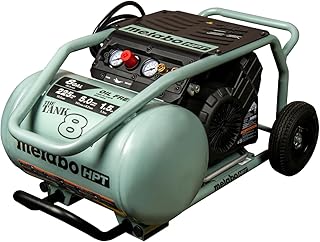
Metabo HPT EC1315S 8-Gallon Trolley
If you need sustained output for a full day of sheathing or roof decking, the EC1315S earns its keep. The 225 PSI rating and rubber-tired trolley design mean fewer refill breaks and effortless rolling across uneven framing-stage floors, making it a practical choice for crews that move fast.
DEWALT DWFP55126 6-Gallon Pancake
A proven workhorse at 165 PSI, the DWFP55126 keeps things simple with an oil-free pump and a frame that survives the back of a truck. It’s slightly lower on pressure than the Metabo units, but for single-nailer framing tasks it performs reliably with minimal fuss.
Rolair FC2002 Twin Stack
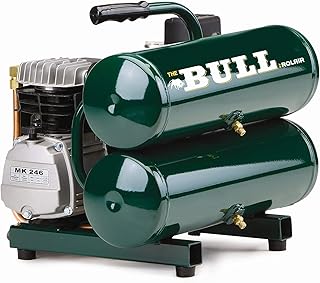
The twin-tank configuration on the Rolair FC2002 smooths out air delivery in a way pancake designs can’t quite match. Its 2 HP motor provides strong recovery times, and the built-in overload protection with manual reset adds a layer of longevity that matters when you’re pushing the unit hard all afternoon.
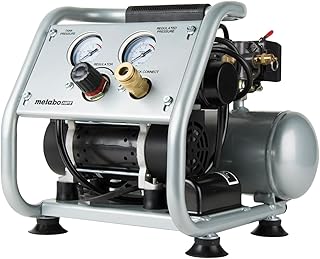
Metabo HPT EC28M 1-Gallon Ultra-Quiet
At just 59 dB, the EC28M is practically library-quiet for a compressor. It won’t replace a larger unit for sustained framing work, but for punch-list nailing, trim touch-ups near finished rooms, or any situation where noise is the primary concern, it’s a genuinely useful tool to keep on hand.
Frequently Asked Questions
How many CFM does a framing nailer need?
Most framing nailers require between 2.2 and 2.8 CFM at 90 PSI. It’s wise to choose a compressor that provides at least 3 CFM so you aren’t waiting for the tank to recover between rapid-fire sequences.
Is a pancake or twin-stack compressor better for framing?
Pancake compressors offer a lower center of gravity and are easier to carry, while twin-stack models generally deliver higher sustained airflow and faster recovery. For solo framing with one nailer, a quality pancake is usually enough; for heavier or multi-tool work, the twin-stack pays off.
Can I run two framing nailers off one compressor?
Yes, but you need a compressor with enough CFM to support both simultaneously—typically above 5 CFM at 90 PSI. Models like the Metabo HPT EC914S are specifically rated for this kind of multi-tool demand.
Do oil-free compressors work as well as oiled models for framing?
For framing nailers, oil-free compressors perform excellently and require far less maintenance. The trade-off is slightly more noise and shorter overall lifespan compared to oiled rotary-screw units, but for typical residential framing the convenience wins out.
Final Thoughts
For most framing situations the Metabo HPT EC914S hits the best balance of output, portability, and value. If your projects call for longer sustained runs across a bigger crew, the EC1315S trolley model is worth the step up. And for anyone who regularly works near finished living spaces, the whisper-quiet EC28M makes a smart complementary addition to a larger shop compressor.