Key takeaways
- Filter Type: Look for H13 True HEPA or equivalent plus a dedicated activated carbon filter. Smoke particles are microscopic; standard HEPA alone won’t neutralize the gaseous odor compounds.
- Coverage Area: Match the purifier’s rated square footage to your actual room size. Undersized units cycle air too slowly to keep up with continuous smoke exposure.
- Carbon Depth: Heavier carbon beds absorb more odors over time. A thin carbon prefilter will saturate quickly in a smoking household and need frequent replacement.
- Noise at Useful Speeds: A purifier that only works on its loudest setting won’t get used in a bedroom. Check decibel ratings at the auto or medium setting, not just the sleep mode floor.
- Filter Replacement Cost: The unit price means little if annual filter changes cost half as much again. Factor in twelve-month running costs before committing.
What's inside
Living with a smoker—or sharing walls with one—means constantly battling that stubborn, clingy smell that Embeds itself into curtains, couches, and every breath you take indoors. Standard fans just push the problem around the room, and most “odor eliminators” barely scratch the surface of secondhand smoke particles, which are small enough to bypass ordinary filters entirely.
This guide cuts through the marketing noise and focuses on air purifiers with genuinely effective filtration for cigarette smoke—true HEPA media paired with activated carbon beds capable of trapping both ultrafine particulates and volatile organic compounds that cause that lingering stench. Every pick below earned its place through verified smoke-removal performance, not just glossy spec sheets.
As an Amazon Associate we earn from qualifying purchases.


How to Choose a Cigarette Smoke Air Purifier (2026)
- Filter Type: Look for H13 True HEPA or equivalent plus a dedicated activated carbon filter. Smoke particles are microscopic; standard HEPA alone won’t neutralize the gaseous odor compounds.
- Coverage Area: Match the purifier’s rated square footage to your actual room size. Undersized units cycle air too slowly to keep up with continuous smoke exposure.
- Carbon Depth: Heavier carbon beds absorb more odors over time. A thin carbon prefilter will saturate quickly in a smoking household and need frequent replacement.
- Noise at Useful Speeds: A purifier that only works on its loudest setting won’t get used in a bedroom. Check decibel ratings at the auto or medium setting, not just the sleep mode floor.
- Filter Replacement Cost: The unit price means little if annual filter changes cost half as much again. Factor in twelve-month running costs before committing.
The Best Cigarette Smoke Air Purifiers (2026) Reviewed
PuroAir 240
The PuroAir 240 combines a multi-stage HEPA filter with its proprietary CarbonTech layer—claimed to be up to 500 times more effective than standard carbon at adsorbing smoke molecules. For a single-unit price that undercuts many competitors, it handles rooms up to 1,000 square feet and runs an auto mode that ramps fan speed in response to detected air quality changes. It is a strong value pick for a smoke-afflicted bedroom or home office.
Dreo 338 (DR-HAP008)
Dreo’s entry stands out with a built-in PM2.5 monitor that gives you real-time feedback on smoke particle density—useful data that most budget purifiers simply do not provide. Its AHAM VERIFIDE certification confirms independently tested CADR numbers, and the integrated scent diffuser lets you introduce a masking fragrance without buying a separate device. Four speed settings plus a genuinely quiet sleep mode make it adaptable across living spaces and nighttime use.
PuroAir 240 Two-Pack
If smoke is a whole-home problem, buying two PuroAir 240 units together is considerably more cost-effective than purchasing them separately. Placing one unit near the source—typically a living room or den—and another in a bedroom creates overlapping coverage that prevents smoke from migrating between rooms. This bundle is the practical choice for households where a single purifier cannot keep pace.
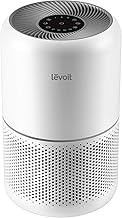
LEVOIT Core 300 (Core300-P)
The LEVOIT Core 300 has earned its reputation as a compact workhorse, and the upgraded Core300-P variant extends coverage to over 1,000 square feet while maintaining a whisper-quiet 24-decibel sleep mode. Its H13 True HEPA filter captures 99.97% of smoke particulates at 0.3 microns, and LEVOIT’s broad filter availability keeps long-term ownership affordable. For smokers on a tighter budget who still need AHAM-verified performance, this remains a reliable starting point.
AIRDOCTOR AD3500
The AD3500 is the heavy-hitter here, covering up to 2,520 square feet with hospital-grade UltraHEPA filtration paired with a thick premium carbon bed. Where smaller units struggle with heavy, continuous smoke exposure, the AD3500’s oversized filters and higher airflow maintain consistent cleaning without exhausting the media prematurely. It carries a premium price, but for open-plan homes or dedicated smoking rooms with significant square footage, the investment pays off in genuinely breathable air.
Frequently Asked Questions
Can an air purifier completely eliminate cigarette smoke?
No air purifier removes 100% of smoke. The best units capture the vast majority of fine particulates and significantly reduce gaseous odors, but residual smell may persist in porous surfaces like upholstery and carpet. Pairing a purifier with regular fabric cleaning produces the best results.
How often should I replace filters in a smoking household?
Heavy smoke accelerates filter saturation. Plan to replace HEPA filters every 6 to 8 months rather than the typical 12-month cycle, and check carbon filters even more frequently. Most manufacturers offer subscription options that reduce the per-filter cost.
Is a larger purifier always better for smoke?
Not necessarily. An oversized unit cycling clean air through a tiny room wastes energy and may produce unnecessary noise. Match the purifier’s CADR rating and coverage area to your actual space for balanced performance and operating cost.
Do air purifiers help with secondhand smoke health risks?
HEPA purifiers remove a substantial portion of the airborne particulate matter linked to secondhand smoke exposure. While they are not a substitute for smoking outdoors, they meaningfully reduce the concentration of harmful particles in indoor air.
Final Thoughts
For most households dealing with cigarette smoke on a budget, the PuroAir 240 offers the strongest balance of filtration power and price, and the two-pack makes whole-home coverage realistic without overspending. If real-time air quality data and verified performance numbers matter to you, the Dreo 338 earns a close second look. For large homes or rooms with heavy, sustained smoke, the AIRDOCTOR AD3500’s hospital-grade filtration and expansive coverage justify its higher tag.