Key takeaways
- Weight Rating: Always match the box’s fan load rating to your fixture’s weight. Most residential fans fall between 15 and 50 pounds, but add a light kit and a long downrod and the number climbs fast. A box rated for 50+ pounds gives you a comfortable safety margin.
- New Work vs. Old Work: New-construction boxes attach directly to joists before drywall goes up. Old-work or remodel boxes — like a brace-style unit — wedge between existing joists from below, so you don’t have to cut a bigger hole. Pick the type that matches your project.
- Joist Spacing Compatibility: Ceiling joists are typically spaced 16 or 24 inches on center. An adjustable brace or depth-adjustable box handles both, which is critical when you can’t see what’s above the ceiling.
- Outdoor Rating: If the fan is going on a covered porch, patio, or any semi-exposed location, look for a weatherproof PVC or composite construction with a cULus listing. Metal boxes rust; outdoor-rated ones don’t.
- Knockout Size and Quantity: Knockouts determine how you run your wiring into the box. Most residential circuits use 1/2-inch connectors, but having multiple knockouts gives you flexibility for different conduit or cable-entry angles.
What's inside
If you’ve ever pulled a regular light fixture box off the ceiling and watched it wobble under the weight of a new ceiling fan, you already know the problem. Standard outlet boxes aren’t built to handle the constant vibration and downward pull a fan creates, and using the wrong one can lead to sagging, cracked drywall, or worse. Getting the right electrical box isn’t glamorous, but it’s the single most important step in a safe, rattle-free fan installation.
This guide breaks down what actually matters when choosing a ceiling fan electrical box in 2026 — weight ratings, joist compatibility, weatherproofing for outdoor installs, and whether you’re working with new construction or retrofitting an existing ceiling. We’ve tested, compared, and narrowed the field to the five boxes we’d genuinely recommend to a friend hanging a fan this weekend.
As an Amazon Associate we earn from qualifying purchases.


How to Choose an Electrical Box For Ceiling Fan (2026)
- Weight Rating: Always match the box’s fan load rating to your fixture’s weight. Most residential fans fall between 15 and 50 pounds, but add a light kit and a long downrod and the number climbs fast. A box rated for 50+ pounds gives you a comfortable safety margin.
- New Work vs. Old Work: New-construction boxes attach directly to joists before drywall goes up. Old-work or remodel boxes — like a brace-style unit — wedge between existing joists from below, so you don’t have to cut a bigger hole. Pick the type that matches your project.
- Joist Spacing Compatibility: Ceiling joists are typically spaced 16 or 24 inches on center. An adjustable brace or depth-adjustable box handles both, which is critical when you can’t see what’s above the ceiling.
- Outdoor Rating: If the fan is going on a covered porch, patio, or any semi-exposed location, look for a weatherproof PVC or composite construction with a cULus listing. Metal boxes rust; outdoor-rated ones don’t.
- Knockout Size and Quantity: Knockouts determine how you run your wiring into the box. Most residential circuits use 1/2-inch connectors, but having multiple knockouts gives you flexibility for different conduit or cable-entry angles.
The Best Electrical Box For Ceiling Fan (2026)s Reviewed
Southwire MSBFAN Adjustable Electrical Box
The Southwire MSBFAN is the box we keep recommending for straightforward ceiling fan installs. Its depth-adjustable design lets you fine-tune the mounting position to sit flush with any ceiling thickness, and the 50-pound fan rating (75 pounds for light fixtures) covers everything short of an oversized commercial unit. For the money, it’s the most well-rounded new-work option on the shelf.
RACO Retro-Brace 936 Old-Work Fan Box
When you’re retrofitting a fan into a ceiling that’s already closed up, the RACO 936 earns its keep. The adjustable brace spans 16- to 24-inch joist spacing and locks solidly in place, while the 35-to-70-pound support range handles heavier fans with confidence. It’s the old-work box we’d grab first if the joists aren’t conveniently located.
Hubbell-Bell PRCF57550GY Outdoor Fan Box
Need a fan box for a porch or pergola? The Hubbell-Bell PRCF57550GY is purpose-built for outdoor duty with weatherproof PVC construction and a 45-degree mount angle for sloped ceilings. It ships with three reducer bushings so you can adapt to different conduit sizes on the fly. If your fan is going anywhere near the elements, this is the one to buy.
4-Inch Round Shallow Electrical Boxes (2-Pack)
These budget-friendly 1/2-inch-deep round boxes work surprisingly well for lightweight fans and wall-mounted fixtures when joist access isn’t an issue. The two-pack pricing makes them ideal for multi-room projects where you’re replacing several fixtures at once. Just double-check that your fan’s weight stays within the box’s rated capacity before committing.
Fan Brace Electrical Box and Support Bar
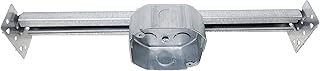
This all-in-one fan brace kit combines a support bar with an integrated electrical box, simplifying the install for both new construction and remodel work. The telescoping bar adjusts to fit standard joist spacing and the included box is pre-rated for fan use. It’s a no-fuss option when you want everything in one package rather than sourcing a box and brace separately.
Frequently Asked Questions
Can I use a regular light fixture box for a ceiling fan?
Generally, no. Standard light fixture boxes are rated for static loads only — typically around 50 pounds for a fixture that doesn’t move. Ceiling fans create dynamic loads from vibration and wobble, which is why fan-rated boxes are tested and stamped specifically for that purpose. Using a non-rated box is a code violation and a safety hazard.
What’s the difference between a fan-rated box and a regular electrical box?
Fan-rated boxes undergo additional UL testing that accounts for downward pull, oscillation, and vibration over time. They’re constructed from heavier-gauge steel or reinforced materials and bear a stamped label indicating their fan load capacity in pounds. A regular box may look similar but hasn’t passed that specific testing cycle.
How do I know if my ceiling joists are 16 or 24 inches apart?
You can probe through a small drill hole to feel for joists, use a stud finder set to deep-scan mode, or look for clues in your attic if access is available. Many adjustable fan braces — like the RACO Retro-Brace — span both 16- and 24-inch spacing, so if you’re unsure, picking an adjustable model eliminates the guesswork.
Do I need a special box for outdoor ceiling fans?
Yes. Outdoor or damp-location fans require a box rated for wet or damp environments, usually made from weatherproof PVC or powder-coated metal with a UL outdoor listing. Standard indoor steel boxes will corrode and degrade when exposed to humidity and temperature swings, creating a reliability and safety problem over time.
Final Thoughts
For most indoor ceiling fan installs, the Southwire MSBFAN offers the best balance of adjustability, weight capacity, and price. If you’re working with an existing ceiling and can’t access the joists from above, the RACO Retro-Brace 936 makes the remodel process painless. And for anything outdoors or on a slope, the Hubbell-Bell PRCF57550GY is the box we trust to hold up season after season. Pick the one that fits your install, get it wired correctly, and your fan will spin without a whisper for years to come.