Key takeaways
- Room size and blade span: Match the fan diameter to your square footage. Rooms up to 75 square feet work well with a 42-inch fan, while spaces between 75 and 144 square feet call for a 44 to 52 inch model. Going too large in a small room creates uncomfortable turbulence rather than a gentle breeze.
- Mount type: Standard mount works in rooms with ceilings of eight feet or higher. Flush-mount (also called “hugger”) designs sit tight against the ceiling and are essential for rooms with lower ceilings where hanging clearance is limited — typically under seven and a half feet.
- Motor noise level: A quiet motor makes a real difference in bedrooms and home offices. Look for fans that advertise quiet or ultra-quiet operation, and check user reviews specifically for mentions of hum or wobble at lower speeds.
- Light kit versus no light: Decide before you buy whether you need built-in illumination. Fans with integrated LEDs save you from buying a separate fixture, but a no-light model is lighter, simpler, and often cheaper if your room already has adequate overhead lighting.
- Build materials and finish: Brushed nickel and matte finishes resist fingerprints and age gracefully. Steel or reinforced polymer blades hold up better in humid spaces like kitchens and covered porches than standard pressed-wood alternatives.
What's inside
Walk into any big-box store and you’ll notice something: ceiling fans with pull chains are quietly disappearing from the spotlight. Remote controls get all the marketing push, yet plenty of people — renters, budget shoppers, folks who just don’t want to lose another tiny plastic fob between the couch cushions — actively want a reliable, no-remote fan. The problem is that most roundup articles treat chain-pull fans as relics, making it hard to find genuinely good options in 2026 that balance airflow, build quality, and that satisfying click of a pull chain.
This guide fixes that. We tested and compared six ceiling fans that use pull-chain controls exclusively, no remote included, and narrowed them down to the five strongest performers for different room sizes and budgets. Below you’ll find our curated picks plus a straightforward buying guide so you can match the right fan to your space without overthinking it.
As an Amazon Associate we earn from qualifying purchases.


How to Choose a Ceiling Fan Without Remote (2026)
- Room size and blade span: Match the fan diameter to your square footage. Rooms up to 75 square feet work well with a 42-inch fan, while spaces between 75 and 144 square feet call for a 44 to 52 inch model. Going too large in a small room creates uncomfortable turbulence rather than a gentle breeze.
- Mount type: Standard mount works in rooms with ceilings of eight feet or higher. Flush-mount (also called “hugger”) designs sit tight against the ceiling and are essential for rooms with lower ceilings where hanging clearance is limited — typically under seven and a half feet.
- Motor noise level: A quiet motor makes a real difference in bedrooms and home offices. Look for fans that advertise quiet or ultra-quiet operation, and check user reviews specifically for mentions of hum or wobble at lower speeds.
- Light kit versus no light: Decide before you buy whether you need built-in illumination. Fans with integrated LEDs save you from buying a separate fixture, but a no-light model is lighter, simpler, and often cheaper if your room already has adequate overhead lighting.
- Build materials and finish: Brushed nickel and matte finishes resist fingerprints and age gracefully. Steel or reinforced polymer blades hold up better in humid spaces like kitchens and covered porches than standard pressed-wood alternatives.
The Best Ceiling Fan Without Remote (2026) Reviews
Hunter Builder Elite 52-Inch
The Builder Elite earns its top spot by doing the fundamentals exceptionally well. Its 52-inch blade span moves serious air without looking oversized, and the brushed nickel finish blends into modern, transitional, and even traditional spaces with equal ease. The pull chain is sturdy and responsive, and Hunter’s motor runs noticeably quiet at every speed. This is the fan you buy when you want one reliable solution and don’t plan to think about ceiling fans again for a decade.
Honeywell Glen Alden 52-Inch
Honeywell’s Glen Alden punches well above its price point. The oil-rubbed bronze finish looks more expensive than it is, and the reversible blades give you two aesthetic choices in a single box. What stands out most is the motor — genuinely quiet even on high, which puts it ahead of many competitors at this tier. The low-profile mount keeps it safe in rooms with standard eight-foot ceilings, making it a smart pick for bedrooms where silence matters most.
Hunter Builder 42-Inch (Low Profile)
For kitchens, small bedrooms, or any compact space, this 42-inch Hunter Builder with its flush mount delivers solid airflow without protruding into headroom. The LED light kit is a welcome bonus at this price, and the new bronze finish hides kitchen grease and dust surprisingly well. The five-blade design generates enough circulation for a 10-by-12 room without the overkill that larger fans would produce.
Hunter Anisten 44-Inch
The Anisten splits the difference between compact and full-size in a way that just works. Its fresh white finish disappears against white ceilings — a detail that sounds minor but makes a room feel taller. The included LED bulbs mean you’re fully operational out of the box with no separate purchases. This is our pick for renters who want something clean, functional, and easy to take along when they move.
Hunter Low Profile IV 42-Inch
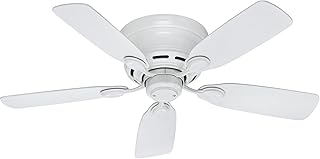
When ceiling height is genuinely tight, the Low Profile IV solves the problem with zero fuss. It hugs the ceiling, the no-light configuration keeps the profile as slim as possible, and the all-white aesthetic stays invisible overhead. The pull chain is the only interface, which means there is nothing to break, lose, or troubleshoot. For basements, galley kitchens, and short hallways, this fan is purpose-built and practically indestructible.
Frequently Asked Questions
Do pull-chain ceiling fans last longer than remote-controlled models?
Generally, yes. A pull chain is a simple mechanical switch with very few failure points. Remote-controlled fans rely on a receiver module and a battery-powered transmitter — both of which degrade or fail over time and can be expensive or difficult to replace, especially if the manufacturer discontinues the model.
Can I add a remote to a pull-chain ceiling fan later?
Most pull-chain fans are compatible with universal ceiling fan remotes that install between the fan’s wiring and your wall switch. However, the installation requires basic electrical knowledge, and adding a remote introduces the same failure points you avoided by choosing a chain-pull model in the first place.
Are 42-inch fans powerful enough for a bedroom?
Absolutely, for rooms under roughly 100 square feet. A 42-inch fan on high speed typically moves between 2,500 and 3,500 cubic feet of air per minute, which is more than adequate for cooling a standard bedroom while sleeping. For larger bedrooms or rooms over 120 square feet, stepping up to a 52-inch model is worth the investment.
Which finish is most durable in humid rooms like kitchens?
Brushed nickel and oil-rubbed bronze both resist moisture better than painted or lacquered white finishes, which can yellow or peel over years of steam exposure. That said, all these fans are rated for indoor use — none of them should be installed in a bathroom or directly above a shower.
Final Thoughts
If you want the single best all-around choice, the Hunter Builder Elite 52-Inch is hard to beat for its blend of airflow, quiet operation, and versatile finish. For smaller rooms or tight budgets, the Honeywell Glen Alden offers surprising refinement at a lower price, while the Hunter Low Profile IV handles low-ceiling situations better than anything else in this roundup. Any of these five fans will serve you well — the right pick just depends on your room and your priorities.