Key takeaways
- Downrod length and ceiling height: A general rule: add one inch of downrod for every foot of ceiling height beyond eight feet. Verify that the fan ships with the downrod length you actually need—some include multiple options while others sell them separately.
- CFM vs. room size: Cubic feet per minute tells you how much air the fan moves. Anything under 4,000 CFM suits a bedroom; 5,000 to 8,000 handles a living area or patio; above 10,000 is open-air territory like barns and workshops.
- Motor type and noise: DC motors are now the benchmark—they run quieter, use less energy, and typically offer more speed settings than traditional AC motors. Look for specific decibel claims rather than vague “quiet” marketing.
- Wet and damp ratings: An exposed patio needs a wet-rated fan. A covered porch or lanai can get by with damp-rated. Mismatch this and you’re looking at rust, motor failure, or both within a season.
- Ceiling slope compatibility: Not every fan handles angled ceilings. Check whether the included or optional downrod-and-canopy kit supports slopes up to the angle of your ceiling, typically up to about 15–30 degrees.
What's inside
Buying a ceiling fan for a vaulted room, a two-story foyer, or a covered patio often hits the same wall: standard downrods are too short, leaving the blades too close to the ceiling and robbing you of real airflow where you actually need it. The right long-downrod fan fixes the gap—but sorting through a marketplace flooded with vague specs and inconsistent sizing can feel like second-guessing in the dark.
This guide cuts through the noise. We evaluated ceiling fans specifically for their downrod options, airflow performance, build quality, and real-world usability. The five picks below each solve a different high-ceiling scenario, from open patios to barns, with honest assessments so you can match the right fan to your space.
As an Amazon Associate we earn from qualifying purchases.




How to Choose a Ceiling Fan With Long Downrod (2026)
- Downrod length and ceiling height: A general rule: add one inch of downrod for every foot of ceiling height beyond eight feet. Verify that the fan ships with the downrod length you actually need—some include multiple options while others sell them separately.
- CFM vs. room size: Cubic feet per minute tells you how much air the fan moves. Anything under 4,000 CFM suits a bedroom; 5,000 to 8,000 handles a living area or patio; above 10,000 is open-air territory like barns and workshops.
- Motor type and noise: DC motors are now the benchmark—they run quieter, use less energy, and typically offer more speed settings than traditional AC motors. Look for specific decibel claims rather than vague “quiet” marketing.
- Wet and damp ratings: An exposed patio needs a wet-rated fan. A covered porch or lanai can get by with damp-rated. Mismatch this and you’re looking at rust, motor failure, or both within a season.
- Ceiling slope compatibility: Not every fan handles angled ceilings. Check whether the included or optional downrod-and-canopy kit supports slopes up to the angle of your ceiling, typically up to about 15–30 degrees.
The Best Ceiling Fan With Long Downrod (2026)s Reviewed
96 Inch Smart Aluminum Ceiling Fan
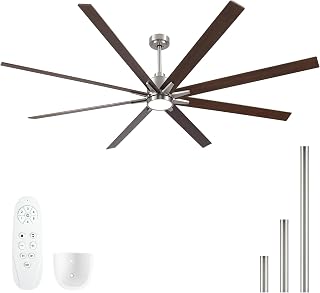
This eight-footer is the airflow heavyweight of the group, pushing upward of 10,000 CFM with DOE certification behind the number. Alexa integration and long downrod options make it a strong choice for oversized patios or commercial spaces where ceiling height demands serious reach and smart-home convenience.
ZMISHIBO 96 Inch Industrial Ceiling Fan
Built without a light for users who want pure function, the ZMISHIBO pairs eight aluminum blades with a damp-rated DC motor and three included downrods for flat or sloped installs. Its six-speed remote and no-frills design suit warehouses, garages, and farmhouses where durability outshines aesthetics.
Rayqueen 84 Inch Brushed Nickel Ceiling Fan
The walnut-finished blades and brushed nickel housing give this one a refined look that bridges indoor and outdoor settings. Three downrod lengths (5.9, 11.8, and 23.6 inches) are included out of the box, and the dimmable three-color LED plus six-speed DC motor round out a well-balanced package.
60 Inch Outdoor Ceiling Fan (Black Gold)
At 8,299 CFM, this black-and-gold unit punches well above its size class. The ABS blades resist moisture and warping, while the reversible DC motor lets you switch from summer downdraft to winter updraft. Multiple long downrods are included, making vaulted patios and high-ceiling porches a straightforward install.
Sevenine 52 Inch Downrod White Ceiling Fan
For mid-size rooms with elevated ceilings, the Sevenine’s compact 52-inch span keeps proportions sensible while its long downrod clears the air. ETL listing, a three-level timer, three color temperatures, and a quiet DC motor make it a dependable all-season pick for bedrooms and covered patios alike.
Frequently Asked Questions
How long should a downrod be for a 10-foot ceiling?
A standard 12-inch downrod usually places fan blades about eight feet off the floor, which is the sweet spot for airflow and safety on a 10-foot ceiling. If your ceiling is higher, add roughly one additional foot of downrod per extra foot of ceiling height.
Can I install a long-downrod fan on a sloped ceiling?
Yes, provided the fan includes a sloped-ceiling canopy or an angled adapter. Many manufacturers now specify maximum slope angles—often between 15 and 30 degrees—so check that rating against your ceiling pitch before purchasing.
Are DC motors worth the price premium over AC?
DC motors typically use 30 to 70 percent less energy, run noticeably quieter, and offer more speed settings. For a ceiling fan that might run eight or more hours a day, the energy savings and reduced noise usually justify the higher upfront cost.
Does a longer downrod reduce airflow?
Not meaningfully. A longer downrod moves the fan farther from the ceiling, which can actually improve air circulation by giving the blades more clearance. The fan’s motor power and blade design have a far greater impact on delivered CFM than downrod length.
Final Thoughts
If maximum airflow is the priority, the 96 Inch Smart Aluminum Ceiling Fan is hard to beat. For indoor-outdoor versatility with a premium look, the Rayqueen 84 Inch Brushed Nickel delivers real value. And for smaller spaces that still need elevation, the Sevenine 52 Inch covers the basics without wasted footprint. Each solves a different high-ceiling problem—match the one that fits your room and forget about it for years.