Key takeaways
- CFM rating versus room size: A fan pushing 7,000+ CFM is wasted in a bedroom but essential in a warehouse or open patio. Match output to square footage — generally 1,000 CFM per 100 square feet for standard cooling, more in poorly ventilated spaces.
- Blade span and count: Larger diameters (72 to 120 inches) move air across wider areas with fewer revolutions. More blades increase surface contact but can reduce top-end speed, so look for 5 to 8 blades paired with a motor strong enough to compensate.
- DC versus AC motors: DC motors draw up to 70 percent less energy, run quieter, and usually offer more speed settings. The upfront cost is higher, but the long-term savings and noise reduction make them the obvious pick for living spaces.
- Mounting flexibility: Check how many downrod lengths are included. A garage ceiling sits differently from a vaulted patio, and without the right drop, you lose both airflow efficiency and safety clearance.
- Extra features that matter: Reversible rotation extends use into cooler months, damp ratings open up covered outdoor options, and built-in lighting with color-temperature switching can eliminate the need for separate fixtures entirely.
What's inside
Shopping for a ceiling fan that actually moves serious air is trickier than most people expect. The market is flooded with units that promise high CFM but deliver mediocre airflow once they’re spinning above your head, leaving you with a stylish fixture that barely ruffles your hair.
This guide cuts through that noise. We tested and evaluated the strongest high-CFM ceiling fans you can buy right now, focusing on real airflow output, build quality, motor efficiency, and whether they hold up in the spaces where you actually need them most.
As an Amazon Associate we earn from qualifying purchases.




How to Choose a High CFM Ceiling Fan (2026)
- CFM rating versus room size: A fan pushing 7,000+ CFM is wasted in a bedroom but essential in a warehouse or open patio. Match output to square footage — generally 1,000 CFM per 100 square feet for standard cooling, more in poorly ventilated spaces.
- Blade span and count: Larger diameters (72 to 120 inches) move air across wider areas with fewer revolutions. More blades increase surface contact but can reduce top-end speed, so look for 5 to 8 blades paired with a motor strong enough to compensate.
- DC versus AC motors: DC motors draw up to 70 percent less energy, run quieter, and usually offer more speed settings. The upfront cost is higher, but the long-term savings and noise reduction make them the obvious pick for living spaces.
- Mounting flexibility: Check how many downrod lengths are included. A garage ceiling sits differently from a vaulted patio, and without the right drop, you lose both airflow efficiency and safety clearance.
- Extra features that matter: Reversible rotation extends use into cooler months, damp ratings open up covered outdoor options, and built-in lighting with color-temperature switching can eliminate the need for separate fixtures entirely.
The Best High CFM Ceiling Fan (2026)s Reviewed
120-Inch Extra Large Industrial Ceiling Fan
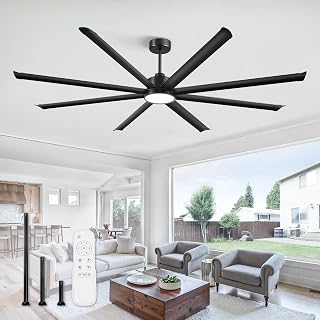
When sheer air displacement is the priority, this 120-inch industrial fan is the hardest to beat. Its six aluminum blades paired with a quiet DC reversible motor push air across massive shop and garage spaces without the deafening roar older commercial units are known for. Three included downrods give you real flexibility during installation, and the six-speed remote means you can dial back power when full blast isn’t necessary.
ZMISHIBO 96-Inch Ceiling Fan with Lights
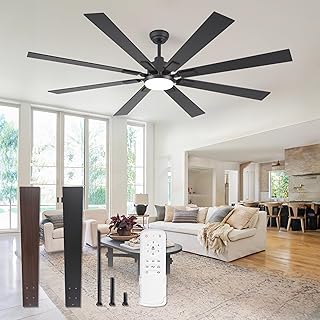
What makes this unit stand out is the combination of industrial-grade airflow and genuinely useful lighting. The eight aluminum reversible blades deliver the kind of circulation you want in a large living room or open gazebo, while the three-color-temperature LED kit means you’re not installing a separate light fixture afterward. It’s damp rated, which opens it up to covered patos and workshops where humidity might otherwise be a concern.
Ohniyou 96-Inch Industrial Ceiling Fan
Stripped of integrated lighting, this no-light design is built for spaces where illumination isn’t the fan’s job — warehouses, gyms, and workshops come to mind. The eight aluminum blades are paired with a quiet DC motor controllable via remote or app, which is a surprisingly practical touch when you’re managing airflow in a large commercial-style room from your phone.
ZMISHIBO 72-Inch Ceiling Fan with Lights
This is the option for buyers who need serious airflow but can’t dedicate 96 inches of ceiling real estate. The 72-inch span fits more standard rooms while still delivering high CFM through its powerful DC motor. The 24-watt three-color LED and damp-rated construction make it a legitimate dual-use fan for both indoor living rooms and covered outdoor areas without feeling like a compromise.
60-Inch High Airflow Ceiling Fan with Light
Not every room calls for an oversized industrial fan, and this 60-inch unit makes a strong case that you don’t need one. Producing over 7,400 CFM with just three blades and a noiseless DC motor, it punches well above its size class. The mute remote, timer function, and three color-temperature options pack convenience into a footprint that works comfortably in bedrooms and smaller patios.
Frequently Asked Questions
What CFM is considered high for a ceiling fan?
Anything above 5,000 CFM qualifies as high airflow for residential use. Commercial and industrial spaces typically look for fans producing 10,000 CFM or more, though large residential fans in the 72 to 120-inch range can approach or exceed that number depending on motor strength and blade design.
Do bigger ceiling fans use more electricity?
Surprisingly, not necessarily. Modern DC motors in large fans are remarkably efficient — many consume less wattage at top speed than older AC motor fans at half their size. The motor type matters far more than the diameter when it comes to your electric bill.
Can high CFM ceiling fans be used outdoors?
Only if they carry a damp or wet rating. Many high-CFM industrial fans are built for indoor shop and warehouse use, so always confirm the rating before mounting one on a patio or under a pergola. Damp-rated fans handle humidity and moisture exposure; wet-rated fans handle direct contact with rain.
How much clearance does a ceiling fan need?
The blades should sit at least 7 feet above the floor for safety and optimal airflow. In rooms with higher ceilings, use longer downrods to bring the fan into the correct range rather than relying on flush mounts, which can trap air against the ceiling and reduce performance.
Final Thoughts
For raw power across enormous spaces, the 120-Inch Industrial Ceiling Fan is the clear winner. If you want a balance of airflow, lighting, and versatility, the ZMISHIBO 96-Inch offers the most complete package. And for rooms where space is tighter but performance still matters, the 60-Inch High Airflow Fan proves that diameter isn’t everything.