Key takeaways
- Standardized DOE or SACC cooling capacity.
- Cabinet width, depth, and height.
- Required rear and side ventilation clearances.
- Exhaust hose diameter and supported routing.
- Window installation panel dimensions.
- Appliance weight and mobility features.
- Filter and drainage accessibility.
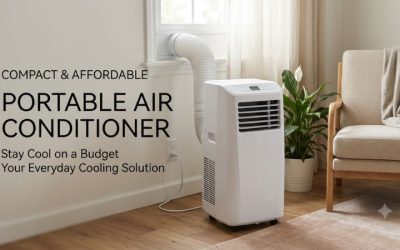
Choosing a portable air conditioner for small spaces involves balancing effective cooling, compact dimensions, energy efficiency, and practical installation. Whether you live in a studio apartment, work from a home office, or need bedroom cooling, the right appliance should improve comfort without overwhelming your available space.
What is the ideal portable air conditioner for small spaces?
For many enclosed residential rooms measuring approximately 100 to 250 square feet, a portable air conditioner rated around 5,000 to 6,000 BTU SACC is a reasonable starting point. Rooms with substantial sunlight, poor insulation, tall ceilings, or heat-producing electronics may require a higher-capacity appliance.
Physical dimensions should receive almost as much attention as cooling capacity. An appliance may fit comfortably within a room according to its advertised measurements while still requiring considerable additional space for its exhaust hose, window connection, airflow clearances, and maintenance access.
The ideal appliance provides enough cooling to maintain comfortable temperatures without creating unnecessary installation difficulties or excessive operating expenses.
Understand the difference between compact size and cooling capacity
A compact appliance is not necessarily a low-capacity air conditioner. Manufacturers use different internal component arrangements, compressor technologies, heat exchanger designs, and airflow configurations.
Two appliances with similar external dimensions may provide different standardized cooling capacities. Conversely, products advertised with the same BTU rating may occupy different amounts of usable floor space.
When comparing appliances, evaluate several independent measurements:
- Standardized DOE or SACC cooling capacity.
- Cabinet width, depth, and height.
- Required rear and side ventilation clearances.
- Exhaust hose diameter and supported routing.
- Window installation panel dimensions.
- Appliance weight and mobility features.
- Filter and drainage accessibility.
A compact cabinet offers limited practical benefit if its installation requires furniture rearrangement or obstructs an important walkway.
Determine whether your room needs active refrigeration
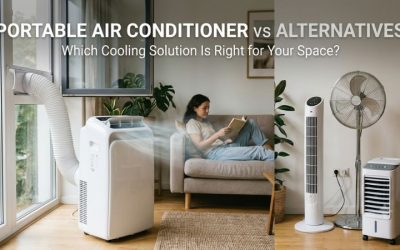
Not every uncomfortable room requires an air conditioner. Sometimes improved air circulation, solar shading, or controlled ventilation can provide sufficient relief.
A refrigerated portable air conditioner becomes particularly useful when indoor temperatures remain uncomfortable despite these measures and when an appropriate outdoor exhaust connection is available.
Unlike a conventional fan, a refrigerated appliance actively transfers heat out of the conditioned space.
Unlike an evaporative air cooler, it does not depend on evaporating water into the room to produce its principal cooling effect. This distinction becomes particularly important in humid climates.
Before purchasing, determine whether your main problem is excessive temperature, elevated humidity, poor air movement, or a combination of these conditions.
Recognize the limitations of portable cooling
Portable air conditioners are designed primarily for localized cooling. Their effectiveness can decline when they must condition multiple connected rooms or compensate for substantial heat continuously entering from outside.
A compact apartment with an open floor plan may present a larger cooling challenge than an enclosed bedroom with similar floor area.
The appliance must also release accumulated heat outside. Simply positioning it in the corner of a room without an appropriate exhaust arrangement will not provide effective room cooling.
Portability refers to the appliance’s movable cabinet, not freedom from installation requirements.
How to calculate cooling capacity for small rooms
Cooling capacity determines how much heat an air conditioner can remove under specified conditions. Selecting an appliance with an appropriate capacity is essential for maintaining comfort without unnecessary expenditure.
Use DOE and SACC ratings when comparing products
Portable air conditioners frequently display two BTU figures. The larger ASHRAE figure and the smaller DOE Seasonally Adjusted Cooling Capacity figure represent different evaluation approaches.
SACC accounts for factors affecting portable air conditioner performance, including certain heat-transfer and infiltration effects associated with portable operation.
For meaningful product comparisons, use the same rating method across all candidates.
| Advertised specification | What it indicates |
|---|---|
| ASHRAE BTU | Cooling capacity under the applicable ASHRAE evaluation method |
| DOE/SACC BTU | Seasonally adjusted portable cooling capacity |
| Electrical input watts | Published electrical power information |
| CEER | Standardized combined energy-efficiency information |
| Maximum room coverage | Manufacturer-estimated application area |
An appliance advertised as 10,000 BTU ASHRAE may provide approximately 6,000 BTU SACC, depending on its exact configuration. These values should not be treated as interchangeable.
Measure the actual room dimensions
Start by measuring the room’s length and width. Multiply these measurements to determine floor area.
For example, a bedroom measuring 12 feet by 14 feet contains 168 square feet of floor area. This provides a useful starting point for evaluating compact cooling equipment.
However, floor area does not account for ceiling height. A room with a high or vaulted ceiling contains more air volume and may experience different heat-transfer conditions than a conventional room with an eight-foot ceiling.
Measure the complete space that the appliance will need to cool, including connected areas that cannot be isolated.
Evaluate sunlight and window exposure
Direct sunlight can substantially increase indoor cooling demand. Rooms facing afternoon sunlight may become uncomfortable even when outdoor temperatures are not at their daily maximum.
Large windows, limited shading, and poorly insulated glass can increase the amount of heat entering a small room.
Before purchasing a higher-capacity appliance, consider whether suitable blinds, curtains, or other permitted shading improvements could reduce the heat load.
Avoid positioning window coverings where they obstruct the air conditioner’s intake, exhaust, or required ventilation clearances.
Account for computers and electronic equipment
A small room used for gaming or professional computer work may generate more internal heat than an ordinary bedroom.
Desktop computers, monitors, televisions, lighting equipment, and other powered devices contribute heat to the surrounding environment.
For illustration, a workstation consuming 500 watts of electrical power contributes approximately 1,700 BTU per hour of heat when that energy is released within the room. This is a theoretical conversion rather than a measured result for a particular computer.
A home office with substantial electronic equipment may therefore require a higher cooling capacity than its physical dimensions initially suggest.
Compare general capacity classes
The following ranges provide preliminary shopping guidance rather than formal equipment sizing calculations.
| Room size | SACC capacity worth evaluating | Typical application |
|---|---|---|
| Under 100 sq. ft. | 4,000–5,000 BTU | Very small enclosed room |
| 100–200 sq. ft. | 5,000–6,000 BTU | Bedroom or compact office |
| 200–300 sq. ft. | 6,000–8,000 BTU | Larger bedroom or studio section |
| 300–400 sq. ft. | 8,000–10,000 BTU | Small living room or demanding office |
| Above 400 sq. ft. | 10,000–12,000 BTU or other systems | Larger or interconnected spaces |
Actual requirements depend on climate, insulation, sunlight, occupancy, equipment heat, and installation conditions.
Avoid treating the upper advertised room coverage as a guaranteed performance limit.
Avoid buying an unnecessarily large appliance
Purchasing a higher-capacity appliance can provide additional cooling capability, but bigger is not automatically better.
A larger conventional appliance may require more floor space, produce additional operating noise, and increase purchase expenses. An oversized fixed-speed air conditioner may also experience frequent cycling under modest cooling demand.
Variable-speed inverter technology can offer greater flexibility across changing conditions, although its minimum operating capacity and control behavior remain model-specific.
For small rooms, the objective is adequate and manageable cooling rather than maximum available BTU output.
Choose the right hose configuration
The exhaust system is one of the most important design differences among portable air conditioners. It influences installation complexity, usable floor space, and how the appliance interacts with indoor and outdoor airflow.
Single-hose portable air conditioners
Single-hose appliances generally draw indoor air into their condenser system before releasing heated air outdoors through one exhaust hose.
Their relatively straightforward installation can be attractive for renters and homeowners with limited window access.
However, exhausting indoor air can create negative pressure that encourages replacement air to enter through door gaps, window openings, and other building pathways.
If that replacement air is warm and humid, it can increase the room’s cooling burden.
Single-hose appliances remain practical for many compact rooms, particularly when purchase price and installation simplicity are important considerations.
Conventional dual-hose portable air conditioners
Dual-hose appliances generally provide separate outdoor-air intake and exhaust pathways for condenser operation.
This arrangement can reduce dependence on conditioned indoor air for condenser cooling and may help limit certain infiltration-related losses.
The trade-off is additional installation complexity. Two separate hoses can occupy more space behind the appliance and require a compatible window panel.
Before purchasing, determine whether the room has sufficient space for the complete operating arrangement rather than simply the appliance cabinet.
Integrated hose-in-hose designs
Some portable air conditioners combine separate airflow pathways within a single integrated hose assembly.
This configuration can provide certain dual-airflow benefits while reducing the visual complexity associated with two separate external hoses.
However, an integrated assembly may still be relatively large and require a particular window adapter or connection arrangement.
Verify exact installation dimensions before assuming that an integrated system will occupy less space in every room.
Which hose arrangement works best in a compact room?
A conventional single-hose model may be the most straightforward choice for an occasionally used bedroom with modest cooling requirements.
A dual-hose or integrated design becomes more relevant when the appliance will operate frequently, when outdoor heat is substantial, or when reducing infiltration-related cooling losses is a priority.
Compare the complete product specifications rather than selecting solely according to hose count.
| Configuration | Main advantage | Main limitation |
|---|---|---|
| Single hose | Straightforward installation | Greater potential for replacement-air infiltration |
| Separate dual hoses | Separate condenser airflow pathways | Additional installation space |
| Integrated dual airflow | Combined hose assembly | Model-specific adapter requirements |
Essential features to look for in a compact portable air conditioner
Compact cooling equipment should provide useful operating features without introducing unnecessary complexity. The most valuable functions are those that improve comfort, installation suitability, and routine maintenance.
Adjustable thermostat
An adjustable thermostat allows the appliance to respond to the selected indoor temperature rather than operating exclusively at maximum cooling output.
Most users benefit from selecting a comfortable temperature and allowing the appliance to manage its operation according to available control functions.
Setting an extremely low target does not necessarily cool the room faster. Instead, it may encourage longer operation after the room has already reached a comfortable temperature.
Temperature readings can also differ between the appliance’s internal sensor and another location within the room.
Variable-speed inverter compressor
An inverter-equipped air conditioner can adjust compressor operation in response to changing cooling demand.
This flexibility may improve temperature stability and reduce unnecessary cycling under suitable operating conditions.
Inverter models can be particularly relevant for bedrooms and home offices that require extended daily operation.
However, their purchase prices may be higher than conventional alternatives. Compare standardized efficiency ratings and realistic usage patterns rather than relying on general claims about energy savings.
Multiple fan speeds
Different fan settings allow users to balance airflow, operating sound, and comfort.
A higher fan setting may help distribute cooled air across the room, while a lower setting may be preferable when the room is already comfortable or when operating noise becomes distracting.
The relationship between fan speed and cooling capacity varies by appliance design.
For a compact bedroom, convenient airflow adjustment can be more valuable than an unnecessarily high maximum cooling capacity.
Sleep mode and programmable timers
Sleep modes and timers can support household routines by adjusting operating behavior or allowing scheduled shutoff.
The exact behavior varies between products. Some sleep modes modify temperature settings over time, while others change fan operation or display brightness.
Review the manufacturer’s description rather than assuming every sleep mode provides the same functions.
A programmable timer can be useful for occasional cooling, but it should not replace appropriate installation and operating safety practices.
Washable and accessible filters
Portable air conditioners commonly use filters to protect internal components from airborne dust and debris.
A filter that is difficult to access may discourage regular maintenance, especially when the appliance is installed between furniture and a wall.
Before purchasing, determine how the filter is removed and how much space is required for cleaning.
Basic washable filters should not be confused with dedicated high-efficiency air purification systems.
Automatic condensate management
During cooling, water vapor can condense on the evaporator surface.
Some portable appliances reuse or discharge part of this moisture through the exhaust system. Others require periodic reservoir emptying or an appropriate drainage arrangement.
A self-evaporating design does not guarantee that manual drainage will never be necessary.
High humidity, operating mode, and exact appliance design influence how condensate must be managed.
Remote controls and smart connectivity
A remote control can improve convenience when the appliance is positioned away from a bed, desk, or seating area.
Wi-Fi connectivity may provide additional scheduling and control functions through a compatible application.
However, smart functionality introduces network and software dependencies. Buyers seeking a simple cooling appliance may find conventional controls entirely sufficient.
Prioritize adequate cooling capacity and installation compatibility before connected features.
How to evaluate a portable air conditioner for small spaces before buying
A compact appliance must fit the complete installation environment. Measuring only the available cabinet location can lead to problems once the exhaust hose, drainage access, electrical cord, and airflow requirements are considered.
Measure usable floor space
Identify a stable, level location where the appliance will not obstruct doors, drawers, furniture access, or commonly used walkways.
Check the cabinet dimensions against the available space and add the required manufacturer-specified clearances.
Remember that the exhaust hose typically occupies additional space behind or beside the appliance.
A compact unit positioned in an unsuitable location may create greater inconvenience than a slightly larger model with a better installation arrangement.
Check window opening compatibility
Portable air conditioners commonly include adjustable installation panels for compatible sliding windows.
However, window arrangements vary substantially between homes.
Possible installation challenges include:
- Casement windows that open outward.
- Unusually narrow or wide openings.
- Windows with deep frames.
- Windows located behind large furniture.
- Security bars or fixed exterior screens.
- Windows required for emergency escape.
Confirm the exact installation requirements before purchasing.
Do not permanently obstruct a required emergency exit or modify a rental property’s structure without appropriate permission.
Consider the distance between the appliance and window
Exhaust hoses have model-specific length and routing limitations.
An appliance positioned too far from the window may require an arrangement that the manufacturer does not support.
Excessive hose extension, sharp bends, or airflow restrictions can interfere with heat rejection and normal appliance operation.
Choose a location that allows the intended exhaust connection without unnecessary modifications.
Evaluate electrical outlet accessibility
Portable air conditioners can draw substantial electrical power during cooling.
The available outlet must satisfy the appliance’s voltage, grounding, current, and installation requirements.
Avoid using unsuitable extension cords, overloaded power strips, or adapters that bypass safety features.
Do not route electrical cables beneath rugs or through areas where they can be damaged by furniture.
Consult a qualified electrician if the room’s electrical arrangement does not meet the equipment requirements.
Allow space for maintenance and drainage
A compact installation should still allow convenient access to filters, drain connections, controls, and removable components.
If the appliance requires periodic reservoir emptying, determine whether the relevant drainage location is accessible without moving heavy furniture.
Consider how the appliance will be cleaned and stored when the cooling season ends.
Choosing a portable air conditioner for specific small-room layouts
Different compact living environments present different cooling challenges. A small bedroom, studio apartment, home office, and dormitory room may have similar floor areas but substantially different operating requirements.
Small bedrooms
Bedroom cooling equipment must balance temperature control with operating sound and airflow comfort.
A compact appliance in the 5,000- to 6,000-BTU SACC class may be suitable for many ordinary bedrooms, depending on environmental conditions.
Prioritize:
- Appropriate cooling capacity.
- Adjustable airflow direction.
- Convenient thermostat controls.
- Documented operating sound information.
- Suitable night-time operating features.
- An installation arrangement that preserves access to the room.
Avoid directing strong cold airflow continuously toward the sleeping area if it causes discomfort.
Studio apartments
A studio apartment often combines sleeping, living, cooking, and working activities within one open space.
Heat from cooking appliances, refrigerators, electronics, and sunlight can increase cooling requirements.
An appliance suitable for an isolated bedroom may provide insufficient cooling across an entire studio.
Measure the complete accessible floor area and consider whether the kitchen can be separated during periods of high heat production.
A higher-capacity or dual-airflow appliance may be worth evaluating when the cooling load is persistent.
Home offices
Home offices can contain substantial internal heat sources, especially when desktop computers and multiple monitors operate throughout the day.
Cooling capacity should account for this equipment rather than relying exclusively on room area.
Operating sound is also important for video meetings, recording work, and concentration.
Position the appliance where its airflow does not directly interfere with microphones, papers, or the user’s seating position.
An inverter appliance may be useful when cooling demand changes between working hours and quieter periods.
Dormitory rooms
Before purchasing a portable air conditioner for a dormitory, check the institution’s appliance, electrical, and window-installation policies.
Some buildings restrict cooling equipment because of electrical capacity, fire safety, window design, or centralized climate-control arrangements.
A portable appliance should not be purchased solely on the assumption that its movable design makes it permissible.
When approved, prioritize compact dimensions, suitable electrical requirements, and straightforward installation.
Small guest rooms
Guest rooms may only require cooling during occasional visits.
A conventional appliance with adequate capacity and simple controls can be more economical than a premium model designed for frequent year-round operation.
Seasonal storage dimensions and installation convenience deserve additional attention.
Choose a product that household members can operate safely without extensive technical knowledge.
Small attic rooms
Attic rooms often experience substantial solar heat gain and may have unusual ceiling shapes.
Despite modest floor dimensions, their cooling requirements can be considerable when roof insulation and ventilation are inadequate.
A higher-capacity portable appliance may provide better supplemental cooling, but improving insulation and addressing building-related heat sources can produce more fundamental benefits.
Verify window compatibility carefully because attic windows may differ from standard sliding configurations.
Energy efficiency and long-term operating expenses
The financial value of a portable air conditioner depends on more than its purchase price. Electricity consumption, usage patterns, maintenance requirements, and equipment suitability influence the total cost of ownership.
Understand electrical power consumption
Cooling capacity and electrical input power are different measurements.
BTU per hour describes cooling output under the relevant evaluation method, while watts describe electrical power consumption.
Two appliances with similar cooling ratings may have different electrical input requirements and efficiency characteristics.
Compare published efficiency information and electrical specifications for the exact model.
Estimate monthly electricity expenses
A useful preliminary estimate can be calculated using average electrical input, daily operating time, and the local electricity rate.
| Hypothetical average input | Daily operation | Monthly electricity | Cost at $0.16/kWh |
|---|---|---|---|
| 500 watts | 6 hours | 90 kWh | $14.40 |
| 750 watts | 6 hours | 135 kWh | $21.60 |
| 1,000 watts | 6 hours | 180 kWh | $28.80 |
| 1,200 watts | 6 hours | 216 kWh | $34.56 |
These examples assume 30 days of operation and represent hypothetical average electrical inputs rather than measured product consumption.
Actual costs depend on compressor operation, fan settings, environmental conditions, and utility rates.
Compare inverter and conventional operation
A conventional fixed-speed appliance may operate at a relatively consistent compressor capacity when cooling is required and stop or cycle when the thermostat is satisfied.
An inverter model can adjust compressor operation within its supported range.
For rooms requiring frequent cooling, this flexibility may offer practical energy and comfort benefits.
For an occasionally occupied guest room, the higher initial cost of an inverter appliance may be less attractive.
Compare expected usage and equipment cost rather than assuming premium technology always provides the lowest total expense.
Reduce cooling demand before purchasing additional capacity
Improving room conditions can reduce the cooling burden regardless of which appliance is selected.
Useful measures include:
- Closing appropriate blinds during direct sunlight.
- Reducing unnecessary electronic equipment operation.
- Improving permitted window sealing.
- Maintaining suitable room insulation.
- Keeping air conditioner filters clean.
- Avoiding unnecessarily low thermostat settings.
These measures supplement appropriate equipment selection rather than replacing necessary cooling capacity.
How to install and operate a compact portable air conditioner
Correct installation is essential to achieving useful cooling performance. A carefully selected appliance may still perform poorly when its exhaust system or surrounding airflow is unsuitable.
Prepare the operating location
Position the appliance on a stable, level surface and maintain the required manufacturer-specified clearances.
Keep the air intake and exhaust free from furniture, curtains, storage containers, and other obstructions.
Allow access to the controls and electrical connection.
If the appliance has recently been transported, follow the manufacturer’s instructions regarding upright positioning and any required waiting period before operation.
Install the window panel
Use the supplied or approved installation components according to the manufacturer’s instructions.
Ensure the panel fits securely within the compatible window opening and that the surrounding gaps are appropriately sealed.
Do not use installation methods that compromise required window security or emergency access.
Connect the exhaust hose
Attach the hose using the designated connections and adapters.
Maintain the approved hose length and routing arrangement. Avoid unnecessary bends, crushing, or unsupported modifications.
Confirm that heated exhaust air is discharged outdoors rather than into another occupied indoor room.
Select a suitable operating temperature
Choose a comfortable thermostat setting and monitor how the room responds.
Avoid unnecessarily extreme settings, which may increase operating time without delivering meaningful additional comfort.
Allow sufficient time for the appliance to reduce room temperature under ordinary operating conditions.
Check condensate and drainage behavior
Review the appliance’s water-management instructions before using cooling or dehumidification modes.
If continuous drainage is required, install the appropriate hose and approved discharge arrangement.
Inspect for leakage and maintain clear access to drain connections.
Monitor real room performance
Use an independent thermometer to evaluate conditions in the occupied portion of the room.
If cooling remains inadequate, inspect window sealing, hose routing, airflow restrictions, internal heat sources, and environmental conditions.
Do not assume that lowering the thermostat will resolve an underlying capacity or installation problem.
Common mistakes when buying compact portable cooling equipment
Choosing a device based only on advertised BTU figures
Always determine whether the product’s advertised capacity refers to ASHRAE or DOE/SACC ratings.
Comparing different measurement methods as equivalent can lead to incorrect equipment selection.
Buying a hose-free device expecting refrigerated cooling
Many compact hose-free products are fans or evaporative coolers rather than conventional refrigerated air conditioners.
Their performance characteristics and environmental requirements differ substantially.
A refrigerated room air conditioner must reject accumulated heat outside the conditioned space.
Ignoring operating sound
The compressor and fan are positioned inside the room in a conventional portable appliance.
Noise can become particularly important in bedrooms and home offices.
Compare documented measurements under reasonably similar operating conditions when available.
Assuming every window kit is interchangeable
Window adapters, hose connections, and installation components can vary between manufacturers and models.
Confirm compatibility before purchasing replacement accessories or planning an unconventional installation.
Ignoring building heat sources
Poor insulation, substantial solar exposure, and heat-producing electronics can overwhelm an otherwise suitable small-room appliance.
Address manageable heat sources rather than automatically increasing equipment size.
Frequently asked questions
Is 6,000 BTU SACC enough for a small bedroom?
It can be sufficient for many enclosed bedrooms with moderate heat loads. Direct sunlight, poor insulation, high ceilings, and substantial electronic equipment may increase the required capacity.
Can a portable air conditioner cool a room without an exhaust hose?
A conventional refrigerated portable air conditioner needs an appropriate external heat-rejection arrangement. Operating without its required exhaust connection will not provide effective net room cooling.
Are portable air conditioners suitable for renters?
They can be practical when rental policies permit installation and the room has suitable windows and electrical outlets. Portable construction does not eliminate building restrictions.
Should I buy a single-hose or dual-hose appliance?
Single-hose equipment may offer straightforward installation and lower initial costs. Dual-hose configurations may reduce certain infiltration-related disadvantages. Compare exact product efficiency, capacity, and installation requirements.
Can I use a portable air conditioner continuously overnight?
Follow the appliance’s operating instructions and electrical requirements. Suitable installation, unobstructed airflow, appropriate condensate management, and a compatible electrical outlet are essential.
Does a small portable air conditioner use less electricity?
Not necessarily. Actual consumption depends on efficiency, operating time, room conditions, and equipment sizing. A smaller appliance that runs continuously may consume more energy than a properly sized alternative.
Conclusion
The right portable air conditioner for a compact room combines appropriate DOE cooling capacity, manageable installation dimensions, suitable window compatibility, and practical operating efficiency. Begin by evaluating 5,000- to 6,000-BTU SACC appliances for modest enclosed spaces, consider additional capacity for demanding heat loads, and prioritize safe installation and reliable temperature control over unnecessary premium features.
More from Amazon
Programs that pair well with the guide above. Offers and eligibility are set by Amazon and may change.
Collect the home and kitchen items you want in one registry that guests can shop from.
Create a wedding registrySet up recurring deliveries of everyday items on eligible products. Terms and savings are set by Amazon.
Explore Subscribe & SaveFree shipping on eligible items, Prime Video and more. Eligible new members can start with a free trial.
Start a Prime free trialAudiobooks and podcasts to listen to on the go. Eligible new members can start with a free trial.
Try Audible freeAs an Amazon Associate we earn from qualifying purchases.