Our Top Picks
 Moukeren 14" X 50 ft T-shirt Quilt Fusible14" X 50 ft13.98 x 3.15 x 3.15 inches1.31 poundsCheck on Amazon
- Moukeren 14" x 25 ft T-shirt Quilt Fusible14" X 25 ft14.17 x 2.56 x 2.56 inches0.7 poundsCheck on Amazon
The best stabilizer for a T-shirt quilt is a lightweight fusible knit or woven-style interfacing that stops the shirt fabric from stretching while keeping the quilt soft; beginners often start with a fusible woven-type such as Pellon SF101 Shape-Flex or a fusible knit such as Pellon Easy-Knit, while a very thin featherweight such as Pellon 911FF suits people who want minimum bulk. This guide explains how each type behaves, how to match it to your shirts, and where cheaper or heavier options go wrong.
Why T-Shirts Need Stabilizer
T-shirt fabric is a jersey knit. It stretches in at least one direction, curls at cut edges and distorts when sewn next to stable quilting cotton. A stabilizer fused to the back of each shirt block gives the knit a stable grain, so squares stay square, seams line up and the quilt lies flat. Quilting instructors commonly describe this as the step that separates a wavy quilt from a neat one. Skipping it is possible with some heavier shirts, but most makers advise stabilizing every block.
Moukeren 14" X 50 ft T-shirt Quilt Fusible Interfacing Stabilizer | Cotton Iron-on Backing for T-shirt Quilts, Memory Quilt Stabilizer for Sewing, Quilting and DIY Projects
Chosen because it specifies Cotton Iron-on Backing for T-shirt Quilts and Memory Quilt Stabilizer for Sewing.
View on AmazonMoukeren 14" x 25 ft T-shirt Quilt Fusible Interfacing Stabilizer | Cotton Iron-on Backing for T-shirt Quilts, Memory Quilt Stabilizer for Sewing, Quilting and DIY Projects
Chosen because it specifies Cotton Iron-on Backing for T-shirt Quilts and Memory Quilt Stabilizer for Sewing.
View on Amazon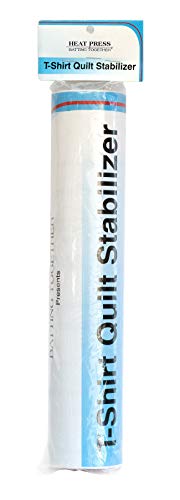
Stabilizer Types at a Glance
| Type | Best for | Stated character | Limits |
|---|---|---|---|
| Fusible woven-type interfacing (for example Pellon SF101 Shape-Flex) | Most shirts, first-time quilters | The maker describes it as a lightweight, 100 percent cotton-based fusible | Adds some firmness; pre-washing needs follow the label |
| Fusible knit interfacing (for example Pellon Easy-Knit) | Softer drape, stretchy shirts | The maker lists it as a stretch-with-grain interfacing for knits | Can still allow some give; cut it with the stretch direction in mind |
| Featherweight fusible (for example Pellon 911FF) | Thin shirts, low bulk | The maker lists it as a very light, non-woven fusible | Less stability on heavy or very stretchy shirts |
| Medium-weight fusible non-woven | Heavy sweatshirt-weight blocks | Firmer, more body | Stiff quilt feel if used on every block |
| Sew-in or tear-away stabilizer | Shirts with prints that cannot take heat | No iron needed | More work, can shift during sewing |
| Fusible batting-style or fleece | Cozy, thick quilts | Adds loft | Bulk at seams, harder to quilt |
How to Choose by Shirt Type
Thin, stretchy cotton jersey
Lightweight fusible knit or a woven-type interfacing keeps the shirt from rippling. Reviewers and quilting teachers generally advise a stabilizer that matches the shirt’s weight: heavy interfacing on thin cotton can make the block feel stiff and the shirt print crack over time.
Mid-weight cotton T-shirts
This is the usual case. A fusible woven-type interfacing is the most common recommendation, since it adds stability without too much bulk, and it works with standard quilting cotton sashing.
Polyester and performance shirts
Athletic shirts are slippery and often sensitive to heat. Follow the interfacing label for iron temperature, test on a scrap, and consider a lower-heat fusible or a sew-in stabilizer. Some shirts have prints that melt or shine under a hot iron; a pressing cloth is advised in most fusing instructions.
Sweatshirts and hoodies
Thick fleece-backed fabrics usually do not need heavy stabilizer. Many makers suggest a light fusible just to control stretch, because adding firm interfacing makes the blocks too thick to quilt comfortably.
Shirts with large screen prints
Plastic-like prints can crack or blister when fused with high heat. Place the stabilizer on the reverse side, press from the back, and lift and press instead of sliding the iron. If the label does not list a safe temperature for the print, test on a scrap or off-block area first.
Fusible vs Sew-In
Fusible stabilizers are the standard for T-shirt quilts because they bond to the whole back of the shirt and stop edge distortion before cutting. Sew-in options are used when heat damages the shirt or when the maker prefers to avoid adhesive. They are generally harder to handle because they can shift during sewing and do not control stretch across the whole block as evenly. If you pick sew-in, baste the stabilizer to the shirt around the edges.
Fit, Sizing and Cutting Notes
- Check the roll or bolt width when planning; interfacing is commonly sold in widths such as 20 or 45 inches, so confirm the width on the package.
- Cut stabilizer slightly larger than the block, fuse it, then trim to final size so edges stay crisp.
- Press with the iron in a lifting-and-pressing motion rather than sliding, to keep the knit from stretching.
- Match grain: place the stabilizer so its stable direction runs with the shirt’s most stretchy direction, following the maker’s instructions.
- For a typical blanket, plan for stabilizer on every block plus a small extra amount for mistakes.
- If you wash shirts before fusing, avoid fabric softener or dryer sheets, which can reduce adhesive bonding.
Care and Safety Notes
Always read the instructions on the interfacing label for iron temperature, steam use and cooling time. Allow fused blocks to cool flat before handling. Keep irons away from children and unplug after use. After the quilt is finished, wash according to the interfacing and batting labels, typically gentle cycle and low heat. Repeated high-heat drying can weaken adhesive bonds, so air-drying or low heat is often advised. If an iron cord is frayed or the iron sputters, stop using it and have it repaired or replaced rather than continuing.
Budget, Mid-Range and Premium Tiers
Budget
Generic fusible interfacing from fabric-store bolts is the lowest-cost route. Quality varies; some bonds weaken after washing or leave bubbles. If you choose budget stock, test a scrap shirt first and wash it once to see whether the bond holds.
Mid-range
Branded interfacing from established makers such as Pellon is the typical mid-range choice, with clear labels that list weight, fiber and care. For most T-shirt quilts, this tier gives the best balance of cost and bonding reliability.
Premium
Premium choices are usually specialty knit stabilizers or higher-quality professional-grade fusibles. They may offer softer hand and better stretch control, but for a first quilt the mid-range option is usually enough.
Pick X If… Decision Table
| Pick this if | Choose | Why |
|---|---|---|
| This is your first T-shirt quilt | Fusible woven-type interfacing | Predictable, widely used and easy to find |
| You want a soft, drapey blanket | Fusible knit interfacing | Keeps flexibility while controlling stretch |
| Your shirts are very thin | Featherweight fusible | Minimum added weight |
| You are using sweatshirts | Light fusible or none | Avoids too much bulk |
| Prints are heat sensitive | Sew-in or low-heat option | No melting risk |
| You want a cozy thick quilt | Light fusible plus fleece backing | Warmth without stiff blocks |
Alternatives and Companion Supplies
- Lightweight sashing fabric: Quilting cotton between shirt blocks adds stability and lets mismatched shirt sizes fit together.
- Press cloth and fresh iron: Protects prints and keeps adhesive from transferring to the soleplate.
- Rotary cutter, ruler and mat: Clean, accurate cuts are easier on stabilized knit than on unstabilized jersey.
- Walking foot: Helps feed layers evenly when sewing knit and cotton together.
Step-by-Step Planning Tips
Start by sorting shirts by weight and stretch, then group similar shirts so the same stabilizer suits each group. Decide the finished block size first, commonly a square sized to fit the largest design, and cut stabilizer a little over that size. Fuse each block, let it cool flat, then trim. Many instructors suggest laying out the blocks on a floor or bed before sewing so you can balance colors and logos. Press seams open or to one side consistently, and use a walking foot to keep layers feeding evenly. When in doubt, make one test block from your thinnest shirt: if it stays flat after fusing, washing and drying once, the same stabilizer should hold up for the rest of the quilt. Keep the spare off-cuts for patching or for testing iron temperature on unusual prints.
Frequently Asked Questions
Do I really need stabilizer for a T-shirt quilt?
Most makers advise it because jersey knit stretches and curls, which makes blocks uneven. A stabilizer keeps squares accurate and seams straight. A few thick or non-stretch shirts can work without it, but testing on one block is the best way to find out.
Should I wash T-shirts before fusing interfacing?
Washing removes factory finishes and pre-shrinks the shirt, which many quilting guides recommend. Skip fabric softener and dryer sheets, which can interfere with the adhesive. Follow the interfacing label for any pre-washing instructions of its own.
Will fusible stabilizer make the quilt stiff?
Heavier products can. Lightweight and featherweight fusibles keep the quilt softer, and washing generally relaxes it slightly. If softness is a priority, choose the lightest weight that still stops the shirt from stretching.
What if the shirt print is rubbery or plastic?
Press from the back with a lower heat setting and a pressing cloth, and test on a scrap first. If the label does not state a safe temperature, a sew-in stabilizer can avoid heat contact altogether.
How do I stop stabilizer from peeling after washing?
Press firmly for the time listed on the label, let the block cool, and wash on a gentle cycle with low heat. Peeling usually results from too little heat, too little pressing time or residual softener on the fabric.
Can I use fusible batting instead of interfacing?
You can, but it adds thickness at the seams and can make quilting harder. Most makers use a thin interfacing on each block and a separate batting layer in the quilt sandwich for warmth.
More from Amazon
Programs that pair well with the guide above. Offers and eligibility are set by Amazon and may change.
Collect the home and kitchen items you want in one registry that guests can shop from.
Create a wedding registrySet up recurring deliveries of everyday items on eligible products. Terms and savings are set by Amazon.
Explore Subscribe & SaveFree shipping on eligible items, Prime Video and more. Eligible new members can start with a free trial.
Start a Prime free trialAudiobooks and podcasts to listen to on the go. Eligible new members can start with a free trial.
Try Audible freeAs an Amazon Associate we earn from qualifying purchases.