Choosing a living room floor lamp vs alternatives depends on how you use the space. This comparison weighs floor lamps against table lamps, wall sconces, ceiling fixtures, and LED strips for brightness, flexibility, installation, cost, and clutter, helping you build a comfortable lighting plan without buying the wrong type of fixture.
Living Room Floor Lamp vs Alternatives: Quick Comparison
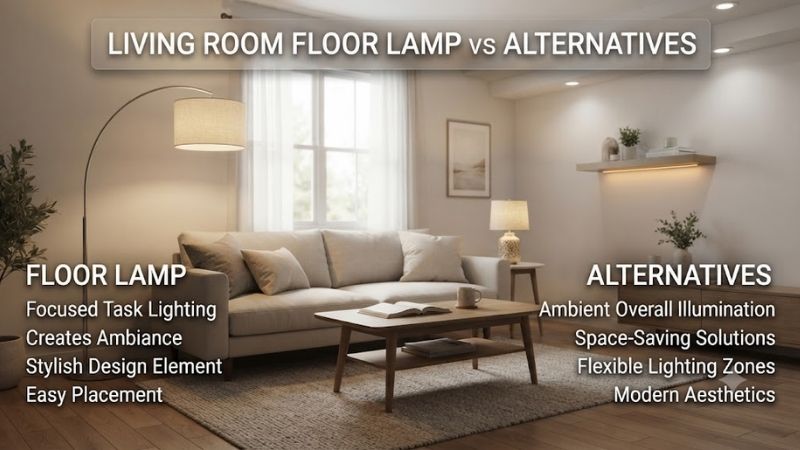
A floor lamp is one of several ways to improve living-room lighting. Its main advantages are placement flexibility, straightforward installation, and the ability to introduce light without occupying a table.
However, other fixtures may provide better illumination, use less floor space, or integrate more naturally into the room.
| Lighting Type | Primary Advantage | Main Limitation | Best Use |
|---|---|---|---|
| Floor lamp | Flexible positioning | Uses floor space | Reading and supplemental lighting |
| Table lamp | Convenient local lighting | Requires furniture surface | Side tables and consoles |
| Wall sconce | Preserves floor space | May require installation | Narrow rooms and accent lighting |
| Ceiling light | Broad general coverage | Less flexible placement | Main ambient lighting |
| Pendant light | Decorative overhead illumination | Requires clearance | Defined seating areas |
| LED strip | Concealed accent lighting | Limited direct task function | Media walls and shelves |
There is no universally superior option. The most effective arrangement may combine two or more lighting types.
Floor Lamp vs. Table Lamp
Floor lamps and table lamps are often used for similar purposes, but their placement requirements differ.
Space and Furniture Requirements
A floor lamp stands independently and does not require a side table or console.
This can be useful when a living room has limited furniture surface area.
A table lamp needs a stable supporting surface but may occupy less floor area when the table already exists.
For example, a homeowner with a side table beside the sofa may find a table lamp more convenient than introducing another floor-standing object.
In contrast, someone with a narrow seating arrangement and no room for a side table may benefit from a slim floor lamp.
Lighting Performance
Both types can provide ambient or task lighting depending on shade design, bulb output, and position.
A floor lamp can place the light source higher in the room, potentially improving general distribution.
A table lamp often positions light closer to seated users, which can be convenient for reading or conversation.
However, the lamp’s height alone does not determine usefulness.
A well-positioned table lamp may provide better reading illumination than a poorly placed floor lamp.
Safety and Stability
A table lamp depends on the stability of its supporting furniture.
A floor lamp depends on its base and floor placement.
Both can create hazards if cords are routed poorly or fixtures are placed where they may be knocked over.
Households with children or pets should evaluate the complete arrangement rather than assuming one type is automatically safer.
Choose a floor lamp when: You need flexible lighting without adding furniture.
Choose a table lamp when: A suitable side table already exists and local illumination is the priority.
Floor Lamp vs. Wall Sconce
Wall sconces provide lighting from a wall-mounted position, allowing the floor to remain clear.
This can be particularly attractive in narrow rooms.
Space Efficiency
A wall sconce can preserve floor space beside a sofa or along a circulation route.
It may also eliminate the need for a large table lamp.
However, its mounting position is less flexible.
Once installed, relocating a hardwired sconce usually requires additional electrical work.
A floor lamp can be moved when furniture arrangements change.
Installation Requirements
Plug-in wall sconces may require only suitable mounting hardware and access to an outlet.
Hardwired sconces generally require electrical installation appropriate to local codes and the fixture’s instructions.
The installation process can make wall sconces less convenient for renters or homeowners who frequently rearrange furniture.
A floor lamp usually requires much less setup.
Lighting Direction
Wall sconces can provide upward, downward, or diffused illumination.
They are useful beside sofas, along walls, or near decorative features.
However, fixed sconces may be poorly positioned if the furniture layout changes.
Adjustable wall-mounted reading lamps offer more control, but they still require a suitable installation location.
Choose a floor lamp when: Flexibility and minimal installation are priorities.
Choose a wall sconce when: Floor space is limited and the lighting position will remain relatively permanent.
Floor Lamp vs. Ceiling Light
Ceiling lights and floor lamps often serve different roles rather than competing directly.
A ceiling fixture is commonly responsible for general illumination, while a floor lamp supplements that light.
Whole-Room Coverage
A centrally positioned ceiling fixture can distribute light across a substantial area.
This makes it useful for everyday activities, cleaning, and safe movement.
A floor lamp usually provides more localized illumination unless it has sufficient brightness and favorable light distribution.
A strong torchiere may contribute significant ambient light, but the result depends on ceiling reflectance and room geometry.
In a large room, ceiling lighting is often the more practical primary source.
Control Over Lighting Atmosphere
A single bright ceiling light can make a living room feel uniformly illuminated.
That may be useful for cleaning or activities requiring visibility, but less desirable during movies or relaxed evenings.
A floor lamp introduces light from another position, allowing more control over the room’s appearance.
For example, a warm shaded floor lamp beside a sofa can create a softer evening atmosphere while the ceiling fixture remains off.
Installation and Flexibility
Installing or replacing a hardwired ceiling fixture may require qualified electrical work.
A floor lamp generally needs only assembly and a suitable outlet.
This difference is important for renters who cannot modify existing wiring.
However, floor lamps still require safe cord placement and adequate floor clearance.
Choose a floor lamp when: You want flexible supplemental or atmospheric lighting.
Choose a ceiling light when: Broad general illumination is the main requirement.
Floor Lamp vs. Pendant Light
Pendant lights hang from the ceiling and are often used as decorative focal points.
They can provide light over a table or defined seating area without placing a base on the floor.
Design and Visual Impact
A pendant can create a strong visual feature above a coffee table or seating arrangement.
Because it hangs overhead, it may make the lighting feel integrated into the architecture.
A floor lamp creates a different effect by adding a vertical decorative element near furniture.
Both can contribute to room design, but their visual presence differs.
Placement and Clearance
Pendant lights require appropriate ceiling support and sufficient clearance above furniture and circulation areas.
A poorly positioned pendant may obstruct sightlines or create uncomfortable glare.
A floor lamp can be repositioned more easily when the room layout changes.
Cost and Maintenance
A pendant may involve installation expenses in addition to the fixture price.
A floor lamp generally avoids hardwiring costs.
However, floor lamps can occupy valuable floor space, especially when fitted with broad bases or long projecting arms.
Choose a floor lamp when: Furniture flexibility and easy installation matter most.
Choose a pendant when: A permanent overhead focal point is desirable.
Floor Lamp vs. LED Strip Lighting
LED strips are popular for television areas, shelving, and decorative room lighting.
However, their purpose differs significantly from that of most floor lamps.
Accent Lighting vs. Functional Lighting
An LED strip behind a television can add a soft glow around the display.
Indirect backlighting may help balance the visual contrast between a bright screen and dark surroundings.
A floor lamp can perform a similar atmospheric function, but it may also provide useful reading or general illumination.
Many decorative LED strips are not intended to replace task lighting.
Their practical brightness depends on output, mounting, diffusion, and the surfaces reflecting the light.
Installation and Appearance
LED strips can be concealed behind furniture or architectural features.
This helps preserve floor and table space.
However, installation may require cable routing, cleaning the mounting surface, attaching profiles or diffusers, and selecting an appropriate power supply.
Exposed LED strips can create visible points of light or uneven illumination.
A floor lamp may be easier to move and maintain.
Smart Features
Some LED strips offer app control, color changes, and scheduling.
Smart floor lamps can provide similar features.
However, the presence of RGB lighting does not guarantee useful white-light performance.
For everyday visibility, compare actual light output and color quality rather than focusing exclusively on decorative effects.
Choose a floor lamp when: Functional illumination and easy relocation are priorities.
Choose LED strips when: Concealed accent lighting is the main goal.
Comparing Brightness and Light Distribution
Direct vs. Indirect Light
Direct lighting sends illumination toward a particular surface.
Reading lamps and adjustable wall fixtures commonly use this approach.
Indirect lighting relies on reflection from ceilings or walls.
Torchieres, certain sconces, and concealed LED installations may produce indirect illumination.
Neither is inherently better.
Direct lighting can be more useful for tasks, while indirect lighting often creates a softer general appearance.
Why Lumens Are Not Enough
Lumens measure total visible light output.
However, two fixtures with identical lumen ratings may illuminate the room differently.
A directional lamp concentrates light within a smaller region.
A diffused lamp spreads its output more broadly.
A ceiling fixture may distribute light across the entire room, while a reading lamp focuses it near a chair.
Choose the distribution required by the activity.
Glare and Visual Comfort
An exposed bright bulb can create uncomfortable glare regardless of its fixture type.
Shades, diffusers, and careful positioning help control this problem.
For television areas, avoid placing bright lamps where they reflect directly in the screen.
For reading, position the light so the page is illuminated without exposing the bulb to the user’s direct view.
Which Lighting Option Saves the Most Space?
In a compact living room, every piece of furniture competes for usable space.
A wall sconce or ceiling light uses no floor area, making either attractive when walking clearance is limited.
A table lamp occupies an existing surface but may not require additional furniture.
A slim floor lamp uses some floor space but provides flexibility that fixed lighting cannot match.
LED strips can be concealed, although their lighting function may be more limited.
Best for Narrow Living Rooms
Wall-mounted lighting may offer the greatest spatial efficiency.
However, a narrow floor lamp can be suitable when wall installation is not permitted.
Avoid wide tripod bases or projecting arc arms in tight walkways.
Best for Studio Apartments
A dual-head floor lamp can be useful because it combines ambient and reading illumination.
This may reduce the need for multiple fixtures.
However, when the apartment already has adequate overhead lighting, a compact reading lamp may be a better choice.
Best for Large Open-Plan Spaces
Larger rooms typically benefit from multiple lighting sources.
Ceiling fixtures can provide general illumination, while floor and table lamps serve individual seating areas.
This layered arrangement provides greater flexibility than relying on one bright fixture.
Floor Lamp vs. Alternatives: Installation and Ownership Costs
Initial Purchase Costs
Basic floor lamps and table lamps can be relatively affordable.
Wall sconces and pendant lights may involve additional installation costs, particularly when new electrical wiring is required.
Ceiling-light upgrades can also require professional work.
However, premium floor lamps may cost more than simple wall fixtures.
Compare the complete project rather than assuming one lighting category is always cheaper.
Electricity Consumption
Electricity use depends on the wattage and duration of operation, not simply the type of fixture.
An efficient LED floor lamp and an efficient LED ceiling light may have similar electricity costs when operating at comparable power levels.
A larger lighting installation may consume more electricity if several fixtures are used simultaneously.
Dimming and appropriate lighting controls can reduce unnecessary operation.
Maintenance and Replacement
Fixtures using replaceable LED bulbs are often straightforward to maintain.
Integrated LED systems may require specialized components if the light source or driver fails.
LED strips may require replacement of a power supply, controller, or strip section.
Hardwired fixtures may involve more complicated access or repair.
Long-term maintenance should therefore influence the buying decision.
Which Lighting Type Is Best for Different Households?
Renters
Floor lamps and table lamps are often convenient because they generally require no permanent electrical modifications.
Plug-in wall sconces may also be suitable where mounting is permitted.
Hardwired changes should be discussed with the property owner.
Families With Young Children
Stability, cord management, and safe placement are important.
Wall-mounted or ceiling fixtures may reduce floor obstacles, but installation and fixture suitability still matter.
Floor lamps should be positioned away from high-activity areas and secured only according to manufacturer guidance.
People Who Read Frequently
Adjustable task lighting is usually beneficial.
A floor reading lamp, table lamp, or adjustable wall-mounted fixture can work well when positioned correctly.
The most important factors are usable illumination, glare control, and comfortable adjustment.
Homeowners Who Rearrange Furniture
Floor lamps provide valuable flexibility.
They can move with the seating arrangement without requiring electrical modifications.
Fixed wall and ceiling lighting may become less useful when furniture positions change substantially.
Home Theater Enthusiasts
Indirect lighting can help create a comfortable television environment.
Dimmed floor lamps, wall sconces, or concealed LED strips may all work.
Avoid light sources that produce distracting screen reflections.
Common Mistakes When Comparing Lighting Options
Choosing Based Only on Appearance
A decorative lamp may look attractive but fail to serve the required lighting function.
Identify the purpose of the light before comparing styles.
Assuming Ceiling Lights Are Always Better
Ceiling fixtures can provide broad illumination, but they are not always ideal for relaxed evening lighting or concentrated tasks.
Supplemental lighting may improve comfort.
Assuming Floor Lamps Cannot Light a Room
A powerful uplighter can contribute substantial general illumination.
However, the result depends on room size and surface reflectance.
Ignoring Installation Requirements
Hardwired fixtures may involve more cost and preparation than plug-in alternatives.
Consider installation before committing to a design.
Overlooking Long-Term Maintenance
An attractive integrated LED fixture may be difficult to repair.
Check light-source replacement options and product support before buying.
Frequently Asked Questions
Are Floor Lamps Better Than Table Lamps?
Floor lamps are useful when table space is limited or light needs to be positioned higher. Table lamps can be more convenient when suitable furniture already exists. Neither is universally better.
Is a Floor Lamp Better Than a Ceiling Light?
A ceiling light generally provides broader room coverage, while a floor lamp offers more flexible placement and atmosphere. Many living rooms benefit from both.
Do Wall Sconces Save More Space Than Floor Lamps?
Yes, wall sconces generally preserve floor space. However, they may require mounting or electrical work and are less convenient to relocate.
Can LED Strips Replace a Living Room Floor Lamp?
LED strips can provide decorative accent lighting, but many do not offer sufficient practical illumination for reading or general activities.
What Is the Best Lighting for a Small Living Room?
A combination of general ambient lighting and focused task lighting is often effective. A slim floor lamp can provide a flexible solution when installing additional fixtures is impractical.
Are Floor Lamps Cheaper Than Wall or Ceiling Lighting?
They can be less expensive to install because many require no hardwiring. However, purchase prices vary widely, and some premium floor lamps cost more than basic fixed fixtures.
Is Layered Lighting Better Than One Bright Light?
Layered lighting often provides greater flexibility by allowing different fixtures to support different activities. It can improve atmosphere and functional illumination without making the entire room equally bright.
Conclusion
When comparing a living room floor lamp vs alternatives, the best solution depends on available space, lighting requirements, installation flexibility, and maintenance. Floor lamps offer easy relocation and versatile supplemental light, while wall sconces preserve floor space and ceiling fixtures provide broad illumination. Table lamps and LED strips can serve useful local or decorative roles. A combination of lighting types often creates the most comfortable and adaptable living room.