This living room floor lamp buying guide explains how to match a fixture to your room and daily routine. Learn the difference between ambient, task, and accent lighting; compare lumens and color temperature; and check base stability, placement, bulb replacement, and dimming before spending money on a lamp that may not fit your needs.
Why Choosing the Right Floor Lamp Matters
A floor lamp can change how a living room looks and functions without requiring permanent electrical work. It can brighten a dark corner, provide focused light for reading, or create comfortable evening illumination.
However, many buying decisions focus too heavily on appearance.
A stylish lamp may produce insufficient light for its intended purpose. A very bright lamp may create uncomfortable glare, while a wide base can interfere with furniture placement.
The ideal fixture must balance light distribution, brightness, physical dimensions, safety, and long-term ownership.
Understanding these factors before shopping helps prevent expensive mistakes.

Understand the Three Main Types of Lighting
Ambient Lighting
Ambient lighting provides general illumination throughout a room.
Floor lamps commonly contribute ambient light through upward-facing reflectors or diffusing shades.
A torchiere is a typical example. It directs light toward the ceiling, where it reflects into the surrounding space.
This approach can produce comfortable indirect illumination, especially with light-colored ceilings.
However, the result depends on room geometry and surface reflectance.
A single uplighter may be sufficient for supplementary lighting in a small living room but inadequate as the only source in a large space.
Task Lighting
Task lighting provides concentrated illumination for specific activities.
Reading lamps, adjustable metal-shade fixtures, and certain arc lamps serve this purpose.
The goal is to direct enough light toward the task while avoiding uncomfortable glare.
A person reading on a sofa may benefit from an adjustable lamp located beside or slightly behind the seating position.
However, the exact position should be evaluated while sitting normally.
A lamp that looks correctly placed from across the room may shine directly into the user’s eyes.
Accent Lighting
Accent lighting emphasizes decorative elements or creates atmosphere.
A floor lamp may illuminate artwork, highlight a textured wall, or add a soft glow to an otherwise dark corner.
Decorative LED corner lamps often serve this function.
However, accent lighting is not necessarily suitable for reading or general activities.
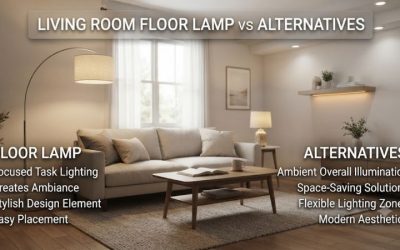
A well-designed living room may benefit from combining multiple lighting layers rather than expecting one fixture to perform every role.
Compare the Main Floor Lamp Styles
| Lamp Style | Main Purpose | Strength | Limitation |
|---|---|---|---|
| Torchiere | Ambient lighting | Wide indirect distribution | Limited task focus |
| Arc lamp | Overhead-style lighting | Reaches over furniture | Requires horizontal clearance |
| Tripod lamp | Decorative ambient lighting | Strong visual presence | Broad footprint |
| Adjustable reading lamp | Task lighting | Precise direction | Narrow coverage |
| Shaded traditional lamp | Soft ambient light | Diffused illumination | Limited adjustment |
| Dual-head lamp | Multipurpose lighting | Ambient and task functions | More visual complexity |
| Smart corner lamp | Decorative effects | Compact profile | Variable functional brightness |
Torchiere Floor Lamps
Torchieres direct light upward.
They can be useful when a room lacks an effective overhead light because reflected light helps illuminate a broader area.
A dimmable LED torchiere can provide flexibility between brighter everyday use and softer evening lighting.
However, high brightness is not automatically beneficial.
In a room with a low reflective ceiling, an uplighter can be effective. In a space with high ceilings or dark finishes, more of its light may be absorbed or distributed away from useful surfaces.
Choose a torchiere primarily for ambient illumination.
Arc Floor Lamps
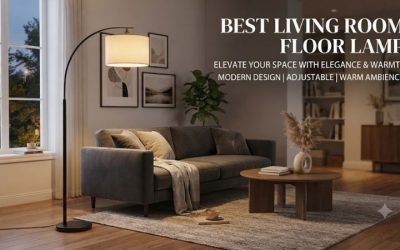
Arc lamps extend a curved or angled arm over a seating area or table.
They can provide the visual effect of an overhead light without ceiling installation.
This makes them attractive above sectional sofas or in rooms where a pendant fixture cannot be installed.
However, the arm requires horizontal clearance, and the base must counterbalance the extended structure.
Measure the complete reach of the lamp, not merely the base diameter.
In homes with children or energetic pets, stability deserves particular attention.
Tripod Floor Lamps
Tripod lamps use three supporting legs, often creating a decorative architectural appearance.
They complement Scandinavian, mid-century, and contemporary interiors.
A fabric shade can soften the light and produce a pleasant atmosphere.
However, tripod bases consume more floor space than many straight upright lamps.
They may also be inconvenient near narrow walkways.
Choose a tripod lamp when there is enough room to appreciate its structure without interfering with movement.
Adjustable Reading Lamps
Adjustable floor lamps are especially useful beside sofas and armchairs.
They allow the light source to be repositioned for reading or other activities.
Some designs use movable arms, while others allow only the shade to rotate.
Before buying, check whether the adjustment range actually reaches the intended reading position.
A lamp with limited movement may not be suitable for a deep sofa or recliner.
Dual-Head Floor Lamps
Dual-head lamps combine general and focused lighting functions.
An upper light may illuminate the ceiling while a secondary head directs light toward a chair.
This can be an efficient arrangement when floor space is limited.
However, the design is often more functional than decorative.
Check whether the heads operate independently and how their brightness is controlled.
How Bright Should a Living Room Floor Lamp Be?
Understanding Lumens
Lumens measure the amount of visible light emitted by a source.
Higher lumen output generally indicates more light, but it does not guarantee that the light reaches the intended surface.
For instance, an 800-lumen bulb in a directional reading lamp may illuminate a book effectively.
A much brighter uplighter may spread its output throughout the room without providing the same focused reading illumination.
This is why light direction matters alongside brightness.
Lumens vs. Watts
Watts measure electrical power consumption.
Traditional incandescent bulbs required relatively high wattage to produce substantial light.
Modern LEDs can achieve similar outputs with much lower power requirements.
For example, an LED bulb producing approximately 800 lumens commonly consumes far less electricity than a traditional 60-watt incandescent bulb.
When comparing lamps, prioritize lumen output and lighting purpose rather than advertised wattage alone.
Brightness for Different Activities
| Activity | Lighting Priority | Suitable Approach |
|---|---|---|
| Watching television | Low glare and contrast balance | Dimmed indirect lighting |
| Reading | Useful illumination on the page | Adjustable task lamp |
| Conversation | Comfortable general visibility | Shaded or indirect ambient light |
| Cleaning | Broader, brighter illumination | Strong ambient lighting |
| Relaxing | Softer light | Warm dimmable lamp |
| Crafting | Focused visibility | Adjustable directional fixture |
These are functional recommendations rather than fixed lumen requirements. Room size, age-related visual needs, and other light sources all affect the necessary brightness.
How Color Temperature Affects Your Living Room
2700K: Warm and Relaxed
Light around 2700K has a warm appearance commonly associated with residential lighting.
It complements wood furniture, fabric upholstery, and relaxed evening settings.
This makes it a popular starting point for lamps used near sofas and conversation areas.
However, color preference is subjective, and some people prefer a slightly less warm appearance.
3000K: Warm but Slightly Cleaner
Light around 3000K remains warm while often appearing a little less yellow than 2700K.
It can be a versatile choice for living rooms used for several activities.
A 3000K floor lamp may provide a comfortable balance between decorative atmosphere and everyday visibility.
The exact perceived appearance depends on the shade, surrounding colors, and other lighting.
4000K: Neutral-White Lighting
Light around 4000K is commonly described as neutral white.
It may be useful in a living room that also serves as a home office or workspace.
However, some homeowners find neutral-white lighting less relaxing during the evening.
A color-adjustable lamp can provide flexibility when the room supports both work and leisure.
Why Color Rendering Matters
Color Rendering Index, or CRI, describes how accurately a light source renders colors compared with a reference source under defined conditions.
A lamp with good color rendering may make furniture, artwork, and textiles appear more natural.
CRI 80 is common among residential LED products, while CRI 90 or higher can be desirable where color appearance matters.
However, CRI is not a complete description of light quality. Glare, distribution, spectral characteristics, and fixture design also affect visual comfort.
Integrated LED vs. Replaceable Bulb Floor Lamps
Advantages of Integrated LEDs
Integrated LED fixtures can support compact designs, dedicated dimming systems, and efficient light distribution.
They may also reduce the need to purchase bulbs separately.
Some models provide smart controls or adjustable color temperature.
However, when an integrated light source fails, the repair process may be more complicated.
Buyers should check whether replacement LED modules, drivers, or service parts are available.
Advantages of Replaceable Bulbs
A replaceable-bulb floor lamp offers flexibility.
Homeowners can select compatible bulbs with different brightness levels, color temperatures, or smart features.
When the bulb reaches the end of its service life, replacement is generally straightforward.
This can be attractive to buyers who value long-term maintainability.
However, the bulb must match the fixture’s socket, maximum wattage, physical clearance, and dimmer compatibility.
Which Is Better for Long-Term Ownership?
Neither design is universally superior.
Integrated LEDs may provide specialized lighting features and streamlined construction.
Replaceable-bulb lamps typically offer more flexibility when changing or replacing the light source.
For a simple decorative living room lamp, a replaceable-bulb model may be the more practical choice.
For advanced dimming or specialized light effects, integrated LEDs may offer advantages.
Choosing the Right Floor Lamp Height and Size
Height Should Match the Lamp’s Function
The ideal height depends on light direction and surrounding furniture.
An uplighter may work well above seated eye level because it directs light upward.
A reading lamp needs its beam positioned toward the reading material.
A decorative fabric-shaded lamp should provide comfortable illumination without exposing the bulb directly to seated users.
Avoid treating one height measurement as suitable for every design.
Base Width Affects Placement
A broad tripod or arc-lamp base may occupy more room than expected.
Before buying, measure the available floor area next to the sofa and compare it with the complete fixture footprint.
Remember that shades and arms may project beyond the base.
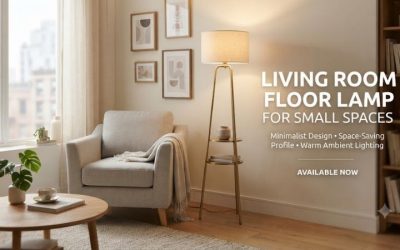
A narrow base is especially valuable in apartments and compact living rooms.
Shade Shape Changes Light Distribution
An opaque metal shade concentrates light in specific directions.
A fabric shade allows more light to diffuse through its surface.
A translucent glass shade may produce a broader decorative glow.
The shade’s shape and opacity can therefore influence the usefulness of the lamp as much as the bulb itself.
Floor Lamp Stability and Safety
Choose a Stable Base
Floor lamps should stand securely on a level surface.
A weighted base may improve stability, but this alone does not guarantee protection against tipping.
Check assembly instructions and avoid placing fixtures where they may be struck by moving furniture.
For homes with children or pets, consider models with appropriately stable construction and manufacturer-approved securing options.
Check Electrical Certification
Choose lighting products intended for the U.S. electrical market.
Look for appropriate safety certification by a recognized testing organization, such as UL or ETL, where applicable.
Use the correct power supply and follow all manufacturer instructions.
Protect Power Cords
Keep ordinary lamp cords outside walking routes.
Avoid placing cords beneath area rugs, pinching them against furniture, or using damaged plugs.
Do not overload outlets or adapters.
If outlet placement is inconvenient, reconsider the lamp’s location rather than creating unsafe cable routing.
Maintain Clearance From Flammable Materials
Follow the manufacturer’s guidance regarding distance from curtains and other nearby materials.
Use only bulbs that meet the fixture’s electrical and thermal limitations.
LEDs generally produce less waste heat than incandescent bulbs of comparable brightness, but fixtures still require appropriate installation and ventilation.
Floor Lamp Materials: Metal, Wood, and Glass
Metal Floor Lamps
Metal frames can support slim structures and adjustable mechanisms.
They are commonly used in modern reading lamps and torchieres.
However, quality depends on joint construction, base design, and finish durability rather than material alone.
Wooden Floor Lamps
Wood adds visual warmth and complements many residential interiors.
Wooden tripod lamps are popular in Scandinavian and mid-century-inspired rooms.
However, their wider base may be less suitable for compact spaces.
Glass Floor Lamps
Glass shades offer attractive diffusion and decorative possibilities.
They may work well in traditional or contemporary rooms.
However, glass requires careful handling, and heavier shades can affect the lamp’s weight distribution.
How to Match a Floor Lamp to Your Living Room Layout
Beside a Sofa
A floor lamp beside a sofa can provide either decorative or functional lighting.
For reading, choose an adjustable head that directs light toward the seated user.
For atmosphere, a shaded lamp or indirect uplighter may be preferable.
Leave enough clearance for people to sit, stand, and move comfortably.
Behind a Sectional
A narrow upright lamp can work behind a sectional if the arrangement permits safe access.
An arc lamp may also reach over the sofa, but its base must remain secure and its arm must not obstruct movement.
Check clearance with reclining seats or other moving furniture.
In a Dark Corner
A torchiere or diffused decorative lamp can make a dark corner feel more connected to the rest of the room.
Indirect light often works well when the wall and ceiling can reflect illumination.
If the corner has dark finishes, the effect may be weaker.
Next to a Reading Chair
An adjustable task lamp is generally the most effective option.
Position the beam toward the book or activity and verify that the bulb is not directly visible.
The ideal placement depends on the chair height, reading position, and individual preferences.
Common Floor Lamp Buying Mistakes
Choosing Style Before Lighting Function
A decorative fixture may look attractive but fail to deliver sufficient usable light.
Decide whether ambient, task, or accent lighting is the primary purpose before comparing designs.
Ignoring the Full Fixture Dimensions
Lamp height and base diameter do not tell the whole story.
Measure the shade, arm reach, and surrounding clearance.
Assuming More Lumens Always Means Better Light
More light can create glare or unnecessary brightness.
Proper distribution and adjustable intensity are often more valuable than maximum output alone.
Overlooking Bulb and Dimmer Compatibility
Not every LED bulb works correctly with every dimmer.
Check the fixture and bulb specifications to avoid flickering or poor dimming performance.
Neglecting Long-Term Maintenance
Consider how the light source, controls, and other components will be serviced.
A low initial price may be less attractive if a failed integrated light source requires replacing the entire fixture.
Frequently Asked Questions
What Should I Look for When Buying a Living Room Floor Lamp?
Consider lighting purpose, brightness, color temperature, stability, base dimensions, bulb compatibility, and maintenance. The best choice should match the room’s layout and daily activities.
How Tall Should a Living Room Floor Lamp Be?
There is no universal height. Uplighters, reading lamps, and decorative lamps have different positioning requirements. Compare the fixture with nearby furniture and intended lighting direction.
How Many Lumens Do I Need?
The appropriate output depends on the lamp’s role, room size, available daylight, and other lighting. Compare light distribution rather than relying exclusively on total lumens.
Is a Dimmable Floor Lamp Worth It?
Dimming is useful when the same room supports reading, television viewing, and relaxation. However, it is less important for a lamp used consistently for one purpose.
Are LED Floor Lamps Expensive to Run?
LEDs generally use relatively little electricity for the amount of light produced. Actual operating cost depends on wattage, daily use, and local electricity rates.
Are Arc Lamps Suitable for Small Living Rooms?
They can be, but only when their bases and projecting arms fit without blocking furniture or circulation.
Conclusion
A living room floor lamp buying guide should help you choose a fixture that delivers the right illumination, fits the furniture layout, and remains practical to maintain. Start with the lighting function, then compare lumens, color temperature, shade design, stability, and bulb replacement. A well-matched floor lamp can improve comfort and functionality without unnecessary features or expense.