A washable area rug buying guide should address what a product label cannot: whether the rug fits your washer, stays secure under furniture, and survives your cleaning routine. Learn how to compare rug construction, fabric, sizing, pads, stain care, and long-term ownership costs before choosing a practical living room rug.
What Is a Washable Area Rug?
A washable area rug is designed to tolerate a specified cleaning process without requiring the same level of specialized maintenance as many conventional carpets. Depending on the product, that process may involve machine washing, hand washing, or removal of a washable cover.
The important distinction is that washable does not mean every rug can be placed in any washing machine.
Construction, size, backing, pile thickness, and fiber composition determine how a rug should be cleaned. Some models feature lightweight synthetic fabric with integrated backing, while others separate the decorative cover from a supporting pad.
These differences affect convenience, comfort, drying time, and total ownership cost.
Machine-Washable vs. Hand-Washable Rugs
Machine-washable rugs are designed for laundering in suitable washing machines according to the manufacturer’s instructions. This can make them convenient for households that frequently encounter spills.
Hand-washable rugs may tolerate water and mild cleaning products but require a more labor-intensive process. Larger hand-washable rugs can be difficult to clean thoroughly and may require substantial space to dry.
A rug advertised as washable should therefore be evaluated by its actual cleaning requirements, not the marketing label alone.
For most households specifically seeking easy maintenance, machine-washable construction is preferable when compatible laundry equipment is available.
Why Construction Matters
Traditional rugs may incorporate thick backing, heavy yarns, adhesives, or materials that respond poorly to complete immersion.
Washable rugs commonly use lighter construction or components engineered to tolerate repeated laundering.
However, reducing weight and thickness can change how the rug feels underfoot. Some washable designs are less cushioned than conventional woven or tufted carpets.
The best choice depends on whether the household prioritizes comfort, decorative appearance, or frequent cleaning.
Main Types of Washable Area Rugs
| Rug Type | Main Benefit | Main Limitation | Best Application |
|---|---|---|---|
| One-piece washable rug | Simple installation | Entire rug must be washed | Small to medium rooms |
| Two-piece washable system | Removable cover | Requires pad alignment | Larger living rooms |
| Cotton flatweave | Natural texture | Shrinkage and drying concerns | Casual interiors |
| Low-pile synthetic rug | Easy routine vacuuming | Limited cushioning | High-traffic rooms |
| Washable plush rug | Softer surface | Bulkier cleaning | Comfort-focused rooms |
One-Piece Washable Rugs
A one-piece washable rug combines the decorative surface and backing into a single unit.
Installation is straightforward because there is no separate cover to position. This can be useful for renters and homeowners who regularly rearrange furniture.
One-piece construction is particularly practical in smaller dimensions. A lightweight 4-by-6-foot rug can be removed and laundered without handling multiple components.
However, large one-piece rugs can become heavy, especially when saturated with water. The backing must also be compatible with the washing and drying process.
Before purchasing an oversized one-piece rug, verify both the dry weight and recommended washing-machine capacity.
Two-Piece Washable Rug Systems
Two-piece systems use a removable decorative cover and a separate supporting pad.
The main benefit is reduced laundry bulk. Instead of washing the entire floor covering, the homeowner removes the cover while leaving the pad in place.
This approach can be especially convenient for larger living rooms or households that wash rugs frequently.
The trade-off is installation complexity. Covers must be aligned correctly, and certain designs may require extra attention around corners and furniture.
The pad also has its own cleaning requirements. Many separate pads are intended for spot cleaning rather than machine laundering.
Washable Cotton Flatweaves
Cotton rugs provide a natural appearance with relatively uncomplicated construction.
Flatwoven designs work particularly well in casual interiors, where a low-profile surface complements wood furniture and lightweight seating.
Because cotton absorbs moisture, drying requires careful attention. Some cotton rugs may shrink or distort if washed at unsuitable temperatures.
Reversible designs can offer additional flexibility, but both sides still require regular cleaning.
Washable Plush and Tufted Rugs
Plush washable rugs appeal to buyers who want softness rather than the flat feel associated with many thin washable products.
These rugs can work well in bedrooms, reading corners, and living rooms where people spend time sitting on the floor.
However, thicker fibers increase laundry bulk and can retain moisture longer.
A plush rug may also require more careful vacuuming to remove debris without damaging the pile.
For a high-traffic household, a medium- or low-pile design may offer a better compromise.
How to Choose the Right Washable Rug Material
Polyester: Versatile and Practical
Polyester is a common choice for machine-washable rugs because it supports lightweight construction, printed patterns, and numerous textures.
Low-pile polyester is often convenient for homes with pets and children. Surface debris is generally easier to remove than from thick shag fibers.
However, synthetic fibers can flatten under heavy furniture and may be sensitive to inappropriate drying temperatures.
The manufacturer’s care instructions should always determine washing conditions.
Cotton: Natural Feel and Casual Appearance
Cotton offers softness, natural texture, and compatibility with relaxed interior styles.
A cotton flatweave may be suitable for renters who want an affordable rug that is easy to move.
The main concern is dimensional stability. Shrinkage, creasing, and deformation are possible when washing instructions are not followed.
Cotton also absorbs moisture, which can extend drying time.
Wool: Comfortable but Usually More Specialized
Wool can provide resilience, attractive texture, and a comfortable surface, making it popular in traditional area rugs.
However, many wool rugs are not machine washable. Excessive agitation, unsuitable detergents, and heat can cause shrinkage or felting.
Some manufacturers offer specially constructed washable wool products, but their care requirements should be checked individually.
Never assume a conventional wool rug is machine washable simply because wool is a natural fiber.
Polypropylene and Other Synthetic Fibers
Polypropylene is often used in affordable indoor and outdoor rugs because it can resist many common stains and moisture-related challenges.
Nevertheless, numerous polypropylene rugs are intended for spot cleaning or rinsing rather than machine washing.
The backing and overall construction determine washability.
A product made from water-resistant fibers is not automatically suitable for a domestic washing machine.
How to Select the Correct Rug Size
Rug size should be determined by furniture placement and room proportions.
| Size | Typical Use |
|---|---|
| 3 x 5 feet | Small accent areas |
| 4 x 6 feet | Compact apartments |
| 5 x 7 feet | Small seating arrangements |
| 6 x 9 feet | Medium living rooms |
| 8 x 10 feet | Larger seating areas |
| 9 x 12 feet | Spacious living rooms |
Measure Furniture Before Measuring Empty Floor Space
A common mistake is selecting a rug based only on room dimensions.
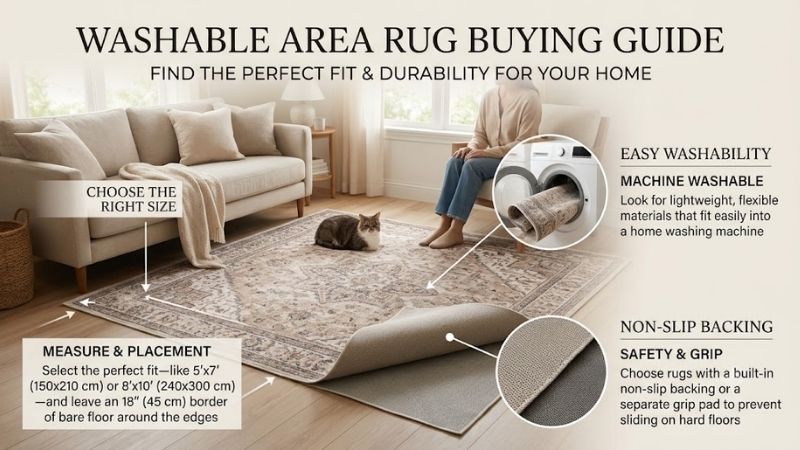
A rug should visually connect the furniture it supports. In a living room, placing the front legs of the sofa and chairs on the rug often creates a cohesive seating arrangement.
If the rug sits too far away from the furniture, it can appear disconnected.
Before buying, use painter’s tape to mark the proposed rug dimensions. This provides a clearer understanding of placement and remaining walking space.
Account for Door Clearance
The rug and pad must not interfere with doors.
Even a low-pile rug can cause clearance problems when combined with a thick cushion pad.
Measure the distance between the floor and the bottom of the door before selecting a rug for an entryway or compact room.
Think About Furniture Removal During Cleaning
A rug positioned beneath several heavy furniture pieces may be difficult to remove.
This is especially important when choosing a machine-washable rug intended for frequent cleaning.
Consider whether the rug can be pulled out without completely dismantling the seating arrangement. A removable-cover system may be more convenient when the pad can remain beneath the furniture.
Washer Capacity: The Most Important Buying Check
The ability to place a rug into a washing machine does not establish that the machine can clean it safely.
A rug may physically fit inside the drum but leave insufficient space for water circulation and movement.
The machine must also accommodate the rug’s weight, particularly when wet.
Why Rug Dimensions Alone Are Not Enough
Two rugs measuring 5 by 7 feet may have completely different washing requirements.
A lightweight flatwoven cover can fold into a compact bundle, while a thick tufted rug with integrated backing can occupy significantly more space.
Construction, fiber density, and backing determine the actual laundry load.
Always check guidance for the specific model and size.
How to Compare Manufacturer Requirements
For context, Ruggable’s published washing-machine guide identifies different minimum drum capacities by rug size and construction. Its standard chart lists 3.1 cubic feet for certain 5-by-7-foot rugs and 4.5 cubic feet for certain 8-by-10-foot rugs.
These figures are manufacturer-specific and should not be applied to every washable rug.
Some larger or thicker products require commercial washing machines, even when the manufacturer describes them as machine washable.
What If Your Washer Is Too Small?
Using an undersized machine is not a sensible shortcut. Overloading can prevent proper cleaning and place stress on the appliance.
Possible alternatives include choosing a smaller rug, selecting a lighter removable-cover system, or using a commercial laundromat when permitted by the product’s care instructions.
If commercial cleaning would be necessary frequently, include that expense in the buying decision.
Rug Pads, Backing, and Floor Protection
Why a Rug Pad Matters
A rug pad can improve stability, reduce unwanted movement, and add cushioning beneath a thin washable rug.
It may also create a more comfortable surface for walking or sitting on the floor.
However, pads vary in thickness, material, and compatibility with specific rug systems.
A rug designed for use with a particular pad may not perform properly with an unrelated substitute.
Choosing Backing for Hardwood and Vinyl Flooring
Floor compatibility is essential.
Some backing materials can interact with floor finishes, especially when exposed to moisture or heat.
Hardwood and luxury vinyl manufacturers may specify which padding materials are acceptable.
Always follow the flooring manufacturer’s guidance before choosing a rug backing or nonslip underlay.
Prevent Moisture From Becoming Trapped
Washable rugs should be completely dry before installation.
Moisture trapped between a rug and hard flooring may cause odors, discoloration, or damage to sensitive surfaces.
After major spills, lift the rug and inspect the floor beneath it.
Even products described as spill-resistant may allow moisture to reach the backing under certain conditions.
What to Look for in Durability and Construction
A washable rug should withstand routine foot traffic and its prescribed cleaning process.
Check Edge Stitching and Binding
Edges experience repeated stress when rugs are vacuumed, moved, folded, and laundered.
Loose stitching or poorly finished edges may become more noticeable over time.
Check whether the rug has reinforced binding and whether the manufacturer provides guidance on preventing fraying.
Evaluate Pile Density and Texture
Low pile is generally practical for busy rooms because it is easier to vacuum and less likely to obstruct movable furniture.
Medium pile can provide additional texture, while plush construction adds softness.
However, higher pile also means more fiber volume that must be cleaned and dried.
Choose the pile height according to actual use rather than appearance alone.
Consider Repeated Washing
A rug may perform well after its first wash but gradually experience changes in texture, shape, or color.
Repeated laundering creates mechanical stress, making appropriate detergent, water temperature, and drying conditions important.
Without controlled durability testing, shoppers should avoid assuming that an expensive rug necessarily withstands more wash cycles than an affordable model.
Warranty terms and manufacturer care instructions can provide additional guidance.
Best Washable Rug Features for Different Households
Homes With Pets
Prioritize short pile, secure backing, and clearly documented cleaning instructions.
Pet hair is generally easier to vacuum from a flatter surface. A patterned rug may also make minor marks less visible between cleaning sessions.
However, pet accidents require immediate attention. A washable rug does not automatically prevent moisture from reaching the floor.
Homes With Children
Spill resistance, soft cushioning, and stable edges are useful features.
A rug used for floor play should feel comfortable but should not shift during movement.
Choose a size that defines the play area without creating excessive furniture interference.
Rental Apartments
Lightweight construction and manageable dimensions are valuable for renters.
A rug should be easy to move when relocating and should not damage flooring.
A compatible pad is particularly important because renters may be responsible for floor damage or staining.
High-Traffic Living Rooms
Look for practical pile height, durable edge construction, and easy routine vacuuming.
A washable rug may reduce cleaning difficulties, but it still needs regular maintenance.
For rooms with heavy daily use, a stable low-pile design is often a sensible starting point.
Common Washable Rug Buying Mistakes
Assuming Every Washable Rug Fits a Household Washer
Machine compatibility depends on the selected product and available appliance.
Always confirm the minimum recommended washer capacity before purchasing.
Choosing a Rug Without Considering the Pad
A low-priced rug may require an additional pad to remain secure.
Ignoring this expense can distort price comparisons.
Buying Based Only on Appearance
A visually attractive rug may be inconvenient if it is too thick, difficult to move, or incompatible with the washing machine.
Practical requirements should be established before comparing colors and patterns.
Ignoring Drying Instructions
Some rugs can be tumble dried on low heat, while others require air drying or prohibit machine drying.
A rug that cannot be dried conveniently may be frustrating in homes with limited outdoor space.
Washing More Frequently Than Necessary
Machine washing creates wear and consumes water and energy.
Minor spills can often be addressed through appropriate spot cleaning, reducing the need for full laundering.
Frequently Asked Questions
What Should I Look for When Buying a Washable Area Rug?
Prioritize correct size, machine compatibility, material, backing, drying requirements, and overall cost. Choose a rug that fits the household’s cleaning routine rather than relying on marketing descriptions.
Are Machine-Washable Rugs Durable?
Many can provide good everyday service when maintained correctly. However, longevity depends on construction, foot traffic, washing frequency, and care practices.
Can an 8-by-10-Foot Washable Rug Be Washed at Home?
Some lightweight rugs and removable covers can be washed in sufficiently large household machines. Others require commercial equipment. Check the exact product’s washer-capacity requirements.
Do Washable Area Rugs Need Special Detergent?
Many manufacturers recommend mild detergent without bleach or fabric softener, but instructions vary. Follow the individual care label.
Are Washable Rugs Better Than Traditional Rugs?
They may be more convenient for frequent spills, but traditional rugs can provide greater thickness, natural-fiber texture, or different long-term maintenance characteristics. The better choice depends on the household.
How Often Should a Washable Rug Be Washed?
There is no universal schedule. Washing frequency depends on traffic, visible dirt, spills, pets, and the manufacturer’s care guidance. Regular vacuuming and prompt spot cleaning can reduce unnecessary laundering.
Conclusion
A washable area rug buying guide should lead to a practical purchase, not simply a decorative preference. The best rug is appropriately sized, compatible with available washing equipment, stable on the floor, and manageable to maintain. Compare construction, material, backing, drying requirements, and total ownership cost before choosing a rug for your living room.