Key takeaways
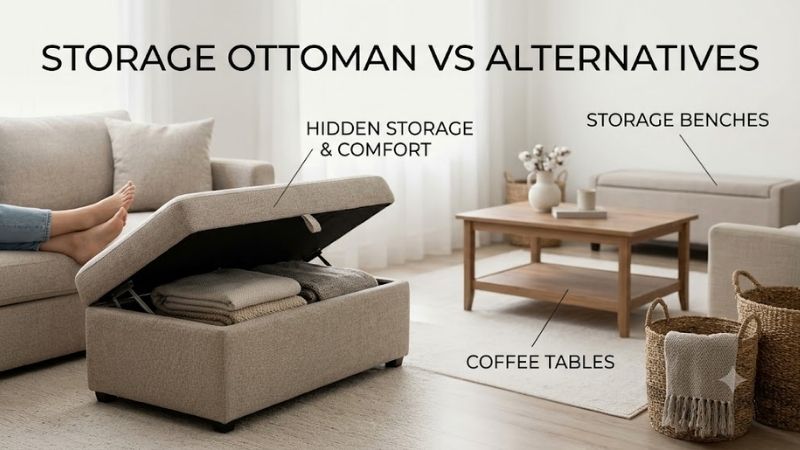
- A storage ottoman is worth considering when you want a footrest or occasional seat that also conceals blankets, accessories, or household clutter.
Ottoman with storage vs alternatives compares upholstered footrests with coffee tables, benches, baskets, cabinets, and other living-room organization solutions. A storage ottoman combines comfort and concealed capacity, but it is not always the most practical option. This guide explains the differences in floor space, accessibility, safety, maintenance, and long-term value.
Quick Verdict: Should You Buy a Storage Ottoman?
A storage ottoman is worth considering when you want a footrest or occasional seat that also conceals blankets, accessories, or household clutter.
Its central advantage is combining furniture functions that might otherwise require separate pieces.
However, a coffee table may provide a more stable hard surface. A storage bench can offer longer seating, while baskets are easier to access and relocate.
A cabinet or shelving unit can store more structured items, and a lift-top coffee table is better suited to certain laptop or tabletop activities.
The correct choice depends on whether soft seating, storage capacity, or surface functionality matters most.
Quick Comparison Table
| Furniture type | Main advantage | Main limitation | Best use |
|---|---|---|---|
| Storage ottoman | Footrest plus concealed storage | Lid access and soft top | Living-room blankets |
| Coffee table with drawers | Stable top and organized storage | Usually not a footrest | Everyday table use |
| Storage bench | Long compartment and potential seating | Larger fixed footprint | Entryway or bedroom |
| Storage basket | Inexpensive and portable | Exposed or less structured storage | Blankets and toys |
| Storage cabinet | Shelves and enclosed organization | More substantial furniture volume | Organized household supplies |
| Lift-top coffee table | Adjustable hard working surface | Mechanical complexity | Laptop and casual dining |
| Nesting tables | Flexible surfaces | Little concealed storage | Small living rooms |
| Under-sofa storage | Uses otherwise empty space | Limited access and clearance | Seasonal accessories |
Storage Ottoman vs Coffee Table With Storage
A storage coffee table and an upholstered ottoman may occupy similar areas in front of a sofa.
However, they provide different everyday experiences.
Surface Function
A coffee table generally offers a stable hard surface for drinks, remote controls, books, and other objects.
A padded ottoman offers a softer surface for resting the legs.
A storage ottoman can sometimes support a tray, but that arrangement is not automatically equivalent to a fixed table.
The stability of the tray and its loading requirements matter.
Storage Access
Coffee tables may have drawers, shelves, or lifting compartments.
These can be easier to access without removing everything from the top.
An ottoman with a removable lid may require moving a tray and other objects before opening.
Comfort
A coffee table is not intended as a footrest unless explicitly designed for that function.
An upholstered ottoman usually suits leg support more naturally.
Which Is Better?
Choose a coffee table with storage when tabletop use is the main priority.
Choose a storage ottoman when foot comfort and concealed soft-item storage matter more.
Storage Ottoman vs Storage Bench
A storage bench usually has an elongated seating surface.
It can serve as entryway furniture, bedroom storage, or occasional seating when properly rated.
Seating Arrangement
A long bench may accommodate more than one person in certain designs.
A small storage ottoman may support only a single occupant, if seating is permitted.
However, neither category should be assumed suitable for a particular load without checking specifications.
Storage Shape
A bench can accommodate certain longer objects.
An ottoman may provide a deeper compartment relative to its footprint.
The more useful option depends on what will be stored.
Placement
A bench often fits naturally along a wall or at the foot of a bed.
A storage ottoman may work better in front of a sofa or beside an armchair.
Which Is Better?
Choose a storage bench for elongated storage and appropriate seating along a wall.
Choose an ottoman for central living-room use and foot support.
Storage Ottoman vs Storage Baskets
Storage baskets are among the simplest alternatives.
They can be placed beside a sofa, under a shelf, or inside a cabinet.
Flexibility
A basket is usually easier to move than a large upholstered ottoman.
Several baskets can separate different categories of items.
For example, one may hold toys while another contains magazines.
Accessibility
Open baskets provide immediate access.
A storage ottoman hides items beneath a lid.
The choice depends on whether the household values quick retrieval or visual concealment.
Floor Space
Several baskets can occupy more combined floor area than one storage ottoman.
However, baskets may also fit into underused corners or shelving.
Seating
A basket should not be treated as a seat unless explicitly designed and rated for that purpose.
An appropriate storage ottoman offers an additional furniture function.
Which Is Better?
Choose baskets for low-cost, portable organization.
Choose a storage ottoman when you want to combine concealed storage with a footrest or suitable seating.
Storage Ottoman vs Cabinet
A cabinet provides more structured organization.
It may include shelves, doors, drawers, and adjustable compartments.
Storage Efficiency
A taller cabinet can use vertical space rather than only floor area.
This may be more efficient for books, electronics, documents, and other rigid items.
An ottoman generally emphasizes a low horizontal compartment.
Organization
Cabinet shelves keep categories separated and make individual items easier to locate.
An ottoman may contain one open compartment, making smaller objects harder to organize.
Internal boxes can help, but they reduce some usable capacity.
Living-Room Appearance
A storage ottoman may appear softer and more integrated with a sofa.
A cabinet introduces a taller vertical furniture element.
The visual preference depends on the room.
Safety
Tall cabinets may require appropriate anti-tip anchoring, particularly in homes with children.
An ottoman avoids that particular tall-furniture issue but introduces lid and entrapment considerations.
Which Is Better?
Choose a cabinet when structured vertical storage is the priority.
Choose an ottoman when storage and soft seating need to share one low furniture piece.
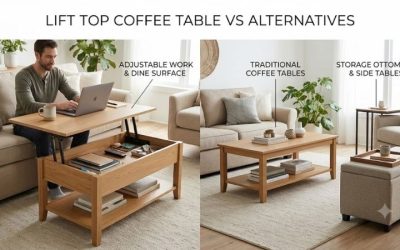
Storage Ottoman vs Lift-Top Coffee Table
A lift-top coffee table is designed to raise part of its tabletop toward the seated user.
This can support particular work, eating, or reading activities.
Work Surface
A raised hard surface can make laptop use more convenient than placing a computer on a padded ottoman.
However, the mechanism must be operated according to its limits.
A lift-top table is not automatically a full ergonomic workstation.
Storage Access
Some lift-top tables reveal a compartment beneath the moving surface.
This may keep small accessories concealed.
However, opening the mechanism may require moving items from the top.
Mechanical Complexity
A lift-top table adds hinges and support hardware.
An ottoman may use a much simpler removable lid.
Neither design is automatically more durable.
Which Is Better?
Choose a lift-top coffee table when an adjustable firm surface is essential.
Choose a storage ottoman when leg support and soft upholstery are more important.
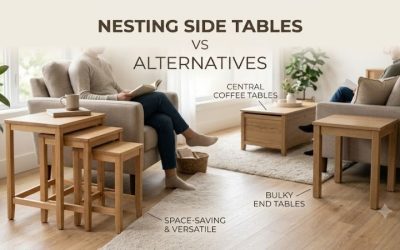
Storage Ottoman vs Nesting Tables
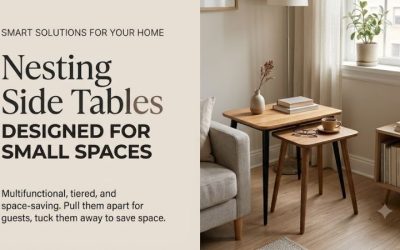
Nesting tables provide flexible tabletop surfaces that can be separated and recombined.
They may be useful in small living rooms where temporary surfaces are needed.
However, most nesting tables offer little concealed storage.
Flexibility
Small tables can be positioned beside different seats.
They can also be grouped together when not needed.
An ottoman is usually a single larger piece of furniture.
Surface Stability
Nesting tables provide hard surfaces appropriate for their intended loads.
An upholstered ottoman generally does not provide the same stable tabletop function without suitable accessories.
Storage
A storage ottoman can conceal clutter.
Nesting tables primarily create surfaces rather than compartments.
Which Is Better?
Choose nesting tables for flexible temporary surfaces.
Choose a storage ottoman for concealed items and foot support.
Storage Ottoman vs Under-Sofa Storage
Under-sofa storage uses space that may otherwise remain unused.
This can be an efficient approach in compact rooms.
Floor-Space Savings
Suitable containers beneath the sofa occupy no additional visible central-floor area.
A storage ottoman adds a separate furniture footprint.
However, under-sofa space may be limited by legs, structural supports, and clearance.
Accessibility
Under-sofa containers may require pulling items across the floor.
This can be inconvenient for daily-use objects.
An ottoman can place the storage directly beside the occupant.
Cleaning
Under-sofa containers can interfere with vacuuming and collect dust.
A storage ottoman creates different cleaning requirements around its legs and upholstery.
Which Is Better?
Choose under-sofa storage for infrequently accessed items when clearance permits.
Choose a storage ottoman for items needed close to the seating area.
Which Alternative Fits Different Homes?
| Household need | Strong starting option | Why |
|---|---|---|
| Blankets near the sofa | Storage ottoman | Combines footrest and concealed space |
| Frequent drinks and laptop use | Coffee or lift-top table | Firm working surface |
| Shoes and accessories near entryway | Storage bench | Long wall-oriented form |
| Children’s toys | Baskets or suitable cabinet | Accessible organization |
| Books and electronics | Shelving or cabinet | Structured compartments |
| Occasional extra tabletop area | Nesting tables | Flexible surfaces |
| Seasonal items in a small apartment | Under-sofa containers | Uses available hidden space |
Compare Total Floor Space
Furniture value should be evaluated through the complete arrangement.
Suppose a living room has space for one 36-inch-wide central furniture piece.
A storage ottoman might replace a separate footrest and storage basket.
That can be useful.
However, if the household also needs a hard coffee table, adding a separate table may eliminate the expected floor-space savings.
Conversely, a lift-top table may combine a work surface and storage but provide no comfortable foot support.
The best solution is not necessarily the piece with the most advertised functions.
It is the one that reduces the need for other furniture without compromising daily activities.
Safety and Maintenance Differences
Storage ottomans introduce lid and compartment hazards.
Coffee tables with lifting mechanisms introduce moving hardware and pinch points.
Tall cabinets may require anti-tip anchoring.
Baskets can be lightweight but may not be suitable for climbing or seating.
The correct product should be used only for its intended purpose.
In homes with young children, do not allow play inside enclosed storage furniture.
Keep hinged lids, lift-top mechanisms, and heavy objects appropriately controlled.
Cost and Long-Term Value
A small folding storage ottoman can be inexpensive.
A large upholstered storage ottoman may cost several hundred dollars.
Cabinets and lift-top coffee tables span similarly broad price ranges depending on materials and construction.
A low initial price does not always mean lower ownership cost.
Consider upholstery cleaning, mechanism repairs, replacement parts, floor protection, and the possibility of moving the furniture.
A storage ottoman is good value when its multiple functions are genuinely used.
It offers less value when it becomes an additional obstacle in an already crowded room.
Common Comparison Mistakes
Assuming an Ottoman Is Always More Space-Efficient
It can add unnecessary furniture if a coffee table or cabinet is still required.
Comparing Exterior Size Instead of Internal Storage
Padding and frames reduce usable capacity.
Treating a Padded Top as a Stable Desk
Soft upholstery is not equivalent to a firm work surface.
Ignoring Child Safety
Storage lids and enclosed compartments can create hazards.
Choosing a Tall Cabinet Without Considering Stability
Tall storage furniture may require anchoring and appropriate installation.
Frequently Asked Questions
Is an Ottoman With Storage Better Than a Coffee Table?
It is better when you prioritize foot support and concealed storage. A coffee table may be more practical when you regularly need a firm surface for drinks, books, or work.
Is a Storage Bench Better Than an Ottoman?
A bench often suits entryways or bedrooms and may provide a longer compartment. An ottoman may integrate more naturally into a living-room seating area.
Are Storage Baskets More Affordable?
They often have lower starting prices, but actual value depends on capacity, quantity, and placement. A storage ottoman offers additional furniture functions that baskets generally do not.
Can a Storage Ottoman Replace a Cabinet?
It may replace limited storage for blankets and accessories. It is less suited to organized vertical storage for books, documents, or numerous rigid items.
Is a Lift-Top Coffee Table Better for Small Apartments?
It can be when an adjustable tabletop is needed. A storage ottoman may be more suitable for lounging and concealed soft-item storage.
Which Option Is Safest Around Children?
Safety depends on the actual product, installation, and supervision. Avoid allowing children inside storage compartments, maintain lid hardware, and anchor tall furniture where required.
Conclusion
An ottoman with storage offers an appealing combination of foot support and concealed organization, but it is not the best replacement for every furniture type. Coffee tables serve hard-surface needs, benches suit longer storage and seating arrangements, baskets offer portability, and cabinets provide structured vertical organization. Lift-top and nesting tables provide additional surface flexibility. Choose the option that supports your actual activities while preserving room access, safe use, and long-term value.