An ottoman with storage buying guide should help you evaluate more than fabric color and hidden capacity. The right design must fit the room, open conveniently, support its intended uses, and remain practical to clean. This guide explains size, internal volume, lid mechanisms, frame construction, seating limits, and long-term ownership decisions.
What Is a Storage Ottoman?
A storage ottoman is a furniture piece that combines an enclosed compartment with a padded or otherwise finished top.
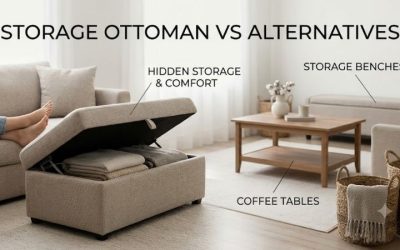
Depending on its design, it may function as a footrest, occasional seat, coffee-table substitute, or bedroom storage bench.
However, not every storage ottoman is intended for all those purposes.
A folding fabric storage box may resemble a stool while lacking sufficient structural documentation for regular seating.
A large upholstered ottoman may support lounging comfortably but provide a less stable surface for drinks.
The correct purchase depends on identifying the primary function before comparing styles.
Main Types of Storage Ottomans
| Type | Main advantage | Main drawback |
|---|---|---|
| Round storage ottoman | Compact appearance | Limited rigid-item capacity |
| Square storage cube | Efficient placement | Smaller compartment |
| Rectangular storage bench | Longer storage space | Uses more wall length |
| Upholstered coffee-table ottoman | Broad padded surface | Not naturally suited to uncovered drinks |
| Folding storage ottoman | Easy relocation and storage | May have lighter construction |
| Hinged-lid ottoman | Attached lid | Opening clearance and hardware maintenance |
| Tray-top storage ottoman | Additional tabletop function | Stability and access trade-offs |
| Modular sofa ottoman | Coordinates with seating | Higher price and larger footprint |
Step 1: Identify the Primary Function
Before measuring storage volume, determine how the ottoman will be used.
Footrest
A footrest should have a height and surface that feel appropriate with the nearby chair or sofa.
The product must remain stable during ordinary use.
A very high ottoman may place the legs at an uncomfortable angle.
Occasional Seating
An ottoman used as a seat must be explicitly suitable for that function.
Check the manufacturer’s loading specifications.
A decorative storage container should not automatically be treated as seating furniture.
Coffee-Table Substitute
A broad ottoman may replace a coffee table when the room primarily needs a soft surface and extra storage.
However, it is less convenient for uncovered cups, food, writing, or devices requiring a hard surface.
A compatible tray may help, provided the arrangement remains stable.
Bedroom Bench
A rectangular bench can provide storage at the foot of a bed.
However, the length should suit the bed and leave enough clearance for walking and opening nearby drawers.
Step 2: Measure the Exterior Dimensions
The ottoman must fit the room in its normal position.
Measure its width, length, and height.
Then consider nearby furniture.
For example, a compact Threshold storage cube measures approximately 18 inches by 18 inches.
IKEA VIMLE measures approximately 38.6 by 28.8 inches.
Both provide storage, but their room requirements differ substantially.
Height Matters for Footrests
If the ottoman will sit in front of a sofa, compare its top height with the sofa’s seat height.
The correct relationship depends on comfort and the intended posture.
A very low ottoman may not provide the desired leg support, while a very high one may be inconvenient.
Clearance Matters for Movement
An ottoman placed in the center of a small living room can obstruct access even when it fits dimensionally.
The surrounding walking route matters as much as the furniture’s footprint.
Check Door and Drawer Access
A storage ottoman should not block nearby cabinet doors, wardrobe drawers, or essential exits.
Avoid choosing a layout that requires regularly moving heavy furniture.
Step 3: Calculate Usable Storage Capacity
A manufacturer’s external dimensions do not equal the inside compartment dimensions.
The frame, upholstery, lid, and base occupy space.
Interior Measurements
Look for internal length, width, and height.
A rigid item must fit within all three dimensions.
A large external bench may still have internal supports that limit the usable length.
Cubic Feet and Gallons
Capacity may be expressed in cubic feet, liters, or gallons.
For reference, one cubic foot equals approximately 7.48 US gallons.
However, capacity figures should be compared using consistent units and the actual usable compartment.
An exterior-volume calculation is not an acceptable substitute for measured storage capacity.
Example Using VIMLE
IKEA VIMLE documents approximately 28 gallons of storage.
This provides a meaningful reference for soft blankets and household accessories.
However, a rigid object still needs to fit within the actual compartment opening.
Weight of Stored Contents
Heavy items can stress the ottoman floor and frame.
A product’s seating-load rating does not automatically describe the weight it can safely store internally.
Confirm applicable limits separately.
Step 4: Choose the Right Lid Mechanism
Removable Lid
A removable lid offers straightforward access and relatively few mechanical parts.
However, a user must lift it away and place it somewhere.
For frequently accessed storage, this can become inconvenient.
Hinged Lid
A hinged lid remains attached.
This can be useful for storing items retrieved daily.
However, the hinge must operate properly, and the lid needs clearance to open.
Supported or Slow-Closing Lid
Some products incorporate hardware that controls lid movement.
This may reduce uncontrolled closing under specified conditions.
However, the existence of a lid support does not guarantee that fingers cannot be pinched or that the compartment is child-safe.
Tray-Style Lid
A reversible lid may provide a firmer top surface.
The buyer should assess whether the tray locks or merely rests in place.
A loose tray can be inappropriate for unstable objects or excessive loading.
Step 5: Evaluate Child and Pet Safety
Storage compartments should not be treated as hiding places.
Children or pets can become trapped or injured when a lid closes unexpectedly.
Never allow anyone to climb inside the furniture.
Pinch Points
Hinges, lid edges, and moving supports can trap fingers.
Keep hands clear while closing the top.
Entrapment
A storage ottoman is not designed as a play enclosure.
Do not assume it provides ventilation, emergency opening, or other protections suitable for an occupied compartment.
Standing on the Ottoman
A footrest or occasional seat is not a substitute for a step ladder.
Standing creates different forces from ordinary seated use and can cause instability.
Hinges and Hardware
Check periodically for loose screws, damaged supports, or unexpected lid movement.
Stop using damaged furniture until it is appropriately repaired.
Step 6: Examine Frame Construction
Storage ottomans commonly use plywood, particleboard, fiberboard, MDF, metal, or combinations.
Each material can be suitable for a particular construction.
Plywood and Engineered Wood
Plywood and other engineered wood materials are widely used in upholstered furniture.
Strength depends on thickness, joints, fasteners, and overall design.
A plywood label does not guarantee superior durability.
MDF
MDF is common in inexpensive folding storage furniture.
It can support appropriate designs but may have different moisture and loading limitations from other materials.
Follow the intended-use instructions.
Metal Frames
Some wicker or decorative ottomans use metal frames.
Metal can provide structural support, but joints and contact points remain important.
Folding Construction
Collapsible ottomans should be assembled correctly before loading.
Never use a folding unit that is partly collapsed, damaged, or missing its specified base support.
Step 7: Evaluate Cushion Comfort
A padded ottoman should provide an appropriate surface for its intended purpose.
Foam, fiber padding, springs, and underlying support materials influence comfort.
However, a thick cushion is not necessarily better.
A very soft top may be comfortable for feet but less stable for seated use.
Foam density also differs from firmness.
A manufacturer’s foam-density specification describes material construction rather than directly predicting how hard the surface feels.
Step 8: Compare Upholstery Materials
Polyester
Common in budget and midrange furniture.
Cleaning requirements vary, and some covers are fixed.
Cotton Blends
Can offer a natural-fiber feel.
However, shrinkage and laundering depend on the specific cover.
Velvet and Chenille
Provide decorative textures but can require particular care.
Texture alone does not establish durability.
Faux Leather
May be wiped according to approved cleaning instructions.
Coatings can deteriorate under unsuitable conditions.
Wicker and Woven Materials
Provide decorative texture and may be lightweight.
However, cleaning, snags, and moisture exposure deserve attention.
Step 9: Decide Whether Removable Covers Matter
A removable cover can be valuable for upholstery used frequently.
However, removable does not automatically mean machine-washable.
The care label governs cleaning.
A washable cover can improve convenience, but future replacement availability is not guaranteed.
Check whether replacement covers are sold separately before paying a premium for that feature.
Step 10: Evaluate Total Cost
Purchase price is only part of ownership.
Delivery, assembly, specialized cleaning, replacement covers, and possible hinge repairs may add expense.
Entry-Level Folding Models
These can be appropriate for temporary housing or basic storage.
However, seating and durability claims require careful review.
Midrange Structured Ottomans
These may offer more substantial frames, upholstery, and decorative options.
The extra cost is justified only when those features matter.
Larger Sofa-Matching Ottomans
They can provide coordinated appearance and significant storage.
However, they use more space and may cost several times as much as a compact cube.
Practical Buying Checklist
| Requirement | Question to answer |
|---|---|
| Function | Footrest, seat, table, or storage? |
| Footprint | Does it fit without blocking access? |
| Interior capacity | Will intended items fit? |
| Storage load | What can the compartment hold safely? |
| Seating rating | Is the product approved for sitting? |
| Lid | Removable, hinged, supported, or tray-style? |
| Child safety | Are there trapping or pinch hazards? |
| Upholstery | Which cleaning method is required? |
| Frame | What materials and construction are documented? |
| Delivery | Does it fit through the doorway? |
| Assembly | Can it be assembled correctly? |
| Warranty | What components and defects are covered? |
Frequently Asked Questions
How Do I Choose the Right Storage Ottoman Size?
Measure the available floor area and the items you need to store. Compare both exterior dimensions and internal capacity. A large ottoman is not necessarily better if it obstructs everyday movement.
Can Storage Ottomans Be Used as Seats?
Some can, but only when the manufacturer intends that use and the published load rating is appropriate. Do not assume every folding storage box is seating furniture.
Is a Hinged Storage Ottoman Better?
A hinged lid can simplify access, but it requires appropriate hardware and room clearance. A removable lid can be simpler for occasional use.
What Is the Best Material?
There is no universal winner. Frame materials, upholstery, construction quality, and the intended use all matter.
Are Storage Ottomans Safe Around Children?
They require supervision and appropriate use. Children should not climb inside, stand on the lid, or play with moving hinges. The product’s instructions and hardware condition are important.
Is a Large Storage Ottoman Worth the Money?
It can be when the household uses its storage and furniture functions regularly. A smaller model may be better value when only limited concealed storage is required.
Conclusion
The right ottoman with storage should provide enough concealed capacity, convenient access, appropriate structural support, and practical maintenance without overwhelming the room. Begin with intended use and actual interior measurements. Then compare lid operation, frame construction, seating suitability, upholstery, delivery, and total ownership cost. Choose a design that makes everyday organization easier rather than simply adding another piece of furniture.