Key takeaways
-
Width and length: 24 × 24 inches in documented configurations
-
Heights: 7, 10, and 12 inches
-
Construction: Support foam with a comfort-oriented upper layer
-
Cover: Removable stretch-knit cover
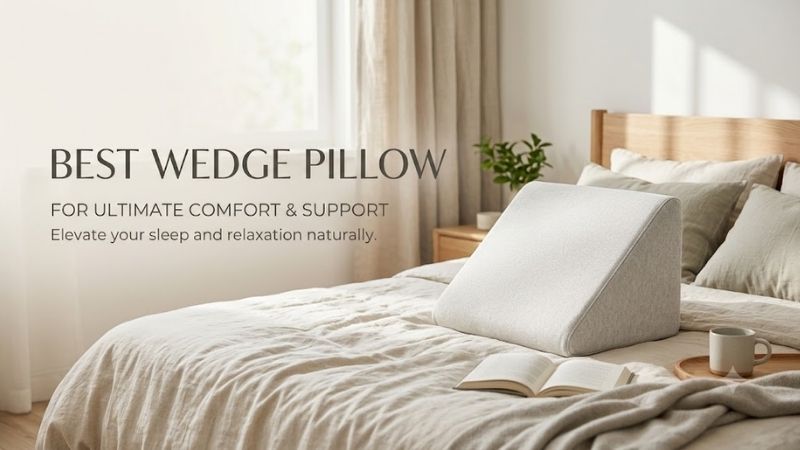
The best wedge pillow supports the upper body at a comfortable incline without forcing the neck into an awkward position. Some wedges are intended for nighttime torso elevation, while others are primarily useful for reading, resting, or supporting the legs. This guide compares six designs, including specialized side-sleeping systems, adjustable wedges, and traditional foam ramps, so you can choose a product for its actual intended use.
First, Decide Why You Need a Wedge Pillow
The reason for buying a wedge should determine its shape.
For nighttime acid reflux, the goal is generally to elevate the upper torso rather than merely stacking pillows beneath the head. For reading in bed, a steeper backrest may be more comfortable. For leg elevation, the relevant shape and positioning are different again.
Clinical guidance recognizes head-of-bed elevation as one non-drug approach that may help some people with nighttime reflux. However, a wedge is not a replacement for assessment and treatment of persistent GERD.
Our recommended options are:
| Product | Primary Use | Construction | Key Trade-Off |
|---|---|---|---|
| Brentwood Home Zuma Foam Wedge | General upper-body elevation | Foam wedge | Fixed incline |
| MedCline Reflux Relief System | Side-sleeping reflux positioning | Multi-component wedge system | High cost and large footprint |
| Coop Adjustable Wedge Pillow | Variable positioning | Adjustable wedge | More components to arrange |
| Contour Folding Wedge, Extended 32″ | Portable torso elevation | Folding support foam | Firmness may not suit everyone |
| Lunix Orthopedic Bed Wedge Pillow Set | Reading and multi-position support | Modular foam pieces | Not equivalent to a single reflux wedge |
| InteVision Foam Bed Wedge Pillow | Traditional foam incline | Foam wedge with comfort layer | Fixed shape and footprint |
Detailed Reviews by Intended Use
Brentwood Home Zuma Foam Wedge — Best Overall Traditional Wedge
Best For: Buyers seeking a straightforward foam incline for upper-body support.
Why We Picked It: The Zuma is an identifiable foam-wedge collection with multiple height options, helping shoppers match their preferred incline to their sleeping or resting needs.
Key Specifications:
-
Width and length: 24 × 24 inches in documented configurations
-
Heights: 7, 10, and 12 inches
-
Construction: Support foam with a comfort-oriented upper layer
-
Cover: Removable stretch-knit cover
Features and Benefits
The simple triangular shape creates a consistent slope without requiring movable components.
Different heights allow buyers to choose a gentler or steeper incline.
The 7-inch version may be a more approachable starting point for someone who intends to sleep on the wedge, while steeper options may be preferred for upright resting.
Practical Performance
The 24-inch length deserves attention. Taller sleepers or those seeking full torso elevation may find that a longer wedge provides a smoother transition.
A wedge that ends abruptly beneath the back can create an uncomfortable pressure point.
Pros
-
Multiple height choices
-
Straightforward construction
-
Removable cover
Cons
-
Fixed incline once purchased
-
May be too short for some torso lengths
Buy If: You want a recognizable traditional foam wedge.
Skip If: You need frequent angle adjustments or a specialized side-sleeping system.
MedCline Reflux Relief System — Best for Specialized Side Sleeping
Best For: Adults seeking a purpose-built inclined side-sleeping arrangement for reflux positioning.
Why We Picked It: MedCline combines a torso wedge, insert pillow, and shaped body pillow into a coordinated system.
Key Specifications:
-
Components: Wedge, insert pillow, and body pillow
-
Intended positioning: Side sleeping
-
Incline: Approximately 15–20 degrees
-
Small wedge: 27 inches wide × 29 inches long × 6 inches tall
-
Medium wedge: 30 × 32 × 7 inches
-
Large wedge: 30 × 35 × 8 inches
Features and Benefits
The system supports more than the head. Its longer inclined surface is designed to elevate the upper torso.
The body pillow assists with side-sleeping positioning, while the insert pillow provides a separate resting area for the head.
This can be attractive to people who cannot remain comfortable on a narrow conventional wedge.
Practical Performance
The major disadvantages are cost, size, and the adjustment required to become comfortable with the system.
It occupies a substantial part of the bed and is not intended to function like a compact reading pillow.
MedCline publishes clinical claims about its design, but those claims should not be generalized to every user or treated as a guarantee of symptom resolution.
Pros
-
Purpose-built side-sleeping arrangement
-
Multiple torso sizes
-
Coordinated pillow components
Cons
-
Expensive
-
Large footprint and specialized positioning
Buy If: You need a comprehensive side-sleeping incline system and have considered its suitability with your healthcare professional.
Skip If: You simply want an inexpensive wedge for occasional reading.
Coop Adjustable Wedge Pillow — Best Adjustable Support
Best For: Buyers who want more positioning flexibility than a fixed foam triangle offers.
Why We Picked It: Coop offers an adjustable wedge designed for changing the resting incline.
Key Specifications:
-
Product type: Adjustable wedge pillow
-
Primary function: Upper-body positioning
-
Construction: Adjustable multi-part design
-
Cover and care: Follow manufacturer instructions
Features and Benefits
An adjustable wedge is useful when someone wants different levels of elevation for sleeping, relaxing, and reading.
Instead of buying several fixed-height wedges, the user can change the arrangement to suit the activity.
Practical Performance
Flexibility is useful, but the wedge still needs to provide stable support.
Check that components remain properly positioned and do not create abrupt gaps beneath the torso.
Pros: Adjustable support; versatile use; alternative to fixed ramps.
Cons: Requires setup; position must remain stable during use.
Buy If: You regularly change between reclining and resting positions.
Skip If: You prefer a single solid wedge without adjustments.
Contour Folding Wedge, Extended 32-Inch Length — Best Longer Folding Design
Best For: Buyers wanting a longer inclined surface with a folding construction.
Why We Picked It: The extended-length design addresses one of the major limitations of compact foam wedges: insufficient torso support.
Key Specifications:
-
Product line: Contour Folding Wedge
-
Advertised length: 32 inches
-
Construction: Folding wedge
-
Intended use: Upper-body elevation
Features and Benefits
A longer wedge can spread support across more of the back, rather than concentrating pressure near the shoulders.
The folding construction is useful for storage when the pillow is not being used.
Practical Performance
Length does not guarantee comfort. The incline and firmness must still be appropriate.
Side sleepers should consider whether the wedge supports shoulder positioning without creating uncomfortable compression.
Pros: Extended length; folding design; comparatively simple construction.
Cons: Takes up space when unfolded; fixed support character.
Buy If: A compact wedge feels too short beneath your torso.
Skip If: You need a multi-component body-positioning system.
Lunix Orthopedic Bed Wedge Pillow Set — Best for Reading and Repositioning
Best For: People who use wedges primarily for reading, resting, and changing body positions.
Why We Picked It: Lunix offers modular orthopedic wedge sets designed to support several seated or reclining arrangements.
Key Specifications:
-
Product type: Multi-piece orthopedic wedge system
-
Construction: Foam positioning cushions
-
Configurations: Vary by exact set
-
Intended use: Repositioning and general comfort
Features and Benefits
Multiple cushions can support the back, neck, or legs in different combinations.
For someone spending time reading or watching television in bed, modular positioning may be more practical than one triangular foam ramp.
Practical Performance
The modular design should not automatically be considered equivalent to a long, continuous reflux wedge.
An arrangement that bends sharply at the waist may be less appropriate when the intended goal is nighttime torso elevation.
Pros: Flexible positioning; multiple uses; supports upright activities.
Cons: Requires more storage; not every setup is suited to overnight sleeping.
Buy If: You want versatile lounging support.
Skip If: You specifically need a continuous sleeping incline for reflux management.
InteVision Foam Bed Wedge Pillow — Best Conventional Foam Alternative
Best For: Shoppers wanting a recognizable fixed-foam wedge without a complex system.
Why We Picked It: InteVision offers conventional incline pillows that can be compared on height, dimensions, and comfort-layer construction.
Key Specifications:
-
Product type: Foam wedge
-
Construction: Support foam with a comfort-oriented surface in relevant models
-
Incline: Model-dependent
-
Care: Cover and core require different handling
Features and Benefits
The simple construction reduces the number of components that must be arranged before sleeping.
It may suit someone who already knows the incline height they prefer.
Practical Performance
A fixed wedge cannot compensate for incorrect sizing. Check actual width, length, and height.
A regular pillow placed on top of the wedge may improve head comfort, but stacking too much height can create unwanted neck flexion.
Pros: Straightforward design; conventional foam support; useful comparison to premium wedges.
Cons: No height adjustment; comfort depends heavily on chosen dimensions.
Buy If: You want an uncomplicated inclined pillow.
Skip If: You require a specialized side-sleeping system.
How to Use a Wedge Pillow Without Creating New Discomfort
Elevate the Torso Rather Than Only the Head
For reflux-oriented sleeping, supporting the upper body is generally more useful than stacking several pillows beneath the head.
Excessive head-only elevation can bend the neck and create an uncomfortable position.
The wedge should support the upper back and shoulders while allowing the head to rest in a comfortable alignment.
Understand Wedge Height and Angle
Height alone does not determine the incline.
A 10-inch wedge with a long support surface has a different angle from a 10-inch wedge with a short surface.
A more gradual slope may be easier to tolerate for extended sleeping.
Compare the wedge’s full dimensions rather than selecting only by its maximum height.
Consider Side Sleeping
Side sleepers need enough width for the shoulder and upper torso.
A narrow wedge can leave part of the body unsupported.
Some users may prefer a separate head pillow on the wedge, but the combined height must remain comfortable.
Avoid Excessive Bending at the Waist
An abrupt angle beneath the mid-back or waist can cause discomfort.
Choose a length that distributes support over the intended area.
If a particular configuration causes pain or pressure, stop using that arrangement.
Check Medical Suitability
A wedge pillow may help some people manage nighttime reflux positioning. It does not treat the underlying cause of every reflux symptom.
People recovering from surgery, those with significant respiratory conditions, or anyone given specific positioning restrictions should follow clinical instructions rather than general product recommendations.
Frequently Asked Questions
Are Wedge Pillows Good for Acid Reflux?
Elevating the upper torso may reduce nighttime reflux for some people. A continuous incline is generally preferable to stacking ordinary pillows under the head.
Is a Higher Wedge Always Better?
No. An excessively steep incline may be uncomfortable and difficult to maintain throughout the night.
Can Side Sleepers Use a Wedge Pillow?
Yes, but sufficient width, suitable contouring, and head support are important.
Can a Wedge Pillow Replace Treatment for GERD?
No. It may serve as a positioning aid, but persistent symptoms require appropriate medical evaluation and treatment.
Is a Wedge Pillow Good for Reading?
Many are, although reading may be more comfortable with a steeper or adjustable backrest than the incline preferred for sleeping.
Conclusion
Brentwood Home Zuma is a strong traditional wedge candidate, while MedCline is suited to buyers seeking specialized side-sleeping positioning. Coop offers adjustability, Contour provides extended folding support, and Lunix is more appropriate for flexible lounging arrangements. Select the wedge according to its intended function rather than assuming every inclined pillow works the same way.