Our Top Picks
 Waykar 34 Pints 2025 Most Efficient Energy StarDrain Hose10.87 x 8.39 x 19.3 inches22.05 PoundsCheck on Amazon
 VEAGASO 28 Pint Dehumidifier for Basement and Home2000 Sq.Ft2 x 2 x 2 inches16.5 PoundsCheck on Amazon
 DR.PREPARE 38 Pint Dehumidifier for 2000-2500 Sq.Ft Rooms9.8*8.7*17.5 Inch8.7 x 9.8 x 17.5 inchesCheck on Amazon
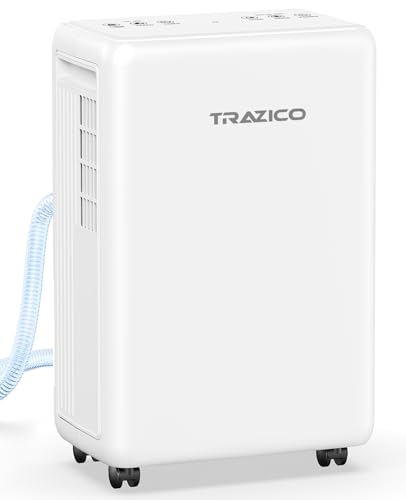 Trazico 30 Pint Dehumidifier for Basement with Drain2000 Sq.ft10.01 x 6.3 x 15.01 inchesCheck on Amazon
A listing that says 2,000 square feet is describing a best-case room, and the pint figure printed next to it may come from an older, kinder rating method. That is the fact to keep in mind while reading the seven titles below. Only five of the seven give a pint capacity, from 28 to 38, and the other two give a 2.5 liter tank and a small-unit description instead.
The units compared here are all in the compact, plug-in category. They are not the 50 to 70 pint workhorses covered in our guide to the best 50 pint dehumidifier. Whether a 28 to 38 pint model is enough for your 2,000 square feet depends on how damp the space is, how many closed rooms it has and which rating the seller used. This page walks through each of those questions before it gets to the models.
Nobody on the team used or measured these units. Everything about a model comes from its title, and estimates are labeled as such.
Quick answers before the long version
Waykar 34 Pints 2025 Most Efficient Energy Star Dehumidifier for Home & Basement, Ideal for Spaces up to 2,000 Sq. Ft. with Auto or Manual Drainage, 0.62-Gallon Water Tank
One of the moisture-control product options compared in this guide.
View on AmazonVEAGASO 28 Pint Dehumidifier for Basement and Home, Up to 2,000 Sq. Ft. | Compressor Dehumidifier with Drain Hose, 3 Modes, 30–80% Humidity Control, 38 dB Sleep Mode, 24H Timer, Auto Defrost, Timer
One of the moisture-control product options compared in this guide.
View on Amazon
Dehumidifiers for Home, 2000 Sq.Ft Small Dehumidifier with 3.3ft Drain Hose, 2.5L Tank, Timer Sleep Mode, Portable Dehumidifier for Basement, Bedroom, Bathroom (Floral White)
One of the moisture-control product options compared in this guide.
View on AmazonDR.PREPARE 38 Pint Dehumidifier for 2000-2500 Sq.Ft Rooms, Basement Bedroom Bathroom Dehumidifier with Drain Hose, Smart Humidity Control, 3 Modes, Clothes Drying, Sleep Mode, 24H Timer
One of the moisture-control product options compared in this guide.
View on AmazonTrazico 30 Pint Dehumidifier for Basement with Drain Hose Up to 2000 Sq.ft | Quiet Dehumidifiers for Home Large Room Bedroom Bathroom RV, Smart Humidity Control, 24H Timer, Auto Defrost, 3 Modes
One of the moisture-control product options compared in this guide.
View on Amazon
Bicepos 2000 Sq.Ft Dehumidifier for Basement, 30 Pints, Portable | 130W efficient, rolling casters, auto-shutoff drainage, 3 modes, 24H timer, child lock, protects cameras & leather goods
One of the moisture-control product options compared in this guide.
View on Amazon
Dehumidifiers for Home, 2000 Sq.Ft New Rotary Dehumidifier with Drain Hose/2.5L Water Tank, Quiet Dehumidifier for Basement Bedroom Bathroom RV, Auto Shut Off, Sleep Mode, 7-Color Ambient Light
One of the moisture-control product options compared in this guide.
View on Amazon- Best on paper for efficiency claims: the Waykar 34 pint, because its title lists Energy Star and a 0.62 gallon tank with auto or manual drainage.
- Best capacity for the money: the DR.PREPARE 38 pint, which states the largest pint number and a 2,000 to 2,500 square foot range.
- Best for a quiet room: the VEAGASO 28 pint, whose title gives a 38 dB sleep mode figure.
- Cheapest entries: the QFOX and Onsekin, both small units that you should size cautiously.
- Most hardware listed: the Bicepos, with casters, child lock and auto-shutoff drainage in the title.
Why 2,000 sq ft on a listing is not a sizing answer
Sellers pick a square-foot number that sounds right for the pint capacity, then print it in the title. It is not a measured coverage figure. The same 30 pint unit might be called a 1,500 square foot model on one listing and a 2,500 square foot model on another. The only reliable inputs are how damp the space is, how large it is and which pint rating applies.
The pint rating itself comes in two scales. Before the current standard took effect, the common rating point was 80 degrees Fahrenheit and 60 percent relative humidity, a warm room that makes a compressor work easily. The current AHAM and Department of Energy method rates at 65 degrees and 60 percent. A machine rated 50 pints on the old scale is typically rated around 35 on the new one, a ratio of roughly 0.7. That ratio is an approximation, and individual models vary.
Listings do not always say which scale applies. A recently listed unit is more likely to use the current scale, but this is not a guarantee, and none of the seven titles states it. Look in the specification table on the listing for a line like AHAM rating or capacity at 65 degrees. If you cannot find one, assume the older scale and read the capacity as optimistic.
The pint math for a 2,000 sq ft floor
Many retailer sizing charts list pints by area and dampness. The figures below follow the commonly published older-scale pattern, converted at a rough 0.7 ratio. They are editorial approximations, not a standard.
| Condition of the space | Older-scale pints (approx.) | Current AHAM pints (approx.) | Typical sign |
|---|---|---|---|
| Moderately damp | 22 | 15 | Musty smell in humid weather |
| Very damp | 27 | 19 | Damp feel, condensation on pipes |
| Wet | 32 | 22 | Dampness on walls, floor stains |
| Extremely wet | 37 | 26 | Visible water, seepage |
Add margin for ceilings above 8 feet, for an open stair that connects floors, and for a washer and dryer in the space. A reasonable rule is to add 10 to 20 percent. By that measure, a 30 pint unit on the current scale covers most 2,000 square foot situations below extremely wet, and a 30 pint unit on the older scale is closer to a very damp rating. Because the titles do not name the scale, the safest reading is that a 28 to 34 pint model suits a moderately to very damp floor, and the 38 pint DR.PREPARE gives the most headroom.
If your floor is extremely wet, or if a sump pit, a leaking foundation or a bare crawl space adds water continuously, skip this class and look at larger units. Our 50 pint comparison covers that range.
The seven models at a glance
| Model | Key spec from the title | Price tier | Best for |
|---|---|---|---|
| Waykar 34 Pint | Energy Star, 0.62 gal tank, auto or manual drain | Mid-range | Efficiency-minded buyers |
| VEAGASO 28 Pint | Compressor, drain hose, 38 dB sleep mode | Budget | Quiet rooms |
| Onsekin Small Dehumidifier | 2.5 L tank, 3.3 ft hose, timer | Budget | Small rooms, bathrooms |
| DR.PREPARE 38 Pint | 2,000 to 2,500 sq ft, hose, clothes drying | Budget | Highest stated capacity |
| Trazico 30 Pint | Basement, drain hose, auto defrost | Budget | Cool basements |
| Bicepos 30 Pints | 130W, casters, auto-shutoff drain, child lock | Premium | Movable unit with safeguards |
| QFOX Rotary Dehumidifier | 2.5 L tank, drain hose, 7-color light | Budget | Bedrooms, tight budgets |
Price tiers are relative to this group. Five of the seven sit within the same narrow Budget band; the Waykar is in the middle and the Bicepos stands apart at the top. Because tiers are close, choose on drain method and honest sizing, not on the small price differences.
Seven models, read against the pint math
Waykar 34 Pint Energy Star Dehumidifier
What the title says: 34 pints, Energy Star, for home and basement, spaces up to 2,000 square feet, auto or manual drainage and a 0.62 gallon tank. The title also includes a year and the phrase most efficient; treat the superlative as marketing and look for the efficiency figure on the listing instead.
Sizing read: If 34 is on the current scale, this is comfortably above the 22 pint figure for a wet 2,000 square foot floor. If it is on the older scale, it is about 24 current-scale pints, which still fits a wet space but with little margin. Energy Star in the title suggests a post-2019 rating, which makes the current scale more likely, though the title does not say so.
Drain and tank: A 0.62 gallon tank holds about 5 pints. At the full 34 pints a day, which is a ceiling, the tank would fill in roughly 3.5 hours. That is why the auto drain option matters. Without a hose, expect to empty the tank two or three times a day in humid weather.
Running cost estimate: a 34 pint compressor unit commonly draws roughly 350 to 400 watts. At 10 hours a day, 30 days and 16 cents per kilowatt hour, that is about 17 to 19 dollars a month.
One placement detail applies to every unit in this group but matters most for a 34 pint model: the air it exhausts is warmer and drier than the air it takes in, so it should not blow directly at a wall or a stack of boxes. In a 2,000 square foot basement, a central position near the stairs lets the exhaust spread across the room. Keep stored cardboard off the floor, because it holds moisture and can make a dry-looking room feel damp for weeks.
Pros
- Energy Star named in the title
- Auto or manual drainage listed
- Strong capacity margin for a damp 2,000 sq ft floor
Cons
- Mid-range tier, above five other models here
- Small tank relative to output without a hose
- Noise and dimensions not in the title
Who it’s for: owners who want an efficiency credential and plan to run a hose to a drain.
VEAGASO 28 Pint Compressor Dehumidifier
What the title says: 28 pints, up to 2,000 square feet, basement and home use, compressor design, drain hose, 3 modes, 30 to 80 percent humidity control, a 38 dB sleep mode, a 24 hour timer and auto defrost. It is the only title that states a compressor design and gives a decibel number.
Sizing read: 28 pints is the smallest stated capacity that still claims 2,000 square feet. On the current scale it clears the 22 pint wet line with a modest 25 percent margin. On the older scale it is about 20 current-scale pints, enough for a moderately to very damp space but not a wet one. For a floor with closed rooms, this unit will treat the room it sits in far better than the rest.
Drain and noise: The hose makes continuous operation possible. The 38 dB figure is probably for the lowest fan setting in sleep mode, which is typical, but the title does not say, so expect higher levels in normal modes. 38 dB is comparable to a quiet library, though a compressor click and hum are different from steady noise.
Auto defrost: This matters in a basement that falls below the mid 60s Fahrenheit, where coils can ice. Check the listing for the temperature range at which defrost engages.
The 30 to 80 percent humidity control range in the title is worth a note. A target of 45 to 50 percent is the usual goal for a living area, while a basement used for storage may be fine at 55. Setting the dial lower than necessary makes the compressor run longer and adds to the electric bill without any added comfort, so start at 50 percent and adjust after a week of readings from a cheap hygrometer.
Pros
- Compressor design and a decibel figure in the title
- Auto defrost for cool spaces
- Budget tier with a hose included
Cons
- 28 pints is on the low side for a wet 2,000 sq ft floor
- Tank size is not in the title
- Coverage claim is generous
Who it’s for: a moderately damp basement or bedroom floor where quiet matters.
Onsekin 2000 Sq Ft Small Dehumidifier
What the title says: the claim is 2,000 square feet, but the wording describes a small dehumidifier with a 3.3 foot drain hose, a 2.5 liter tank, a timer and sleep mode, intended for basement, bedroom and bathroom, in a floral white finish. No pint rating, no technology and no wattage appear in the title.
Sizing read: A 2.5 liter tank equals about 5.3 pints, and the word small is in the title. Those two clues suggest a modest unit, and a 2,000 square foot claim for a small unit deserves skepticism. Without a pint rating, there is no way to place it on the table above, so the listing needs to supply one. If it does not, treat this as a bedroom or bathroom unit and not as a floor-wide solution.
Drain: A 3.3 foot hose is short. It reaches a floor drain only if the unit is within about three feet of it, or a sink if the unit sits on a stand. That limits placement more than the 2,000 square foot claim suggests.
Running cost: unknown from the title. Check the listing for wattage; small units can draw considerably less than compressor models.
If you buy this model, set realistic goals. A unit with a 2.5 liter tank and a short hose is well matched to a room of a few hundred square feet, such as a closet, a laundry corner or a bathroom without a window. In those spaces, it can lower humidity enough to stop mildew on grout or musty smells in stored clothes. Treat the 2,000 square foot figure as a title keyword and judge the unit by what the listing says about capacity in pints per day.
Pros
- Lowest-cost tier among the compact options
- Short drain hose and a tank, so two drain methods
- Timer and sleep mode for bedrooms
Cons
- No pint capacity in the title
- 2,000 sq ft claim is hard to square with a small tank
- Hose length limits placement
Who it’s for: a bedroom, closet or bathroom where a compact unit is enough and 2,000 square feet is just a label.
DR.PREPARE 38 Pint Dehumidifier for 2000 to 2500 Sq Ft
What the title says: 38 pints, for rooms of 2,000 to 2,500 square feet, for basement, bedroom and bathroom, with a drain hose, smart humidity control, 3 modes, clothes drying, sleep mode and a 24 hour timer. It has the highest pint number and the widest stated coverage range of the seven.
Sizing read: On the current scale, 38 pints covers even an extremely wet 2,000 square foot floor with margin. On the older scale, it is about 27 current-scale pints, still at the extremely wet line. Either way it is the strongest candidate for a space that is more than mildly damp. The 2,500 square foot upper range provides cushion that the others lack.
Clothes drying mode: A laundry mode generally runs the fan at high speed and holds a low humidity target. It is useful in a utility room or a winter laundry corner, though it will draw more power during use, so avoid leaving it on overnight in a bedroom.
Estimate: a 38 pint compressor model may draw roughly 400 to 450 watts, or about 19 to 22 dollars a month at 10 hours a day and 16 cents per kilowatt hour.
A bigger unit deserves an honest look at where it will sit. A 38 pint compressor model is heavier than a 28 pint one, and a full tank adds more weight, so a rolling base or a spot at floor level near the drain is more practical than a shelf. If you intend to use it for drying laundry, place it where air can flow around hanging clothes, and keep the hose clear of the fabric so condensate drains properly.
Pros
- Highest stated pints in this group
- Budget tier despite the larger capacity
- Laundry mode and drain hose in the title
Cons
- Which pint scale applies is not stated
- No Energy Star or noise figure in the title
- Bigger machines are heavier and louder; check the listing
Who it’s for: owners of a true 2,000 square foot floor with measurable dampness who want the most headroom for the money.
Trazico 30 Pint Dehumidifier for Basement
What the title says: 30 pints, basement, drain hose, up to 2,000 square feet, quiet operation, suitable for a large room, bedroom, bathroom and RV, smart humidity control, a 24 hour timer, auto defrost and 3 modes. The RV mention suggests the seller sees it as a portable unit.
Sizing read: At 30 pints on the current scale, this unit covers even an extremely wet floor (about 26 pints) with a margin near 15 percent, which disappears once you add ceiling height. On the older scale it is about 21 current-scale pints, a very damp rating with little to spare. With a 24 hour timer and smart humidity control, it can cycle efficiently once the space is dry.
Basement use: The title names a basement and lists auto defrost, which together imply a cooler environment. Auto defrost prevents ice buildup on the coil, so that the unit keeps working below roughly 65 degrees Fahrenheit, though how well it performs at that point depends on the model.
Practical note: Many compact units at this price lose capacity quickly as air cools. If your basement stays near 55 degrees in spring, assume real output may be well under the headline pints and consider a larger unit.
A cool basement is the real challenge for any compressor unit. When air temperature falls, the coil gets colder, ice forms and the unit pauses to defrost, which cuts the time it spends removing water. If your basement sits in the 50s through spring, you may see the unit cycle in and out of defrost, and a smaller headline capacity is realistic. Warming the space slightly, sealing rim joist gaps and closing basement windows all help the same machine remove more water.
Pros
- Basement and auto defrost in the same title
- Quiet claim and smart humidity control
- Budget tier with a drain hose
Cons
- No decibel number to back the quiet claim
- Tank size not stated
- 30 pints is marginal for a wet 2,000 sq ft floor
Who it’s for: a cool, moderately damp basement where you can run a hose to a drain.
Bicepos 2000 Sq Ft Dehumidifier, 30 Pints
What the title says: 30 pints, for basement, portable, 130W efficient, rolling casters, auto-shutoff drainage, 3 modes, a 24 hour timer, a child lock, and protection for cameras and leather goods. It is the only title with a wattage figure and the highest price tier of the seven.
Sizing read: 30 pints sits in the same band as the Trazico. The unusual detail is 130 watts. A 30 pint compressor model typically draws more than twice that figure, so the title may describe a different technology or a rating at a different condition. That is an editorial observation, not a finding; the listing should name the type of dehumidifier. If the machine is not a compressor design, expect lower output in cool air.
Running cost: at 130 watts for 12 hours a day over 30 days at 16 cents per kilowatt hour, the cost is about 7.50 dollars a month. If the real draw is higher, scale accordingly.
Safeguards: Casters help you roll it between rooms, a child lock helps in a household with small children, and auto-shutoff drainage suggests the unit stops when the tank fills or drains continuously. These features suit a family home better than a bare basement.
The camera and leather goods wording in the title points to a specific use: protecting collectibles and gear in a storage room. That is a smaller, steadier job than drying a damp basement, and for it a low-wattage unit that runs quietly in the background may be ideal. For a whole floor, however, check carefully that the capacity claim and the power figure refer to the same thing before you rely on this unit alone.
Pros
- Lowest wattage figure in any title
- Casters and child lock
- Auto-shutoff drainage listed
Cons
- Premium tier for a 30 pint model
- Technology type is not in the title
- Cool-air performance should be checked
Who it’s for: families who value mobility, a child lock and low running cost over the lowest purchase price.
QFOX Rotary Dehumidifier for Basement and Bedroom
What the title says: described as a new rotary dehumidifier for a 2,000 square foot space, with a drain hose and a 2.5 liter tank, quiet running, for basement, bedroom, bathroom and RV, with auto shut off, sleep mode and a 7-color ambient light. It is the lowest-priced model in the group.
Sizing read: No pint rating appears. The word rotary describes a compressor type in some product categories, but the title does not make clear whether this is a conventional compressor. A 2.5 liter tank is only 5.3 pints. Without a pint number, a 2,000 square foot claim cannot be matched to the table above, and the safest assumption is bedroom or bathroom duty.
Light feature: A 7-color light is a design feature, not a performance one. Check whether it can be turned off, since a glowing unit in a bedroom is a nuisance for many sleepers.
Estimate: if the unit is a small, low-power design, running costs could be a few dollars a month; if it is a conventional compressor, expect more. The listing’s wattage line settles it.
For a small room the practical check for any unit is whether it keeps a hygrometer reading under 55 percent without running constantly. Place a cheap hygrometer at head height across the room, run the unit for a few days, and watch the readings. If it cannot bring the number down, the room is too wet for the machine, and a larger compressor model is the better choice. That kind of simple check is worth more than the claim in any title.
Pros
- Lowest price tier in the group
- Drain hose and a tank
- Sleep mode and auto shut off
Cons
- No pint rating or wattage in the title
- Technology unclear from the word rotary
- Coverage claim looks optimistic for the tank size
Who it’s for: a bedroom or small damp room on a tight budget, where you read the listing’s capacity line before relying on the 2,000 square foot label.
Whole-floor placement: one unit, one air space
A single dehumidifier treats the air that reaches it. In a 2,000 square foot floor, that means the placement matters as much as the pint rating. Put the unit in the most central open space, usually a hallway, the bottom of a staircase or the middle of an open basement. Keep it a hand’s width from walls and furniture so the intake and exhaust can move air freely.
Leave interior doors open while it runs. A closed bedroom door can keep the humidity in the room at 60 percent while the hallway reads 45. If you cannot leave doors open, you need a unit per zone. A ceiling fan or a small box fan on low can move air through the floor and help the dehumidifier see more of the volume.
For a two-story house, one unit rarely handles both floors. Warm, humid air rises and the lowest level is usually wettest, so put the unit downstairs and add a second small one upstairs if bedrooms stay clammy. Our guide to the best place to put a dehumidifier in a 2 story house goes through that layout in detail, and the broader placement guide covers common single-level mistakes.
Drain options and the tank math
The tank is the weakest link in a 2,000 square foot setup. Use this table to see how long a tank lasts at different removal rates. Tank sizes come from the titles that state them; rates are illustrative estimates.
| Tank (from title) | Approx. pints held | At 15 pints/day | At 22 pints/day | At 30 pints/day |
|---|---|---|---|---|
| 0.62 gallon (Waykar) | 5.0 | 8 hours | 5.4 hours | 4 hours |
| 2.5 liter (Onsekin, QFOX) | 5.3 | 8.5 hours | 5.8 hours | 4.2 hours |
The table shows that no tank in this group lasts a full day at the removal rates a damp 2,000 square foot floor produces. Real removal fluctuates through the day, but the lesson holds: use a hose. All seven titles mention a drain hose or an automatic drain option; the Waykar offers both auto and manual drainage.
A gravity hose needs a downhill path to a floor drain, laundry sink, sump or outside slope. If the only drain is higher than the unit, add a separate condensate pump or choose a model that includes one. Keep the hose free of dips, since a sag holds water and can cause a shutoff or leak.
Running cost for a full floor
Take a 34 pint compressor unit as an example. Assume 375 watts while running and 10 hours of runtime a day for 30 days: 375 times 10 times 30 is 112.5 kilowatt hours. At 16 cents per kilowatt hour the cost is 18 dollars a month. A damp summer might push runtime to 16 hours, which is closer to 29 dollars. A winter month with little runtime could drop below 5.
The Bicepos title lists 130 watts, which at 12 hours a day is 46.8 kilowatt hours and about 7.50 dollars a month. If that figure holds, it saves roughly 10 dollars a month against a 375 watt unit. Over a season that is real but modest, and a lower wattage often means lower output or a different technology. The honest comparison is cost per pint removed, which the titles do not allow.
Checklist before you trust the claim
- Find the pint figure and the rating condition on the listing; if there is none, assume the older scale.
- Measure the floor, then add 10 to 20 percent for tall ceilings or open stairs.
- Decide on hose or tank before buying, and measure the distance to the drain.
- Check the lowest operating temperature if the space is a basement.
- Look for a stated wattage, noise level and tank size.
- Be ready to add a second unit rather than relying on one machine for closed rooms.
How we picked these
Our sources are published specifications, manufacturer documentation and buyer reviews, assembled by the Editorial team. Nobody on the team used or measured these units. For a 2,000 square foot question that matters, because real coverage depends on conditions no title can capture.
The seven models here are the full set supplied for the query. None was removed, and nothing was added from outside the set. What each entry says about a unit comes from its title alone, so the small tank on one unit, the wattage on another and the missing pint rating on two others are all reported as written.
The sizing table, tank fill times and bill estimates are calculations with their assumptions shown beside them. Cost appears as a tier, since a listing price can change from one week to the next.
Frequently asked questions
What size dehumidifier do I need for 2000 square feet?
As an estimate, a 2,000 square foot space needs roughly 22 to 37 pints on the older rating scale, or about 15 to 26 pints on the current AHAM scale, depending on whether it is moderately damp or extremely wet. Add margin for tall ceilings or an open layout. A 30 to 35 pint unit on the current scale suits most damp 2,000 square foot floors; for a very wet space, step up to a 50 pint model.
Can one dehumidifier handle a whole 2,000 square foot house?
One unit handles one connected air space well. If the floor is open, with doors left open and air moving between rooms, a single central unit can work. A two-story house, a house with closed bedrooms, or a basement plus living area usually needs one unit per floor or zone. Air does not move reliably through closed doors or up stairs, so capacity alone cannot solve placement.
What is the difference between old and new pint ratings?
Older pint ratings were measured at 80 degrees Fahrenheit and 60 percent relative humidity, which flatters a machine. The current AHAM and Department of Energy method uses 65 degrees and 60 percent, a cooler and more realistic basement condition, so the same machine gets a lower number. Roughly, an older 50 pint rating becomes about 35 pints under the current method. Listings rarely say which one they use.
Is a continuous drain hose better than a tank?
For 2,000 square feet, yes. A typical 2 to 2.5 liter tank holds about 4 to 5 pints, so a unit pulling 20 pints a day fills its tank in roughly five to six hours and shuts off. A hose to a floor drain, sink or sump lets it run all day. If no drain is available, plan to empty the tank at least twice a day in humid weather.
How much does it cost to run a dehumidifier on a 2000 square foot floor?
As an estimate, a compressor unit in the 30 to 38 pint range draws roughly 300 to 400 watts. Running 10 hours a day for 30 days at 16 cents per kilowatt hour costs about 15 to 20 dollars a month. The title of one model lists 130 watts, which would be about 7.50 dollars at 12 hours a day, but check the listing to see what technology that figure describes.