Key takeaways
- 24 inches: The minimum practical size for a full bathroom. It suits a compact sink, soap, toothbrushes, and a few small toiletries.
- 30–36 inches: The most versatile range for a small or medium bathroom. It usually provides one useful drawer stack without overwhelming the room.
- 48 inches: A comfortable single-sink choice with substantial counter space, or a compact double-sink arrangement where local plumbing allows it.
- 60–72 inches: Best for a primary or shared bathroom. Confirm that the room can accommodate the length without making the toilet or shower feel crowded.
The best floating bathroom vanities are chosen by matching cabinet width, drawer layout, countertop material, wall structure, and plumbing position to the room—not simply by choosing the largest cabinet that fits.
Quick picks by bathroom situation
| Situation | Best vanity type | Recommended width | Why it fits |
|---|---|---|---|
| Small apartment or powder room | Single-basin wall-mounted vanity with one wide drawer | 24–30 inches | Preserves floor area while providing enough daily storage |
| Shared family bathroom | Double-drawer or double-basin floating vanity | 60–72 inches | Separates personal items and gives two people usable basin space |
| Renters | Compact vanity with a removable or minimally altered installation | 24–36 inches | More practical where wall reinforcement and permanent plumbing changes are restricted |
| Children and pets | Moisture-resistant engineered-wood cabinet with rounded countertop edges | 36–60 inches | Balances easier cleaning, safer edges, and concealed storage |
| Limited mobility or back discomfort | Raised wall-mounted cabinet with shallow drawers | 36–60 inches | Allows a more comfortable standing height and reduces bending |
What size floating vanity should you buy?
Vanity width determines basin size and drawer capacity, but depth and clearance often decide whether the room feels comfortable. Standard floating vanities are usually 18–22 inches deep. A shallow 15–18-inch model can work in a narrow bathroom, although its basin and drawers will be smaller.

Vabches 24" Floating Bathroom Vanity with Sink Combo, Natural Oak
Included for 'Best Floating Bathroom Vanities' because the listing specifies Natural Oak, details this guide uses to compare options.
View on Amazon
SOLIDEE 28'' Floating Bathroom Vanity with Sink, Wall Mounted Vanity, Black
Included for 'Best Floating Bathroom Vanities' because the listing specifies Wall Mounted Vanity and Black, details this guide uses to compare options.
View on Amazon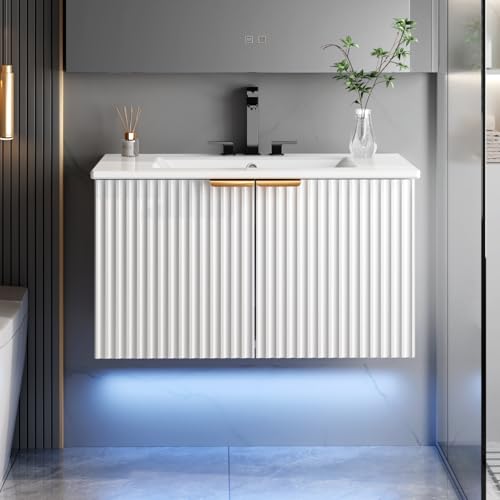
ELEVACHIC 30" Modern Wall Mounted Floating Vanity with Sink, White
Included for 'Best Floating Bathroom Vanities' because the listing specifies White, details this guide uses to compare options.
View on Amazon
OPERTION 48 Inch Fluted Floating Bathroom Vanity with Sink, Natural
Included for 'Best Floating Bathroom Vanities' because the listing specifies Natural, details this guide uses to compare options.
View on Amazon- 24 inches: The minimum practical size for a full bathroom. It suits a compact sink, soap, toothbrushes, and a few small toiletries.
- 30–36 inches: The most versatile range for a small or medium bathroom. It usually provides one useful drawer stack without overwhelming the room.
- 48 inches: A comfortable single-sink choice with substantial counter space, or a compact double-sink arrangement where local plumbing allows it.
- 60–72 inches: Best for a primary or shared bathroom. Confirm that the room can accommodate the length without making the toilet or shower feel crowded.
Leave about 30 inches of clear space in front of the vanity when possible; 21 inches is a commonly used minimum in tight layouts. Keep at least 15 inches from the centerline of a toilet or other side obstruction where the layout permits. Also check door swings, towel-bar locations, and the opening path of nearby drawers.
For a bathroom measuring approximately 5 by 8 feet, a 24–30-inch vanity is usually easier to live with than a 36-inch model, particularly if the toilet sits beside it. In a larger 10 by 12-foot bathroom, a 60-inch vanity can work comfortably, but only if the remaining walkway stays open and the shower door does not collide with the cabinet.
Drawer storage: wide drawers versus divided drawers
Floating vanities look spacious because the open floor beneath them creates visual room, but their storage capacity varies considerably. A cabinet with two broad drawers may hold more than one with four shallow drawers because the plumbing cutout takes less space and the drawer boxes can extend farther sideways.
Choose wide drawers when:
- You store folded towels, hair tools, or several bottles together.
- You want fewer drawer fronts and a cleaner appearance.
- The sink is offset or the cabinet uses a rear plumbing channel.
Choose multiple shallow drawers when:
- Several people need separate compartments.
- You keep small cosmetics, razors, dental supplies, or first-aid items.
- You want to organize items without stacking them.
Measure the usable interior rather than relying on exterior width. A 36-inch vanity may lose 8–12 inches of drawer depth or width around the sink, drain, and supply lines. Look for full-extension drawer slides, adjustable fronts, a sealed cabinet interior, and a top drawer designed around the plumbing rather than simply cut down at the job site.
Countertop materials compared
| Material | Advantages | Trade-offs | Best use |
|---|---|---|---|
| Quartz | Low maintenance, consistent color, resistant to ordinary bathroom stains | Heavy; edges can chip from hard impacts; usually costs more | Busy family and primary bathrooms |
| Porcelain or ceramic | Very low water absorption, easy cleaning, good heat resistance | Hard surface; damaged edges can be difficult to repair | Modern bathrooms and frequent use |
| Solid surface | Seamless integrated sinks are possible; scratches may be refinished | Can scratch more easily than quartz; may look less stone-like | Minimalist designs and easy-clean sink areas |
| Natural stone | Distinctive appearance and strong resale appeal | Needs appropriate sealing; some stones absorb stains or etch | Design-led renovations where maintenance is acceptable |
| Wood or wood-look laminate | Warm appearance and often a lower purchase price | Exposed edges and standing water can cause swelling or finish damage | Dry powder rooms or carefully maintained bathrooms |
For most households, quartz, porcelain, or solid surface offers the best balance of water resistance and maintenance. Regardless of material, wipe standing water near the faucet and backsplash, because repeated moisture can damage the cabinet below even when the countertop itself is waterproof.
Wall-mount requirements you should check first
A floating vanity transfers its weight—and the weight of the countertop, basin, and stored items—into the wall. The mounting rail or brackets should be fastened to structural studs, blocking, or a properly engineered backing system. Ordinary drywall anchors alone are not an adequate support method for a heavy stone-top cabinet.
Before ordering, identify the stud locations and confirm whether the cabinet’s mounting rail lines up with them. If the wall is tiled, the installer may need to locate studs through the finished surface or install blocking before tiling. A 60-inch vanity with a stone countertop can be substantially heavier than a small 24-inch cabinet, so the wall structure matters more as width increases.
Ask whether the vanity requires a continuous rear wall, side brackets, or a separate support frame. Some units include a cleat; others require the installer to supply hardware suitable for the wall type. Concrete, masonry, metal-stud, and wood-stud walls each need different fasteners.
Plumbing clearance and installation realities
Floating furniture does not automatically make plumbing easier. The drain and water supplies must fit inside the cabinet without striking drawers. Measure from the finished floor to the drain centerline, then compare that measurement with the cabinet’s rear panel and drawer layout.
- Confirm whether the drain exits through the wall or floor.
- Check that the P-trap fits within the cabinet’s plumbing zone.
- Look for a rear cutout or removable access panel.
- Leave enough room to shut off the water and service the drain later.
- Do not assume an existing floor drain can be hidden by a wall-mounted design without professional rerouting.
A wall drain is often simpler for a floating vanity, while a floor drain may require a carefully planned opening or plumbing modification. Drawer boxes can also collide with supply valves, especially in shallow cabinets. A vanity that appears compatible by width may still be unsuitable if its top drawer occupies the same space as the trap.
Construction materials: what lasts in a damp room?
Solid wood can be durable, but it expands and contracts with humidity and is not automatically more water-resistant than a well-sealed engineered panel. High-quality plywood or moisture-resistant engineered wood often provides more consistent cabinet stability at a lower price. Particleboard is acceptable when fully sealed and kept dry, but swollen edges are difficult to restore after a leak.
Inspect the areas that wear first: drawer-slide mounting points, sink cutout edges, the bottom of the cabinet, hinge screws, and the finish around the faucet. A sealed underside, soft-close full-extension slides, and a replaceable backsplash are more useful than decorative trim in a frequently used bathroom.
Typical market pricing in 2026 is approximately $250–$600 for a basic 24–36-inch floating vanity, $600–$1,500 for a better-built vanity with a quartz or porcelain top, and $1,500 or more for wide custom cabinetry, premium stone, or integrated sinks. Installation, faucets, mirrors, plumbing alterations, and wall reinforcement are usually additional.
Final buying checklist
- Measure finished wall width, available depth, and the clearance in front of the cabinet.
- Choose 24–30 inches for most compact bathrooms and 60–72 inches only when the room supports it.
- Verify the cabinet’s internal plumbing zone, not just its outside dimensions.
- Match the countertop to your maintenance tolerance: quartz and porcelain are practical, while natural stone needs more care.
- Confirm stud or blocking locations before selecting a heavy countertop.
- Prioritize full-extension drawers, sealed edges, and service access over extra decorative features.
- Check the assembled dimensions and box size against hallways, stairways, and bathroom doors.
The best floating bathroom vanities combine enough drawer space with a wall system and plumbing layout that can safely support them. For most small bathrooms, a 24–30-inch shallow cabinet with one or two well-designed drawers is the most reliable choice; larger rooms can justify a 48–72-inch model when wall reinforcement, clearance, and plumbing access have been confirmed.