Key takeaways
- One sharpener for a mixed household: Look for a three-stage model with coarse and fine abrasives, plus a polishing or honing stage. Confirm that its angle settings suit both your Western and Japanese-style knives.
- Mostly standard chef’s and paring knives: A compact, fixed-angle, two-stage sharpener is simpler to use and often takes up less counter space.
- Thin Japanese knives: Choose a sharpener with a 15-degree guide or an adjustable angle that includes 15 degrees. Avoid assuming a 20-degree sharpener will preserve the knife’s original geometry.
- Serrated bread knives: Buy only if the manufacturer explicitly allows serrated blades. Many electric sharpeners are intended for straight edges and can damage serrations.
- Very little storage space: Compare the actual footprint and cord storage, not just the product description “compact.” A manual pull-through sharpener may be more practical if you sharpen rarely.
Best Electric Knife Sharpeners: Choose by Knife, Edge, and Kitchen Space
The best electric knife sharpeners for most home cooks are compact, two- or three-stage models with guided angles, fine finishing abrasives, and slots compatible with the knives you actually own. Choose a flexible multi-angle sharpener for a mixed collection, a simple fixed-angle model for everyday Western knives, or a dedicated system if your kitchen centers on Japanese knives or serrated blades.
Quick picks by situation
- One sharpener for a mixed household: Look for a three-stage model with coarse and fine abrasives, plus a polishing or honing stage. Confirm that its angle settings suit both your Western and Japanese-style knives.
- Mostly standard chef’s and paring knives: A compact, fixed-angle, two-stage sharpener is simpler to use and often takes up less counter space.
- Thin Japanese knives: Choose a sharpener with a 15-degree guide or an adjustable angle that includes 15 degrees. Avoid assuming a 20-degree sharpener will preserve the knife’s original geometry.
- Serrated bread knives: Buy only if the manufacturer explicitly allows serrated blades. Many electric sharpeners are intended for straight edges and can damage serrations.
- Very little storage space: Compare the actual footprint and cord storage, not just the product description “compact.” A manual pull-through sharpener may be more practical if you sharpen rarely.
What matters more than the number of stages
Sharpening stages and what they do
A coarse stage removes metal to rebuild a dull or damaged edge. A fine stage refines that edge, while a polishing or honing stage smooths it and can help maintain a keen feel between more substantial sharpening sessions. More stages are not automatically better: if your knives are already in reasonable shape, a fine stage may be all you use most often.

Chef’sChoice 15XV EdgeSelect Professional Electric Knife Sharpener with 100-Percent Diamond Abrasives and Precision Angle Guides for Straight Edge and Serrated Knives, 3-Stage, Gray
Included for 'Best Electric Knife Sharpeners' because the listing specifies 3-Stage and Gray, details this guide uses to compare options.
View on Amazon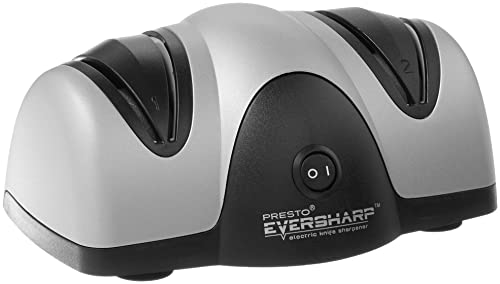
Presto 08800 EverSharp Electric Knife Sharpener
Included for 'Best Electric Knife Sharpeners' as a relevant option in this category; details come from the product listing.
View on Amazon
Work Sharp E2 Electric Kitchen Knife Sharpener
Included for 'Best Electric Knife Sharpeners' as a relevant option in this category; details come from the product listing.
View on AmazonFor a neglected knife, begin with the least aggressive stage that can restore the edge, then progress through the finer stages as directed. Repeated coarse sharpening removes metal, so using it on every occasion can shorten a knife’s useful life. Check the maker’s instructions; stage names and recommended order vary.
Abrasive materials: speed versus edge refinement
| Abrasive | Typical role | Trade-off to consider |
|---|---|---|
| Diamond | Fast stock removal and edge shaping | Effective on hard steels, but a coarse diamond stage can remove metal quickly if overused. |
| Alumina ceramic | Fine sharpening, honing, or polishing | Useful for refining an edge; usually slower than a coarse abrasive for major repairs. |
| Carbide | Rapid edge restoration in some basic sharpeners | Can be aggressive and may leave a rougher edge; use only with the knife types and technique specified. |
These materials are not interchangeable indicators of quality. The abrasive’s grit, shape, angle, and how the machine guides the blade all affect the result. For most kitchens, a controlled coarse stage paired with a finer finishing stage is more useful than a list of abrasive materials without clear stage instructions.
Angle guides and blade compatibility
Angle is the edge angle on each side of the blade, not the combined angle across both sides. Many Western kitchen knives use an edge around 20 degrees per side; many Japanese-style knives are sharpened around 15 degrees per side. These are common conventions, not universal rules. Follow the knife maker’s guidance when available, especially for specialty or premium blades.
A fixed guide removes guesswork, which is helpful for routine sharpening, but it may not match every knife in a varied drawer. An adjustable sharpener is more versatile only if its settings cover your knives and are easy to select accurately. Check compatibility for blade length and thickness, straight versus serrated edges, single-bevel knives, and any restrictions on coated or specialty blades.
Do not force a thick blade into a narrow slot or draw a serrated edge through a slot designed for straight edges. These mismatches can produce poor contact or damage the knife. If a knife has a single-bevel edge, unusual geometry, or a delicate finish, use a sharpening method specifically recommended for it.
Motor performance, noise, and countertop fit
A motor that maintains a steady speed under light pressure makes sharpening more predictable. A powerful-sounding motor is not necessarily a better choice: excessive pressure can overheat an edge or remove more metal than necessary. Prefer a machine with stable feet, a secure blade guide, and instructions that emphasize light, even passes. If the sharpener heats noticeably, vibrates across the counter, or requires you to push hard, stop and check the technique and manufacturer guidance.
Before buying, measure the space where you plan to use and store it. The figures below are practical planning allowances, not dimensions for every model; confirm the manufacturer’s stated size and cord arrangement.
| Countertop or storage situation | Useful planning allowance | What to check |
|---|---|---|
| Small counter or narrow shelf | About 8 × 5 in (20 × 13 cm) of clear footprint | Whether the machine fits without blocking prep space and whether the cord detaches or wraps underneath. |
| Using it beside a backsplash | About 12 in (30 cm) of front-to-back working depth | Room for your hand and the full knife stroke; the sharpener itself may be smaller. |
| Cabinet or drawer storage | Allow roughly 4 in (10 cm) above the unit when lifting it out | Actual height, handle clearance, cord bulk, and whether the unit can be stored securely. |
These allowances help you plan a workable station, but they are not standardized product measurements. A sharpener that fits the shelf may still be awkward to use there if the blade cannot travel through its full stroke. For a small kitchen, favor a stable, lightweight unit with enclosed abrasives and simple cord storage over a larger machine with stages you are unlikely to use.
Two-stage or three-stage: which should you buy?
A two-stage model is usually the sensible choice for a household with a few straight-edge knives that receive regular care. It tends to be simpler to store and operate, and it can handle basic sharpening and refinement. A three-stage model makes more sense if you often restore dull edges, want a distinct polishing step, or need separate stages for different knife types. It is not a substitute for checking the angle and blade compatibility.
Electric sharpeners commonly fall into broad price bands: basic models are often around $30–$70, while more feature-rich units are often around $70–$200 or more. These are general market ranges, not guarantees of performance. Pay for useful compatibility and controls rather than stage count alone.
Before the first sharpening session
- Read the manual for permitted blade types, angle settings, and stage order.
- Place the unit on a dry, level surface with enough room for the entire blade stroke.
- Clean and dry the knife; food residue can interfere with handling and sharpening.
- Use light, steady passes rather than pressing down. Follow the maker’s recommended number of passes.
- Wipe away metal dust and clean the sharpener only as its instructions allow; never rinse an electric unit unless it is specifically designed for that.
- Store the machine unplugged, with the cord secured and the abrasive slots protected from debris.
Bottom line
For a typical home kitchen, the best electric knife sharpener is a stable, compact two- or three-stage model with a fine finishing stage and an angle that matches your main knives. If your drawer mixes Western and Japanese blades, prioritize adjustable or clearly differentiated angle guides. If you own serrated, single-bevel, or specialty knives, verify compatibility before buying—or choose a separate sharpening method for those blades.