Key takeaways
- Overall width: Measure from the outside of the left arm to the outside of the right arm. For an L-shaped sectional, measure both legs separately rather than adding only the longest side.
- Seat width: Measure the usable seating area between the arms. Covers sized by total frame width can still be wrong if the arms are unusually thick.
- Seat depth: Measure from the front edge of the seat cushion to the back cushion. A 24-inch seat and a 30-inch seat need different cover proportions.
- Chaise depth: Measure from the front of the chaise to its back, not from the sofa’s front edge. Chaises commonly range from about 55 to 70 inches deep.
- Arm height and width: Measure from the floor to the top of the arm and across the arm at its widest point. Rounded or pillow-top arms need extra allowance.
- Cushion thickness: Measure compressed and uncompressed thickness if the cushion is soft. A cover that fits a 6-inch cushion may strain over a 10-inch cushion.
- Corner design: Identify whether the corner is a square seat, wedge, or curved piece. A standard square-corner cover will not neatly fit every wedge corner.
The best sectional slipcovers are usually two-piece stretch covers for modular sectionals, while tailored covers are the better choice when you need precise cushion coverage, a formal look, or protection for an unusual layout.
Best sectional slipcovers by situation
| Situation | Best choice | Why it works | Check before buying |
|---|---|---|---|
| Small apartment or compact L-shape | Separate stretch covers for each seat and back cushion | They follow corners more closely and are easier to remove for washing. | Measure the full sofa width, chaise depth, and arm width; leave at least 30 inches for the main walking path. |
| Children, pets, or frequent spills | Machine-washable polyester or polyester-spandex covers | Stretch fabric accommodates movement, while removable pieces let you wash only the dirty section. | Look for a washable label, colorfast fabric, and separate cushion covers. |
| Rental home | Universal, no-sew stretch slipcover | It changes the room without permanent alterations and can move with you. | Use foam tuckers or rolled towels rather than adhesives that may mark upholstery. |
| Back pain or a firm, structured sofa | Tailored cover with individual cushion panels | It is less likely to bunch behind the back or change the cushion’s sitting angle. | Confirm that the cover has separate back and seat sections instead of one loose shell. |
| U-shaped or unusually deep sectional | Custom or semi-custom tailored covers | They can account for multiple corners, armless pieces, and nonstandard proportions. | Submit measurements for every module; one standard L-shaped set rarely covers a U-shape correctly. |
Stretch versus tailored sectional slipcovers
Stretch covers: easier fit and simpler care
Stretch covers are made from knitted polyester, polyester-spandex, cotton blends, or similar flexible fabrics. They are generally the best sectional slipcovers for a standard L-shaped sofa with removable cushions and fairly symmetrical arms. The fabric stretches over the frame, then tucks into the gaps around the cushions.
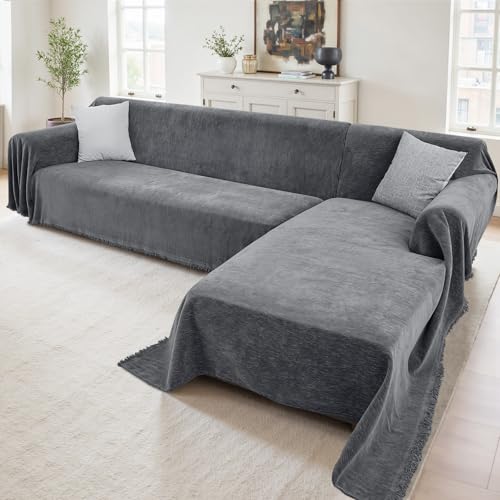
Houmiggle 2 Pieces Sectional Couch Covers L Shaped Cover XL Dark Gray
Included for 'Best Sectional Slipcovers for a Better Fit and Easier Cleaning' as a relevant option in this category; details come from the product listing.
View on Amazon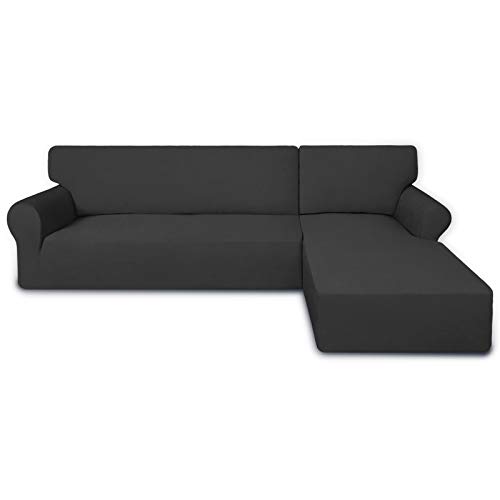
PureFit Super Stretch Sectional Couch Covers - 2 pcs Spandex Non Slip, with Elastic Bottom for L Shape Sectional Sofa Couches, Great for Kids & Pets (3 Seat Sofa + 3 Seat Chaise, Dark Gray)
Included for 'Best Sectional Slipcovers for a Better Fit and Easier Cleaning' because the listing specifies 2 pcs Spandex Non Slip and with Elastic Bottom for L Shape Sectional Sofa Couches, details this guide uses to compare options.
View on Amazon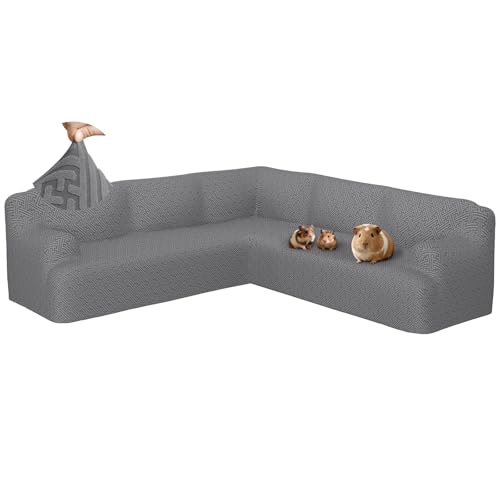
ROFASVCO Sectional Couch Covers L Shape Sofa Cover 1 Piece Stretch Corner Couch Covers Non Slip Washable Sofa Slipcovers Soft Fleece Furniture Protector for Dogs Pet(X-Large, Dark Gray)
Included for 'Best Sectional Slipcovers for a Better Fit and Easier Cleaning' because the listing specifies Dark Gray), details this guide uses to compare options.
View on Amazon
HOMERILLA 2 Piece Sectional Couch Cover for L Shape Sofa Dark Grey XL
Included for 'Best Sectional Slipcovers for a Better Fit and Easier Cleaning' as a relevant option in this category; details come from the product listing.
View on AmazonThe main advantage is tolerance. If your sectional is a few inches wider or narrower than the listed range, a quality stretch cover may still look acceptable. Separate covers for the armless chair, corner unit, chaise, and sofa section are more effective than one cover designed to drape over the entire sectional.
The trade-off is that stretch fabric can reveal the original shape. Broad rolled arms, very deep seats, attached back cushions, and sharply angled corners can cause diagonal wrinkles. Covers also tend to work loose where people sit most: the front edge of the seat, the inside corner, and the gap between the chaise and the sofa.
Tailored covers: cleaner lines and better coverage
Tailored slipcovers use fitted panels, ties, elastic, zippers, or welted seams to follow the sectional’s dimensions. They are preferable when appearance matters as much as washability, or when the furniture has separate box cushions, skirt details, narrow arms, or a defined silhouette.
A tailored cover can cover more of the frame and stay in position better, but it requires more accurate measurements. It is also less forgiving if the sectional has been modified, such as adding a replacement chaise or swapping in thicker cushions. Some tailored covers are made for a specific sectional model; others are semi-custom and require a measurement form.
For the most secure fit, choose individual covers for seat cushions and back cushions whenever possible. A single cover over several seat cushions is faster to install, but it can pull against the cushion seams and make one cushion lift when another person sits down.
Fit details that prevent loose or mismatched covers
Do not measure only the front width. A sectional is a group of connected modules, and each module affects the cover’s fit.
- Overall width: Measure from the outside of the left arm to the outside of the right arm. For an L-shaped sectional, measure both legs separately rather than adding only the longest side.
- Seat width: Measure the usable seating area between the arms. Covers sized by total frame width can still be wrong if the arms are unusually thick.
- Seat depth: Measure from the front edge of the seat cushion to the back cushion. A 24-inch seat and a 30-inch seat need different cover proportions.
- Chaise depth: Measure from the front of the chaise to its back, not from the sofa’s front edge. Chaises commonly range from about 55 to 70 inches deep.
- Arm height and width: Measure from the floor to the top of the arm and across the arm at its widest point. Rounded or pillow-top arms need extra allowance.
- Cushion thickness: Measure compressed and uncompressed thickness if the cushion is soft. A cover that fits a 6-inch cushion may strain over a 10-inch cushion.
- Corner design: Identify whether the corner is a square seat, wedge, or curved piece. A standard square-corner cover will not neatly fit every wedge corner.
Compare your measurements with the manufacturer’s range, and avoid relying on labels such as “three-seat” or “oversized.” Two three-seat sectionals can differ by more than 20 inches in width. If your measurements fall at the top of a stretch cover’s range, size up only when the instructions permit it; otherwise the seams may remain under constant tension.
| Measurement or clearance | Useful target | Why it matters |
|---|---|---|
| Sectional-to-coffee-table clearance | 14–18 inches | Allows comfortable legroom while keeping the table close enough to use. |
| Main walking path around the sectional | 30–36 inches | Reduces snagging and makes a cover installation less awkward. |
| Back clearance from the wall | 2–6 inches, depending on the recline mechanism | Leaves room to tuck the cover without crushing it against the wall. |
| Typical seat height after covering | 17–20 inches from the floor | Thick, tucked fabric should not create an uncomfortable extra ridge at the front edge. |
| Room example for a compact L-sectional | About 10 by 12 feet | Usually workable for a sectional around 90–105 inches on the long side, provided the walkway and table clearances remain open. |
Fabric and care: what to choose for everyday use
Polyester-spandex is the practical default for households that want easy installation and frequent washing. It resists wrinkling and stretches around corners, but it may feel warmer and can show pet hair. Brushed polyester or microfiber feels softer and can hide minor wear, although it may attract lint and require careful drying.
Cotton-rich covers have a more natural hand and may feel cooler, but they can shrink, crease, and lose shape if washed or dried at high temperatures. Linen-look fabrics provide a relaxed appearance but are usually less forgiving around tight corners. Velvet-style stretch covers add visual depth, yet crushed nap can make one cushion appear a different shade from another.
For spills and muddy paws, prioritize a removable, machine-washable cover over a fabric marketed only as stain resistant. Wash cold or according to the care label, use a mild detergent, and avoid high heat unless the instructions specifically allow it. High-heat drying is one of the quickest ways to turn a correctly fitted cover into a tight, shrunken one.
Coverage and durability realities
A slipcover protects the areas it reaches, but “full coverage” can mean different things. Some products cover the front, seat, and arms while leaving the back partially exposed. This is fine when the sectional sits against a wall, but not when it floats in the room. Check whether the rear panel is finished and whether the underside has elastic, ties, or a separate fastening system.
The first wear points are usually the seat front, inside corner, chaise edge, and areas beneath the arms. Covers that rely only on tucked fabric may need weekly repositioning in a busy home. Elastic hems and foam inserts help, but they cannot compensate for a wrong size. For a sectional used every day, a two-cover rotation is often more useful than buying the most decorative fabric available: one can be on the sofa while the other is being washed.
Moving also affects the decision. A sectional cover may weigh only a few pounds, but a complete modular sectional can require several people and a doorway at least 30–32 inches wide, depending on the largest piece and its angle. Remove cushions before measuring the route. If your sectional is likely to be moved through narrow hallways, separate covers for each module are easier to remove, pack, and reinstall than one oversized cover.
How to install a sectional slipcover without loose pockets
- Label each cover before installation: sofa, corner, armless chair, and chaise.
- Place the cover over the frame with the seams aligned to the front corners and arms.
- Pull the fabric evenly from side to side instead of stretching one corner fully before the other.
- Tuck fabric deeply into the gaps around the seat cushions using the supplied foam cylinders or smooth fabric rolls.
- Replace cushions only after the frame is covered, then pull the cushion panels tight and close their fasteners.
- Sit in each position and check for exposed upholstery, blocked recliner levers, or fabric pulling at the corner.
Choose stretch covers when your priority is flexibility, affordable replacement, and easy washing. Choose tailored covers when the sectional has an unusual layout, visible rear surfaces, structured cushions, or a polished room design. In either case, accurate module-by-module measurements matter more than a broad label such as “universal.”