Key takeaways
- Measure the delivery route. Check doorways, stair turns, hallways, and elevator openings. Long side rails may need to be carried at an angle, and bulky cartons can be awkward even when the assembled bed fits the room.
- Sort parts before building. Separate the upper frame, trundle rails, slats, and fasteners. Build on a protected floor and avoid fully tightening all bolts until the frame is aligned.
- Check the trundle before adding the mattress. Roll it in and out several times, confirm it clears the bed supports, and make sure the pull handle is accessible.
- Recheck fasteners after use begins. Follow the assembly guide’s instructions for tightening. If the frame starts to wobble or squeak, check joints, slats, and wheels before adding more weight.
- Keep the operating zone clear. Teach children not to sit or climb on a partly extended trundle, and keep fingers clear of the gap between moving parts.
A twin bed frame with a pull out bed works by storing a second, usually twin-size mattress beneath the main bed and rolling or lifting it out when needed.
It can be a practical choice for children’s sleepovers, shared bedrooms, or occasional guests, provided the room has enough floor space for the lower bed and the trundle mattress fits its height limit. Before buying, check the frame’s usable mattress dimensions, clearance beneath the main bed, and the manufacturer’s weight limits—not just the headline bed size.
- A twin bed frame with a pull out bed works by storing a second, usually twin-size mattress beneath the main bed and rolling or lifting it out when needed.
- How the pull-out bed works
- Measurements to check before choosing
- Choose by room and sleeping situation
- Mattress thickness, bedding, and fit
- Construction trade-offs
- Assembly and moving tips
- When a queen bed frame with pull out bed makes more sense
- Final buying check
How the pull-out bed works
A typical trundle sits on a low wheeled frame underneath the main bed. You pull it out across the floor when it is time to sleep, then slide it back under the upper bed after use. Some models remain low; others use a pop-up mechanism that raises the trundle mattress closer to the height of the main mattress.

VECELO Twin Trundle Bed Frame Only/Roll Out/Enhanced & Up-Graded Metal Slats Support with Lockable Casters, Pure White
Included for 'Twin Bed Frame with Pull Out Bed: How It Works and Best Uses' because the listing specifies Pure White, details this guide uses to compare options.
View on Amazon
VECELO Twin Trundle Bed Frame Only/Roll Out/Enhanced & Up-Graded Metal Slats Support with Lockable Casters, Classic Black
Included for 'Twin Bed Frame with Pull Out Bed: How It Works and Best Uses' because the listing specifies Classic Black, details this guide uses to compare options.
View on Amazon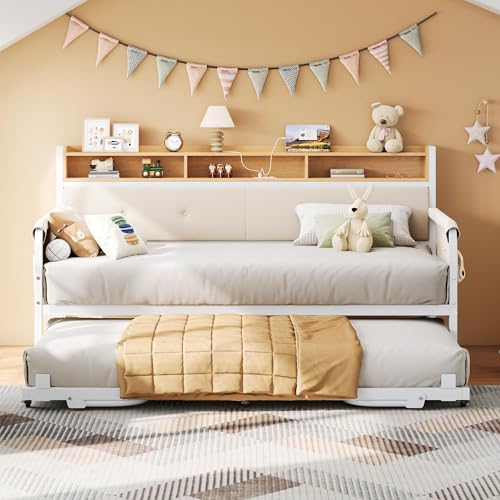
LIKIMIO Daybed with Trundle, Twin Bed Frame,White
Included for 'Twin Bed Frame with Pull Out Bed: How It Works and Best Uses' because the listing specifies Twin Bed Frame and White, details this guide uses to compare options.
View on Amazon
IDEALHOUSE Twin Daybed with Trundle, Metal Twin Size Daybed with Pullout Trundle 6 Casters, Steel Slat Support Sofa Bed for Living Room, Bedroom, Guest Room (Black)
Included for 'Twin Bed Frame with Pull Out Bed: How It Works and Best Uses' because the listing specifies Metal Twin Size Daybed with Pullout Trundle 6 Casters and Steel Slat Support Sofa Bed for Living Room, details this guide uses to compare options.
View on AmazonThe terms “twin bed” and “twin trundle” do not guarantee that every twin mattress will fit. A standard U.S. twin mattress is about 38 by 75 inches, but the trundle opening may be narrower or shorter. Measure the actual mattress platform and check the product specifications before purchasing a mattress.
Measurements to check before choosing
The main bed determines the room footprint when closed; the pulled-out trundle determines how much open floor space you need for sleeping and access. The estimates below use standard twin mattress dimensions and allow for a little maneuvering room. Frame designs vary, so use the assembled dimensions for the specific bed when planning.
| Measurement | Useful planning figure | Why it matters |
|---|---|---|
| Standard twin mattress | About 38 × 75 in. | Confirm the frame’s usable mattress area; some platforms require a slightly smaller mattress. |
| Trundle mattress thickness | Often 6–8 in.; verify the model’s stated maximum | A mattress that is too thick may catch on the main bed or prevent the trundle from sliding fully underneath. |
| Clearance below the main bed | Measure from floor to the lowest rail, support, or obstruction | The mattress, trundle platform, wheels, and bedding all need to fit within this opening. |
| Open trundle footprint | About 38 × 75 in. for the mattress alone | Allow roughly 3 ft of open space beside the main bed for the trundle, plus a clear route to the room door. |
| Usable access around beds | Aim for 24–30 in. along a regular walking side where possible | Extra clearance makes it easier to make beds and move around; tight rooms may need one side against a wall. |
For example, a 10 × 12 ft room can often accommodate a twin bed and a trundle if the main frame is placed along a long wall and the trundle opens into an uncluttered area. A desk, closet door, radiator, or dresser opposite the bed can make that layout impractical. Mark the closed bed and fully open trundle on the floor with painter’s tape before ordering.
Choose by room and sleeping situation
| Your situation | What to prioritize | Watch out for |
|---|---|---|
| Child’s bedroom and regular sleepovers | Sturdy slats, a simple pull handle, rounded edges, and a trundle that a child can operate with supervision | Pinch points, loose hardware, and toys or rugs caught under the wheels |
| Guest room used occasionally | A low-profile mattress that stays within the height limit and a frame that is easy for one adult to pull out | Storing damp bedding or leaving a mattress compressed under the bed for long periods if its care instructions advise against it |
| Small apartment or shared room | A frame with a compact closed footprint and a trundle that opens toward the clearest part of the room | Blocking the only walkway, closet, or exit when the lower bed is in use |
| Frequent adult guests | A pop-up trundle or another design that raises the second mattress, plus clearly stated weight limits | Assuming a low trundle offers the same getting-in-and-out comfort as a regular-height bed |
If two adults need separate beds regularly, check the frame’s maximum load and mattress support specifications carefully. A low trundle may work for occasional use, but its lower height can be less comfortable for some guests. A twin-over-twin daybed with a pop-up trundle offers a more level sleep surface when raised, but needs enough vertical and lateral clearance to operate.
Mattress thickness, bedding, and fit
Trundle mattresses are usually thinner than standard mattresses because they have to clear the underside of the upper bed. Many frames call for a mattress around 6–8 inches thick, but the exact maximum is model-specific. Measure the space from the trundle platform to the lowest point of the upper frame, then leave clearance for the mattress cover and bedding. A mattress that fits without sheets may bind once dressed.
Do not choose a mattress solely by its advertised thickness. Foam can compress differently from a spring mattress, and mattress dimensions can vary slightly by maker. Use the frame maker’s specified size and thickness range. Also check the mattress’s weight: a heavy mattress can make a wheeled trundle harder to pull and may exceed the platform’s limit.
Construction trade-offs
| Frame material | Advantages | Trade-offs to check |
|---|---|---|
| Solid wood | Can be sturdy and repairable; often suits furniture intended for long-term use | May be heavy to move; slats and joints still need regular checks for loosening |
| Engineered wood | Often less expensive and available in finished colors | Repeatedly tightening fasteners can damage worn holes; protect edges from moisture and impacts |
| Metal | Often lighter-looking, with open clearance that can simplify cleaning | Inspect welds and connectors; metal parts can squeak if joints loosen or rub |
Regardless of material, look for closely spaced, well-supported slats and a trundle base designed for rolling. Wheels may snag on thick rugs, uneven flooring, or raised thresholds. A smooth, firm floor makes daily use easier; a thin rug can help protect flooring only if it does not bunch under the wheels.
Assembly and moving tips
- Measure the delivery route. Check doorways, stair turns, hallways, and elevator openings. Long side rails may need to be carried at an angle, and bulky cartons can be awkward even when the assembled bed fits the room.
- Sort parts before building. Separate the upper frame, trundle rails, slats, and fasteners. Build on a protected floor and avoid fully tightening all bolts until the frame is aligned.
- Check the trundle before adding the mattress. Roll it in and out several times, confirm it clears the bed supports, and make sure the pull handle is accessible.
- Recheck fasteners after use begins. Follow the assembly guide’s instructions for tightening. If the frame starts to wobble or squeak, check joints, slats, and wheels before adding more weight.
- Keep the operating zone clear. Teach children not to sit or climb on a partly extended trundle, and keep fingers clear of the gap between moving parts.
Plan to move the bed frame in pieces rather than trying to carry it assembled through a narrow doorway. If you expect to relocate soon, consider the weight of each section, whether the frame can be disassembled without damaging the joints, and whether the parts will fit in your vehicle.
When a queen bed frame with pull out bed makes more sense
A queen bed frame with pull out bed is an option when the primary sleeper needs a wider main mattress but still wants a second sleeping surface for guests. It takes up more room when closed and needs additional clearance when opened. Compare the complete frame dimensions and trundle layout rather than assuming the lower bed will be a standard twin; some designs use different mattress sizes or a pop-up mechanism. For a child’s room or a compact guest room, a twin setup is generally easier to fit and maneuver.
Final buying check
A twin bed frame with pull out bed is a good fit when the trundle will be used often enough to justify its floor-space needs, the mattress stays within the frame’s thickness and weight limits, and the open bed does not block a doorway or essential furniture. Confirm the exact mattress dimensions, measure the under-bed clearance, test the proposed room layout with tape, and review the assembly and support specifications before choosing.