Key takeaways
- Tall and narrow tv stand (30-40″ H x 32-44″ W x 14-16″ D): Best for small bedrooms, apartments, and corners. It holds a 50 to 65 inch TV safely if the top is at least 4 inches wider than the TV’s feet/legs on each side. Ideal when you have less than 48 inches of wall space.
- Wide low stand (20-24″ H x 58-70″ W): Better if you have a long blank wall and want a dresser-like look. It provides more surface area but often puts the screen too low for bed viewing without a wall mount.
What's inside
A tall TV stand for bedroom viewing should place the center of your screen at your eye level while lying in bed, which for most adults means a stand that is 30 to 40 inches tall — significantly taller than the 18 to 24 inch stands designed for living room sofas.
How to Calculate the Right Stand Height for Your Bed
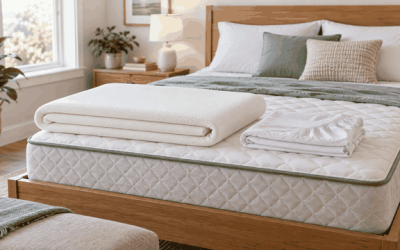
Unlike a living room where your eye level is about 36 to 42 inches from the floor when seated on a sofa, your eye level in bed is determined by your mattress height plus your pillows. Getting this wrong means craning your neck up or slouching down for hours.
Use this simple formula:
Ideal Stand Height = (Your Eye Height in Bed) – (Half of Your TV’s Height)
Your eye height in bed is your mattress top height + about 8 to 12 inches (the height of your head on a standard pillow). Half of your TV’s height is easy to estimate: a 55-inch TV is about 27-28 inches tall, a 65-inch is about 32-33 inches tall, and a 50-inch is about 24-25 inches tall.
| Your Mattress Top Height (floor to top of mattress) | Your Eye Height in Bed (approx.) | Ideal TV Center Height | Ideal Stand Height for 55″ TV (28″ tall) | Ideal Stand Height for 65″ TV (32″ tall) |
|---|---|---|---|---|
| 20 in. (low platform bed) | 28 – 30 in. | 28 – 30 in. | 14 – 16 in. | 12 – 14 in. |
| 24 in. (standard bed frame + mattress) | 32 – 36 in. | 32 – 36 in. | 18 – 22 in. | 16 – 20 in. |
| 28 in. (tall bed frame, pillow-top mattress) | 36 – 40 in. | 36 – 40 in. | 22 – 26 in. | 20 – 24 in. |
| 32 in. (extra-tall storage bed) | 40 – 44 in. | 40 – 44 in. | 26 – 30 in. | 24 – 28 in. |
| Example: 25 in. mattress + 10 in. pillow height = 35 in. eye height | 35 in. | 35 in. | 21 in. (35 – 14) | 19 in. (35 – 16) |
Most shoppers underestimate how high their bed actually is. Measure from the floor to the top of your mattress, then add your pillow height. If the result is 36 inches or more, you will be far more comfortable with a 30 inch tall tv stand or even a 36 inch tall tv stand than with a standard media console. A low stand will force you to look downward, which strains your neck when you are propped up on pillows.
When to Choose a 30-Inch vs. 36-Inch Tall TV Stand
A 30 inch tall tv stand is the sweet spot for most bedrooms with standard 24 to 26 inch mattress heights and TVs between 50 and 65 inches. It puts a 55-inch screen’s center at about 44 inches from the floor (30 inch stand + 14 inch half-TV height), which aligns perfectly with a propped-up viewing position.
A 36 inch tall tv stand is better if you have a tall bed (28 inches or higher), you like to sit fully upright in bed with a headboard, or you have a smaller TV (43 to 50 inches) where you need extra lift to bring the center up. It also works well if you want to watch from a greater distance, like from across a 10×12 ft bedroom, where a slightly higher angle reduces glare from bedding.
Anything below 24 inches is almost always too low for bedroom use unless you have a very low Japanese-style platform bed. The 24-40 in. range covers 95% of bedroom setups, with 28-36 inches being the most versatile.
Do You Need a Narrow or Thin TV Stand for a Bedroom?
In a bedroom, floor space is tighter than in a living room. A standard 58 to 65 inch wide console that fits a living room wall will often block a closet door or window in a 10×12 ft bedroom, where you typically have only 6 to 8 feet of usable wall after accounting for a queen bed (60 inches wide) and nightstands.
This is where a narrow tv stand for bedroom layouts or a thin tv stand for bedroom use makes sense. These terms usually mean the same thing: a stand that is 36 to 48 inches wide and 14 to 16 inches deep, compared to a standard stand that is 20 inches deep.
- Tall and narrow tv stand (30-40″ H x 32-44″ W x 14-16″ D): Best for small bedrooms, apartments, and corners. It holds a 50 to 65 inch TV safely if the top is at least 4 inches wider than the TV’s feet/legs on each side. Ideal when you have less than 48 inches of wall space.
- Wide low stand (20-24″ H x 58-70″ W): Better if you have a long blank wall and want a dresser-like look. It provides more surface area but often puts the screen too low for bed viewing without a wall mount.
For stability, check the depth. A thin stand that is only 12 inches deep can be tippy with a tall, heavy TV. Look for a depth of at least 14 inches and a wide base or wall-anchor option if you go thin.
Storage vs. Minimal Design: Drawers, Shelves, and Cabinets
A tv stand with storage for bedroom use solves a real problem: bedrooms rarely have enough closed storage for media, bedding, and clothes. You have three main types, and the right one depends on what you need to hide.
Tall TV Stand With Storage: Which Type Fits Your Situation?
| Situation | Best Storage Type | Why It Works | What to Check |
|---|---|---|---|
| Small apartment, need dresser + TV stand | TV stands with drawers for bedroom (3-5 drawers, 36-42″ tall) | Replaces a small dresser; hides clothes, linens | Drawer depth at least 13 in.; weight limit 80-120 lbs total; anti-tip hardware included |
| Need to hide router, game console, and clutter | Tall tv stand with storage: cabinets with doors + open shelves | Doors hide wires and boxes; open shelf for soundbar | Back panel has cable cutouts; shelf height at least 8 in. for consoles |
| Minimalist or renter who moves often | Open shelving tower (2-3 shelves, no drawers) | Lighter, cheaper, easier to assemble and move | Box weight 35-50 lbs vs. 65-90 lbs for drawer models |
| Kids or pets in the bedroom | Closed storage with soft-close drawers | No open shelves to climb; no small objects to pull down | Anchoring required; avoid tempered glass doors |
A tv stand with storage for bedroom organization usually costs slightly more — typically $150–$350 for open-shelf metal/wood models and $250–$500 for solid drawer chests — but it saves you from buying a separate dresser. If you choose tv stands with drawers for bedroom use, make sure the top drawer is not too high to open comfortably when the TV is on top; 36 to 40 inches is usually the maximum comfortable drawer height.
Material and Construction Trade-Offs
The material affects not just look, but weight, durability, and how much weight it can hold. Most bedroom TV stands list a top weight limit of 60 to 120 lbs, which is enough for any TV up to 65 inches (a 65-inch TV typically weighs 45-55 lbs without its stand).
| Material | Typical Weight Limit (Top) | Pros | Cons | Best For |
|---|---|---|---|---|
| Solid wood (pine, rubberwood) | 100 – 150 lbs | Most durable, can be refinished, stable | Heavy (70-100 lbs assembled), usually $300–$600, can warp in humidity | Forever furniture, tall dresser-style stands |
| Engineered wood (MDF / particleboard with veneer) | 60 – 100 lbs | Affordable ($120–$280), smooth finish, lighter | Chips if bumped during moves, sags if overloaded, sensitive to water | Budget and renter-friendly options, 30 inch models |
| Metal frame + wood shelves | 80 – 120 lbs | Strong, narrow profile, modern look, lighter than solid wood | Less closed storage, can wobble if joints loosen | Tall and narrow tv stand designs for small spaces |
| Metal + tempered glass | 60 – 80 lbs | Very thin visual profile | Shows dust, glass can chip, lowest storage | Minimalist bedrooms where you want a thin tv stand for bedroom |
For a tall tv stand for bedroom daily use, metal frame with engineered wood shelves offers the best balance of height, stability, and easy moving. Solid wood is worth it if you want a tall tv stand with storage that doubles as a bedroom dresser for years.
Assembly, Moving, and Tip-Over Safety Realities
Tall furniture in a bedroom carries a real tip-over risk, especially drawer models that become top-heavy when a TV is on top and drawers are opened.
- Always anchor it. Any stand over 30 inches tall should be secured to the wall with the included anti-tip strap or L-bracket, especially on carpet where it can lean. This is non-negotiable if you have children or pets who might climb, or if the stand holds more than 50 lbs on top. Use a stud or a proper drywall anchor — the small plastic anchors included in many flat-packs are not enough for a loaded stand.
- Check weight distribution. Place heavier items (books, storage bins) on the bottom shelf or lower drawers, not on top. A 65-inch TV weighing 50 lbs placed on a 36-inch tall stand creates significant leverage if the stand is bumped.
- Measure your path in. A tall and narrow tv stand often ships in one box weighing 45 to 85 lbs. Before you buy, measure your bedroom doorway (usually 28 to 30 inches wide) and hallway turns. Assembled drawer chests are often 16 to 18 inches deep and will fit, but fully assembled one-piece metal towers may not turn a tight corner. Look for “assembly required” if you have narrow apartment hallways — it’s actually easier to move in.
- What wears first. On engineered wood models, the drawer slides and the cam-lock joints loosen first after 2-3 moves. On metal frames, the weld points and shelf pins stay solid longer, but open backs can make the unit rack side-to-side if not tightened evenly. Tighten all bolts every 6-12 months.
- Clearance and ventilation. Leave at least 2 inches behind the stand for cables and airflow, 4-6 inches on each side of a game console, and 18-24 inches of clear floor space in front of drawers so they can fully extend without hitting the bed frame.
For renters who cannot drill into walls, choose a shorter, wider, and heavier stand (under 30 inches) with a low center of gravity, or use furniture anchor alternatives like anti-tip furniture straps that use adhesive plates rated for 80+ lbs — though a proper stud anchor is always safer where allowed.
How to Choose in 30 Seconds
If you want a quick decision without measuring twice, match your situation:
- Standard queen bedroom, 10×12 ft, TV is 55-65 inches: Choose a 30 inch tall tv stand, 42-48 inches wide, with one open shelf for a soundbar and one cabinet. It gives eye-level viewing without dominating the wall.
- Very small bedroom or studio, TV is 43-55 inches: Choose a tall and narrow tv stand, 32-36 inches wide and 30-36 inches tall, metal frame with wood shelves. It fits beside a closet and keeps floor space open.
- Need maximum storage and have a tall bed: Choose a 36 inch tall tv stand with 3-4 drawers. It acts as a dresser and brings a smaller TV up to the right height.
- Kids share the room or pets sleep in the bedroom: Choose a wide, closed-storage model under 34 inches and anchor it. Avoid tall open shelving they can climb.
Measure your mattress height first, then pick the stand height that puts your TV’s center at that eye level. When in doubt between two heights, go slightly higher — looking slightly down from bed is more comfortable than looking up from a low stand.