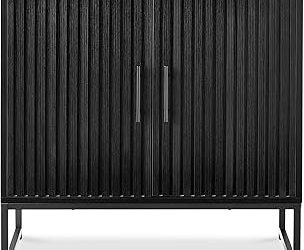
Key takeaways
- Plastic or wood-on-wood runners (common on budget pieces under $150): no ball bearings, prone to sticking or swelling with humidity changes, and often the first thing to crack after 1-2 years of regular use.
- Metal side-mount glides (mid-range, roughly $200-$450): smoother action, rated for moderate daily use, but can develop play or rattle at the mounting screws over several years.
- Full-extension ball-bearing glides (higher-end, often $400+): let the drawer pull out completely, rated for repeated daily use over a decade or more, and are the standard on better oak console tables with drawers and shelf combinations.
What's inside
A console table with drawers and shelves is only as useful as the space actually behind the drawer front and the clear height under the shelf, and both numbers are usually smaller than they look in a listing photo. A drawer marketed as “fits mail and keys” typically has 2-2.5 inches of usable interior depth once you account for the drawer box walls, and a shelf meant for shoes or baskets needs at least 7-8 inches of clearance to be useful rather than decorative. Here’s how to read the real dimensions and construction details before you buy.
What “storage” actually means on a console table
Manufacturers list overall drawer dimensions (width x depth x height of the drawer front), but the number that matters is interior usable space, which is almost always 1-1.5 inches smaller on each side once you subtract the drawer box walls and glide hardware. A drawer front listed at 14″ wide x 4″ deep x 3″ tall often has an interior of roughly 12″ x 3″ x 2.5″. That’s enough for mail, a phone charger, sunglasses, and a couple of key rings, but not enough for gloves stacked flat or a stack of magazines.
Shelf storage runs into a different problem: exposed shelves under a console table are typically 6-9 inches tall, and that clearance is fixed by the apron height and the table’s overall height (most consoles sit 30-32 inches tall). If you’re planning to store shoe baskets or wicker bins, measure the basket height first, add half an inch for clearance, and match that to the shelf gap rather than assuming “shelf” means “basket-ready.”
Realistic capacity by storage type
| Item you want to store | Minimum interior space needed | What typically fits in a standard drawer/shelf |
|---|---|---|
| Mail, keys, sunglasses | 10″ W x 2.5″ D x 1.5″ H | Yes, in almost any drawer |
| Winter gloves (flat) | 10″ W x 4″ D x 2″ H | Only in deeper drawers (4″+ interior depth) |
| Remote controls, chargers | 8″ W x 3″ D x 2″ H | Yes, standard drawer |
| Shoes (adult, standard) | 12″ W x 10″ D x 5″ H | Open shelf only, not drawers |
| Wicker storage baskets (small) | 12″ W x 10″ D x 7″ H | Bottom shelf on taller consoles (32″+) |
| Board games, large folders | 13″ W x 10″ D x 2″ H | Wide, shallow drawers only |
If shoes or baskets are the priority, look for consoles specifically listed with an under-shelf clearance of 8 inches or more, or skip the drawers entirely and choose a narrow console table with shelves that trades drawer storage for two or three open tiers.
Drawer glide type predicts how long the drawers stay usable
The glide mechanism, not the wood species, is usually the first thing to fail on a console table that gets opened daily. There are three common types at different price points:
- Plastic or wood-on-wood runners (common on budget pieces under $150): no ball bearings, prone to sticking or swelling with humidity changes, and often the first thing to crack after 1-2 years of regular use.
- Metal side-mount glides (mid-range, roughly $200-$450): smoother action, rated for moderate daily use, but can develop play or rattle at the mounting screws over several years.
- Full-extension ball-bearing glides (higher-end, often $400+): let the drawer pull out completely, rated for repeated daily use over a decade or more, and are the standard on better oak console tables with drawers and shelf combinations.
If you’re buying for an entryway where the drawer gets opened every time someone comes home, the glide type matters more than almost any other spec on the listing.
Top material thickness and what it tells you
| Material | Typical top thickness | Durability trade-off | Usual price range |
|---|---|---|---|
| Solid wood (oak, walnut, acacia) | 0.75″-1″ | Resists dents and heat well; can show seasonal movement (small gaps) in dry climates | $400-$1,200+ |
| Engineered wood / MDF with veneer | 0.5″-0.75″ | Stable and won’t warp, but chips at edges and corners are permanent; avoid near constant moisture | $150-$450 |
| Particleboard with laminate | 0.5″ or less | Lightest weight, cheapest, but sags under sustained heavy loads (large lamps, stacks of books) within a few years | $80-$200 |
| Metal top (often paired with wood base) | varies, usually thin gauge steel | Very durable surface, resists scratches, but shows fingerprints and can dent if struck hard | $250-$700 |
A top under half an inch thick isn’t automatically a bad choice, but it means the console should stay a light-duty piece: keys, a lamp, framed photos. If you want to rest a heavier decorative bowl or a stack of books, look for at least 0.75 inch of top thickness or a solid wood build.
Matching construction to your situation
| Your situation | Best fit | Why |
|---|---|---|
| Small entryway or narrow hallway | Narrow console table with shelves, 12-14″ deep | Fits tight spaces; open shelves add storage without the bulk of full drawer boxes |
| Renters who move often | Engineered wood with metal ball-bearing glides | Lighter to carry through doorways (most console tables weigh 35-65 lbs; boxes often list 45-70 lbs shipped), still holds up over a few apartments |
| Kids and pets in the house | Solid wood or oak console table with drawers and shelf, rounded edges | Resists scratches and dings better than laminate; open shelf should sit above pet reach if storing anything chewable |
| Long-term family home, daily use | Solid wood top (0.75″+) with full-extension ball-bearing glides | Built to handle a decade or more of opening drawers daily without sagging or sticking |
| Large open living room or long wall | Extra long console table with drawers, 60-72″ wide | Fills wall space behind a sofa without leaving awkward gaps; check the wall length minus 12-18″ of breathing room on each side |
| Traditional or formal decor | Traditional console table with drawers, turned legs, wood or brass hardware | Matches existing furniture lines better than modern minimalist bases |
| Modern or transitional space | Modern wood console table with drawers, straight legs, flat-panel fronts | Cleaner lines, usually pairs with metal or gold accents |
| Want texture without heaviness | Console table with wicker drawers | Lighter visual weight, good airflow, but wicker fronts wear faster than solid wood if handled roughly |
| Glam or eclectic style | Gold console table with shelves | Metal frame adds durability; check that the shelf is rated for actual basket weight, not just decorative accents |
Moving, assembly, and what wears out first
Most console tables ship in one or two boxes weighing 45-70 lbs combined, and the box dimensions (often 60-70 inches long for extra-long models) should be checked against your doorway and stairwell width before ordering, since a box over 30 inches wide can be awkward in narrow apartment stairwells. Assembly usually takes 30-60 minutes and involves attaching legs, the back panel, and the drawer boxes to the frame; the step most people skip is fully tightening the drawer glide screws, which is also the most common cause of a wobbly or sticking drawer within the first few months.
Over years of use, the first parts to fail are almost always, in order: drawer glides (especially plastic ones), the veneer edge on engineered wood tops near the front corners, and hardware (handles/knobs) that loosens from repeated pulling. Solid wood construction with metal glides delays all three; it doesn’t prevent normal wear, but it pushes the point of noticeable wobble or sticking from a year or two out to well past five years in most households.
Quick sizing checklist before you order
- Measure your tallest storage item (basket, shoe, folder) and compare to the shelf clearance, not just the shelf’s existence.
- Subtract 1-1.5″ from listed drawer dimensions on each side to estimate real usable interior space.
- Check glide type in the product description or specs; “full extension” and “ball bearing” are the terms to look for.
- For anything over 48″ wide, confirm wall space with 12+ inches clear on each side so the piece doesn’t visually crowd a doorway or walkway.
- If solid wood, expect small seasonal gaps at joints in low-humidity climates; this is normal movement, not a defect.