Key takeaways
- PSI and GPM compatibility: Match the nozzle’s maximum pressure and flow rating to your washer’s output. A 4,000 PSI nozzle on a 2,000 PSI machine still works fine, but a 3,000 PSI nozzle on a 4,000 PSI unit risks premature wear and poor spray pattern.
- Orifice size: The orifice number (commonly 4.0 or 3.0) determines how much water passes through. Larger orifices suit higher GPM machines; smaller ones concentrate force on lower-output units.
- Material and build quality: Stainless steel internals resist corrosion and handle hot-water applications. Brass housings are lighter but can degrade faster under sustained high temperatures.
- Connector type: Most residential and prosumer pressure washers use a 1/4-inch quick-connect fitting. Confirm your wand’s coupler style before ordering — bayonet and threaded connections require adapters.
- Bonus accessories: Kits that include multiple spray tips or multi-function nozzles offer better value, especially if you clean different surfaces regularly and need to switch between fan and turbo spray patterns on the fly.
What's inside
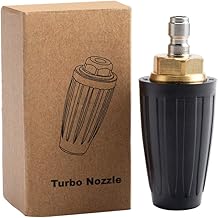
If you’ve ever spent a Saturday morning blasting at driveway grime only to realize your standard pressure washer nozzle is barely keeping up, you know the frustration. Flat-fan tips spread the water too thin for deep buildup, and switching between nozzles mid-job slows everything down. What most homeowners discover too late is that a single turbo nozzle attachment can cut cleaning time nearly in half — by concentrating a rotating zero-degree jet across the surface, it does the heavy lifting that ordinary tips simply can’t.
This guide breaks down the best turbo nozzle pressure washer options available in 2026, comparing flow rates, PSI ratings, build materials, and real-world durability so you can pick the right match for your machine and your job. Every pick here works with a standard 1/4-inch quick-connect fitting, which means no adapters and no headaches.
As an Amazon Associate we earn from qualifying purchases.


How to Choose a Turbo Nozzle Pressure Washer (2026)
- PSI and GPM compatibility: Match the nozzle’s maximum pressure and flow rating to your washer’s output. A 4,000 PSI nozzle on a 2,000 PSI machine still works fine, but a 3,000 PSI nozzle on a 4,000 PSI unit risks premature wear and poor spray pattern.
- Orifice size: The orifice number (commonly 4.0 or 3.0) determines how much water passes through. Larger orifices suit higher GPM machines; smaller ones concentrate force on lower-output units.
- Material and build quality: Stainless steel internals resist corrosion and handle hot-water applications. Brass housings are lighter but can degrade faster under sustained high temperatures.
- Connector type: Most residential and prosumer pressure washers use a 1/4-inch quick-connect fitting. Confirm your wand’s coupler style before ordering — bayonet and threaded connections require adapters.
- Bonus accessories: Kits that include multiple spray tips or multi-function nozzles offer better value, especially if you clean different surfaces regularly and need to switch between fan and turbo spray patterns on the fly.
The Best Turbo Nozzle Pressure Washer (2026)s Reviewed
Simpson 4500 PSI Turbo Nozzle
Built for serious cleaning power, the Simpson handles pressure up to 4,500 PSI and hot water up to 212°F — a rarity among turbo nozzles in this price range. The oscillating jet covers wide paths faster than most competitors, making it a strong choice for large patios and deck restoration projects.
AURORA CAR Turbo Nozzle 4000 PSI
A dependable workhorse at 4.0 GPM with a 4.0 orifice, this nozzle delivers a tight rotating spray that lifts embedded grime from brick, concrete, and vinyl without etching the surface. The 1/4-inch quick connect snaps onto most wands without fuss, and the brass-and-stainless construction holds up well to weekly use.
AURORA CAR Turbo Nozzle & 6-in-1 Combo
This two-in-one pack pairs a dedicated turbo nozzle with a 6-position quick-changeover spray tip — six fan angles in a single body. For homeowners who bounce between washing siding, rinsing cars, and degreasing garage floors, swapping between tools all afternoon turns into a quick twist of the collar.
Tool Daily Stainless Steel Turbo Nozzle
Full 360-degree rotation at up to 3,600 PSI and 3.0 GPM makes the Tool Daily a solid mid-range pick. The all-stainless steel build handles both warm and cold water, and it performs especially well on wooden deck boards where an overly aggressive stream would splinter the grain.
Rotating Turbo Nozzle with 7-Piece Spray Kit
Budget-conscious buyers get the most bang here: a 4,000 PSI turbo nozzle bundled with seven color-coded spray tips and a quick connector. It’s an ideal starter kit for someone outfitting a new washer or replacing worn-out accessories without buying pieces individually.
Frequently Asked Questions
Will a turbo nozzle damage my paint or wood surfaces?
A turbo nozzle concentrates force into a narrow rotating jet, so it can strip paint or gouge soft wood if held too close or aimed too long in one spot. Keep the wand at least 12 inches from the surface and maintain a sweeping motion to avoid damage.
Can I use a turbo nozzle with any pressure washer?
Any pressure washer with a standard 1/4-inch quick-connect wand will accept these nozzles. Just make sure the washer’s PSI and GPM ratings fall within or below the nozzle’s maximum specifications for safe, effective operation.
How often should I replace a turbo nozzle?
With regular residential use, a well-built turbo nozzle should last two to three years. Signs of wear include an uneven spray pattern, reduced pressure, or visible scoring inside the orifice. Stainless steel models tend to outlast brass alternatives.
Is there a meaningful difference between 3.0 and 4.0 orifice sizes?
Yes. A 4.0 orifice flows more water at lower pressure, which suits high-GPM machines. A 3.0 orifice restricts flow for tighter, more concentrated cleaning — better on stubborn stains but requiring adequate pump pressure to maintain the rotating spray.
Final Thoughts
For homeowners tackling varied outdoor cleaning, the AURORA CAR Turbo Nozzle & 6-in-1 Combo offers the best overall versatility by combining turbo power with multi-angle spray options in one kit. If raw cleaning performance on hard surfaces is the priority, the Simpson 4500 PSI Turbo Nozzle delivers unmatched output and hot-water tolerance. And for a budget-friendly entry point without sacrificing build quality, the Rotating Turbo Nozzle with 7-Piece Spray Kit covers the essentials and then some.