Key takeaways
- Tooth count: Blades with around 32 teeth cut quickly through framing lumber, while 60 to 80 teeth are better suited to furniture parts, trim, and cleaner crosscuts. Very high tooth counts favor smoothness over speed.
- Blade size: Match the blade diameter to your miter saw. A 10-inch blade will not substitute for a 12-inch blade, and the saw’s guard and cutting capacity must also be compatible.
- Arbor fit: Check the arbor diameter before ordering. Many 10-inch models use a 5/8-inch arbor, but confirming your saw’s specification prevents an unusable purchase.
- Material and finish: Carbide-tipped teeth are a sensible choice for repeated woodworking. A blade designed for fine finishing can reduce splintering, though wood type and feed speed still affect the result.
- Project type: Choose a general-purpose or combination set if you switch between rough construction and furniture work. Select a dedicated fine-finish blade when clean, visible edges matter most.
What's inside
Choosing a miter saw blade can feel harder than choosing the saw itself. Tooth counts, arbor sizes, kerf widths, and vague “fine finish” claims all sound important, but the wrong blade can leave rough edges, chipped veneer, or cuts that take more sanding than expected.
This guide focuses on practical home-furniture work: trimming boards, cutting molding, sizing shelving, and getting cleaner crosscuts without making the process unnecessarily complicated. The selections below cover versatile multi-packs, everyday fine-finish blades, and high-tooth-count options for detail-conscious projects.
As an Amazon Associate we earn from qualifying purchases.


How to Choose a Saw Blades For Miter Saws (2026)
- Tooth count: Blades with around 32 teeth cut quickly through framing lumber, while 60 to 80 teeth are better suited to furniture parts, trim, and cleaner crosscuts. Very high tooth counts favor smoothness over speed.
- Blade size: Match the blade diameter to your miter saw. A 10-inch blade will not substitute for a 12-inch blade, and the saw’s guard and cutting capacity must also be compatible.
- Arbor fit: Check the arbor diameter before ordering. Many 10-inch models use a 5/8-inch arbor, but confirming your saw’s specification prevents an unusable purchase.
- Material and finish: Carbide-tipped teeth are a sensible choice for repeated woodworking. A blade designed for fine finishing can reduce splintering, though wood type and feed speed still affect the result.
- Project type: Choose a general-purpose or combination set if you switch between rough construction and furniture work. Select a dedicated fine-finish blade when clean, visible edges matter most.
The Best Saw Blades For Miter Saws (2026)s Reviewed
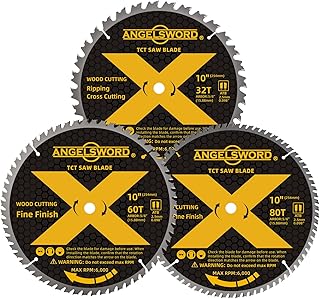
ANGELSWORD 10-Inch 3-Pack
This ANGELSWORD set is a practical starter option because it includes 32-, 60-, and 80-tooth blades for rough framing, standard crosscuts, and finer woodworking. It gives occasional DIY users a way to match the blade to the job instead of forcing one general-purpose blade to do everything.
WEN BL1080 10-Inch 80-Tooth Blade
The WEN BL1080 is aimed at clean, detailed cuts in trim, face frames, and furniture components. Its 80-tooth layout makes more sense for visible edges than for fast bulk cutting, so it is best used when minimizing cleanup is more important than cutting speed.
WEN BL1280 12-Inch 80-Tooth Blade
For owners of a 12-inch miter saw, the WEN BL1280 offers the same detail-oriented approach in the larger format. It is a sensible choice for wider boards, crown molding, and larger furniture parts where a smooth crosscut helps limit sanding and edge repair.
WEN BL1060 10-Inch 60-Tooth Blade
The WEN BL1060 occupies the useful middle ground between speed and surface quality. A 60-tooth blade is often a comfortable everyday choice for home workshops, handling shelving, trim, and dimensional lumber without feeling as specialized as an ultra-fine blade.
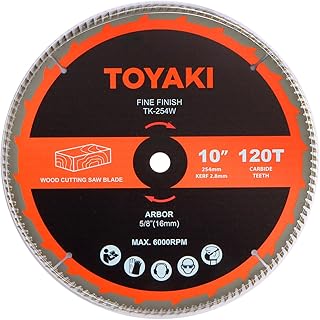
10-Inch 120-Tooth Fine-Finish Blade
This 120-tooth blade is designed for users who prioritize an exceptionally neat cut on suitable wood materials. It is most appealing for delicate trim, small furniture components, and finish work; expect slower cutting and avoid treating it like a construction blade.
Frequently Asked Questions
What tooth count is best for a miter saw?
For general furniture and trim work, 60 teeth is a useful starting point. Choose 80 or more teeth when the cut will be highly visible, and use fewer teeth when speed and rough construction cuts are the priority.
Can I use a table-saw blade on a miter saw?
Only if the blade is specifically suitable for miter-saw use and matches the saw’s diameter, arbor, and operating requirements. Product descriptions that list both saw types can be helpful, but your saw’s manual remains the final authority.
Does a higher tooth count always mean a better cut?
No. Higher tooth counts can produce smoother crosscuts, but they generally cut more slowly and may be less effective in thick or rough lumber. A sharp, properly matched blade and a controlled feed also have a major effect on finish quality.
How can I reduce splintering when cutting furniture boards?
Use a sharp fine-finish blade, support the work securely, and let the saw reach full speed before entering the material. Painter’s tape over the cut line and cutting with the finished face oriented appropriately can also help, depending on the material.
Final Thoughts
The ANGELSWORD 10-Inch 3-Pack is the most flexible pick for mixed household projects, while the WEN BL1060 is a strong everyday choice for balanced cutting. For especially clean visible edges, consider the WEN BL1080 or the 120-tooth fine-finish blade, provided your projects favor precision over speed.