Key takeaways
- CFM Output: Cubic feet per minute determines how fast your pump fills large-volume RV tires. Anything below 1.0 CFM will test your patience on a 35-inch all-terrain; aim for 1.8 CFM or higher for serious tire work.
- Duty Cycle: A 100% duty cycle means the compressor can run continuously without overheating. For RV owners who routinely inflate multiple tires back-to-back, a high duty cycle prevents mid-job shutdowns and extends motor life.
- Power Source: Cordless models with rechargeable lithium packs offer freedom at the trailhead, while 12V corded units draw directly from your vehicle battery for unlimited runtime. Some RV owners keep one of each.
- Maximum PSI Rating: RV tires rarely need more than 120 PSI, but having headroom matters. A 150 PSI-rated compressor gives you a comfortable margin for dual rear wheels and heavy-load scenarios.
- Noise and Portability: Compact designs slip into a storage bay without drama. Check decibel ratings if you plan to inflate early at a quiet campground — a loud compressor earns dirty looks from your neighbors fast.
What's inside
Shopping for an RV air compressor can feel like navigating a maze of conflicting specs, misleading CFM claims, and inflated price tags. Whether you’re topping off 33-inch tires before a desert trail or keeping a heavy Class A rolling on a long highway stretch, the wrong choice leaves you stuck on the shoulder with a dying pump and a bad mood.
This guide cuts through the noise. We evaluated six top-rated portable inflators across inflation speed, duty cycle, power source flexibility, and real-world durability so you can grab the right unit for your rig and hit the road with confidence.
As an Amazon Associate we earn from qualifying purchases.




How to Choose an Rv Air Compressor (2026)
- CFM Output: Cubic feet per minute determines how fast your pump fills large-volume RV tires. Anything below 1.0 CFM will test your patience on a 35-inch all-terrain; aim for 1.8 CFM or higher for serious tire work.
- Duty Cycle: A 100% duty cycle means the compressor can run continuously without overheating. For RV owners who routinely inflate multiple tires back-to-back, a high duty cycle prevents mid-job shutdowns and extends motor life.
- Power Source: Cordless models with rechargeable lithium packs offer freedom at the trailhead, while 12V corded units draw directly from your vehicle battery for unlimited runtime. Some RV owners keep one of each.
- Maximum PSI Rating: RV tires rarely need more than 120 PSI, but having headroom matters. A 150 PSI-rated compressor gives you a comfortable margin for dual rear wheels and heavy-load scenarios.
- Noise and Portability: Compact designs slip into a storage bay without drama. Check decibel ratings if you plan to inflate early at a quiet campground — a loud compressor earns dirty looks from your neighbors fast.
The Best Rv Air Compressor (2026)s Reviewed
NOCO Air AL5 Portable Inflator
Compact, rechargeable, and genuinely quick, the AL5 punches above its size by inflating a standard tire from 0 to 40 PSI in roughly seven minutes. The USB-C power bank doubling as an emergency phone charger makes it a smart multitasker for weekend campers who value minimal gear weight.
ETENWOLF VORTEX S6
With a beefy 19,200 mAh battery and dual-cylinder design delivering a true 100% duty cycle, the VORTEX S6 was built for owners who refuse to babysit their inflator. Its vivid orange casing is easy to spot in a cluttered cargo compartment, and the LED backlight is a genuine lifesaver during pre-dawn departures.
VIAIR 450P-RV Automatic
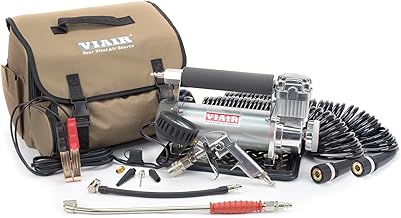
VIAIR’s RV-specific kit remains the benchmark for corded performance, pushing 1.80 CFM at 150 PSI with an automatic shut-off that prevents overinflation. The included inline tire pressure gauge and 30-foot hose mean you won’t be crawling under a dually to reach the inner valve stem.
Generic 12V 150PSI Tire Inflator
Budget-minded RV owners will appreciate the 5.65 CFM claim on this corded 12V unit — among the highest flow rates in its price bracket. The digital preset and auto shut-off features keep it competitive with pricier branded models, though build quality and long-term durability remain the wildcard at this tier.
NOCO AIR20 Portable Inflator
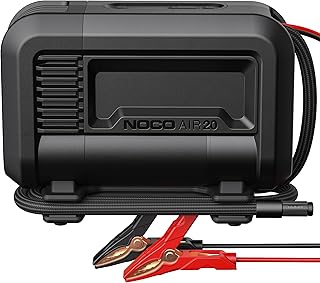
The AIR20 splits the difference between raw power and convenience, delivering a 0-to-40 PSI fill in about two and a half minutes while connecting directly to your battery via included clamps. It handles tires up to 35 inches without breaking a sweat, making it a natural fit for mid-size SUVs and half-ton trucks that tow.
Frequently Asked Questions
Do I need a cordless or corded RV air compressor?
Cordless models shine for quick roadside top-offs and remote campsites without power. Corded 12V units offer unlimited runtime and higher sustained output, which matters when you’re filling six or eight large tires after dropping tire pressure for sand driving.
What PSI do RV tires typically need?
Most Class A and Class C RV tires run between 95 and 120 PSI, depending on load rating. Always check the tire sidewall and your vehicle’s door jamb sticker for the correct cold inflation pressure — it’s rarely the maximum printed on the tire itself.
How long does a portable air compressor last?
Quality units from brands like VIAIR and NOCO routinely survive five or more seasons of regular use. Budget inflators may last a couple of years with light duty, but motors and seals tend to degrade faster under sustained high-temperature operation.
Can one compressor handle both my RV and my tow vehicle?
Absolutely. A compressor rated for 150 PSI with adequate CFM will cover everything from a towed Jeep Wrangler to a 35-foot travel trailer. Look for adjustable pressure presets so you can switch between vehicles without recalibrating each time.
Final Thoughts
For most RV owners, the VIAIR 450P-RV remains the gold standard for reliable, high-output corded inflation, while the ETENWOLF VORTEX S6 earns our pick for cordless buyers who need real sustained performance. The NOCO AIR20 hits a compelling sweet spot if you want fast fills and battery-clip simplicity without breaking the bank. Match your choice to how — and where — you camp, and you’ll never sweat a low-tire-pressure warning again.