Key takeaways
- Weight Capacity: Check the maximum load rating and compare it to your saw’s weight plus any crown molding stops or accessories. Stands rated at 300–330 lbs handle most 12-inch sliding compound miter saws without issue, but larger industrial saws need more headroom. Always leave a margin rather than running near the limit.
- Wheel Quality and Size: Small, hard plastic wheels are fine on smooth concrete but fight you on cracked driveways or job-site terrain. Rubber or pneumatic wheels around 8 inches roll over obstacles more gracefully and won’t scratch finished floors when you’re working inside a client’s home.
- Folding Mechanism and Storage Footprint: A good stand collapses quickly — ideally with one hand — and stands upright for vertical storage. Measure your garage or truck bed space before buying. Some stands fold flat but stay long, which matters if you’re packing alongside other tools.
- Mounting Rail Compatibility: Universal rails fit most saw brands out of the box, but double-check that your specific model locks down without adapters. Quick-release brackets save significant time during setup and teardown, especially if you transport your saw separately from the stand.
- Extra Features That Actually Matter: Onboard outlets, material supports, and storage trays sound appealing but vary wildly in quality. Outlets with grounded three-prong configurations are genuinely useful for job sites without nearby power. Flimsy trays and short extension arms, on the other hand, end up collecting dust.
What's inside
Shopping for a rolling miter saw stand can feel oddly complicated for what should be a straightforward accessory. You need something that holds your saw securely, moves around the shop without wobbling, and doesn’t eat up half your budget — yet product listings overflow with specs that all start to blur together. Wheels this size, load capacity that number, extension arms everywhere. Meanwhile, a cheap stand that wobbles during a cut isn’t just frustrating, it’s a safety hazard. The right pick depends on your workflow, your garage layout, and honestly, how often you plan to roll this thing around versus leaving it parked.
I spent time evaluating the current crop of rolling miter saw stands available in 2026, focusing on real-world factors: how smoothly they roll across uneven garage floors, whether the mounting system feels universal enough for your specific saw, and how compact they fold for storage in tight spaces. This guide covers five standout models that balance build quality, portability, and value — each suited to a slightly different type of user. Whether you’re a weekend warrior trimming baseboards or a finish carpenter hauling gear between job sites, the comparison below will help you narrow things down.
As an Amazon Associate we earn from qualifying purchases.



How to Choose a Rolling Miter Saw Stand (2026)
- Weight Capacity: Check the maximum load rating and compare it to your saw’s weight plus any crown molding stops or accessories. Stands rated at 300–330 lbs handle most 12-inch sliding compound miter saws without issue, but larger industrial saws need more headroom. Always leave a margin rather than running near the limit.
- Wheel Quality and Size: Small, hard plastic wheels are fine on smooth concrete but fight you on cracked driveways or job-site terrain. Rubber or pneumatic wheels around 8 inches roll over obstacles more gracefully and won’t scratch finished floors when you’re working inside a client’s home.
- Folding Mechanism and Storage Footprint: A good stand collapses quickly — ideally with one hand — and stands upright for vertical storage. Measure your garage or truck bed space before buying. Some stands fold flat but stay long, which matters if you’re packing alongside other tools.
- Mounting Rail Compatibility: Universal rails fit most saw brands out of the box, but double-check that your specific model locks down without adapters. Quick-release brackets save significant time during setup and teardown, especially if you transport your saw separately from the stand.
- Extra Features That Actually Matter: Onboard outlets, material supports, and storage trays sound appealing but vary wildly in quality. Outlets with grounded three-prong configurations are genuinely useful for job sites without nearby power. Flimsy trays and short extension arms, on the other hand, end up collecting dust.
The Best Rolling Miter Saw Stand (2026)s Reviewed
DEWALT DWX726
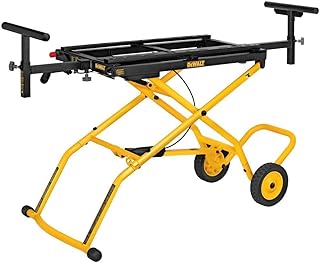
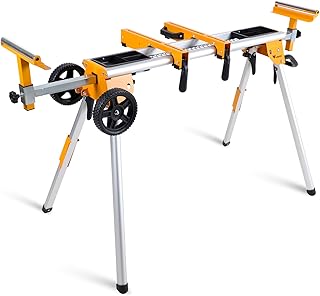
The DWX726 remains the benchmark for a reason. Its wide, folding steel frame feels planted even during aggressive cuts, and the adjustable-height design accommodates saws ranging from compact 10-inch models to full-size 12-inch sliders. The 8-foot material supports extend generously, and the rubber-grip wheels roll smoothly across a two-car garage floor without leaving marks. Setup takes under a minute once you’ve done it once. For most home workshops, this is the default recommendation.
POWERTEC MT4000V
What sets the MT4000V apart is the built-in triple power outlet, which eliminates the extension cord dance when you’re working in the middle of the garage. Load capacity matches the DEWALT at 330 lbs, and the quick-release brackets genuinely release quickly. The orange powder coat resists chips, and the folding geometry tucks neatly against a wall. The 8-inch wheels handle minor debris and threshold transitions well. A strong value pick if integrated power matters to your setup.
WEN MSA330
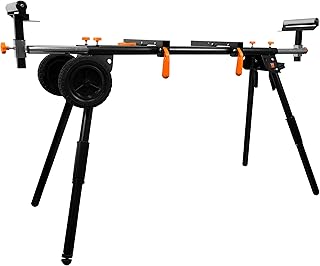
WEN’s MSA330 undercuts the competition on price while delivering three onboard outlets and a collapsible design that rolls on its own wheels when folded. The frame is lighter than the DEWALT or POWERTEC, which makes it easier to load into a truck bed but means you feel more vibration on less stable floors. For occasional use — seasonal trim work, one-off furniture projects — it’s hard to argue with the cost-to-utility ratio.
Channellock Folding Miter Saw Stand
Channellock brings serious extension reach with a full 10 feet of material support, which is ideal for long crown molding runs or working with 12-foot boards solo. The heavy-duty steel base rolls on a mobile platform that feels substantially built, and the signature blue finish is easy to spot in a cluttered workspace. It’s heavier and bulkier than some competitors, but that mass contributes to rock-solid stability during use.
BORA Portacube PM-8000
The Portacube takes a different approach: a rotating top turns the miter saw stand into a general-purpose workbench when you flip the saw off. This dual-purpose design saves floor space in smaller garages, and the wheeled base keeps it mobile. The rotating mechanism is smooth and locks securely in either position. If you need a single surface for both cutting and assembly work, this is the most creative solution in the lineup.
Frequently Asked Questions
Do rolling miter saw stands fit all saw brands?
Most stands with universal mounting rails accommodate major brands like DEWALT, Makita, Bosch, and Craftsman without adapters. However, some saws with non-standard base dimensions or offset mounting holes may require specific brackets. Always check the stand’s compatibility list against your saw model before purchasing.
What is the typical load capacity I should look for?
A load capacity of 300 to 330 lbs comfortably covers most residential miter saws plus accessories. If you’re using a heavy 12-inch sliding compound saw with a stand-mounted crown stop, aim for the higher end. Industrial chop saws or large table setups may require commercial-grade stands rated above 400 lbs.
Are the built-in power outlets worth anything?
Grounded three-prong outlets rated for 15 amps are genuinely convenient for job sites and garage workshops. They let you plug in the saw and a light or vacuum simultaneously without stringing extension cords. Cheaper stands sometimes include outlets with questionable grounding, so stick with reputable brands that list electrical certifications.
Can I leave a rolling miter saw stand set up permanently?
Yes, and many woodworkers do. The main trade-off is floor space. If your workshop stays dedicated to cutting tasks, an unfolded stand saves setup time. If you need the garage back for parking or storage, prioritize a stand with a compact vertical fold and smooth-rolling wheels so transitioning between modes takes under a minute.
Final Thoughts
For most home workshop buyers, the DEWALT DWX726 hits the best balance of build quality, compatibility, and everyday usability — it’s the safe recommendation for a reason. If integrated power outlets save you frustration and cable clutter, the POWERTEC MT4000V delivers comparable construction with that added convenience. And for anyone working in a compact garage where every square foot counts, the BORA Portacube PM-8000 pulls double duty as both a saw stand and a workbench, making it a genuinely clever space-saving investment.