Key takeaways
- Cooling capacity: Match the BTU rating to the enclosed space, not the entire campsite. A small tent or sleeping compartment needs far less capacity than a large RV, while direct sun and poor insulation can raise the demand.
- Power source: Check wattage, startup draw, and connector type before relying on a battery, campsite outlet, generator, or vehicle system. AC/DC compatibility is especially valuable away from hookups.
- Ventilation: Traditional compressor air conditioners usually need hot-air exhaust routed outside through a window, vent, or fabric adapter. Without that path, the unit may add heat rather than remove it.
- Noise and sleep: Fan noise matters in a tent or small vehicle. Look for a stated decibel rating, sleep mode, or adjustable fan speeds, and remember that a compressor may cycle on and off during the night.
- Water and setup: Drainage-free operation is convenient, but performance depends on humidity. Consider condensate drainage, hose length, window kits, portability, and whether setup is realistic at your intended campsite.
What's inside
Camping in hot weather is enjoyable until the tent, RV, or van turns into a sealed box of warm air. Choosing a cooling appliance is not as simple as picking the highest BTU number: outdoor power limits, exhaust requirements, noise, water drainage, and available floor space can all determine whether a unit is genuinely useful at camp.
This guide compares portable air conditioners and compact cooling alternatives for camping in 2026. The focus is practical comfort: how much space each type can cool, what kind of power it needs, whether it works in a tent or vehicle, and which compromises to expect before packing it for a trip.
As an Amazon Associate we earn from qualifying purchases.




How to Choose a/an Portable Air Conditioner Camping (2026)
- Cooling capacity: Match the BTU rating to the enclosed space, not the entire campsite. A small tent or sleeping compartment needs far less capacity than a large RV, while direct sun and poor insulation can raise the demand.
- Power source: Check wattage, startup draw, and connector type before relying on a battery, campsite outlet, generator, or vehicle system. AC/DC compatibility is especially valuable away from hookups.
- Ventilation: Traditional compressor air conditioners usually need hot-air exhaust routed outside through a window, vent, or fabric adapter. Without that path, the unit may add heat rather than remove it.
- Noise and sleep: Fan noise matters in a tent or small vehicle. Look for a stated decibel rating, sleep mode, or adjustable fan speeds, and remember that a compressor may cycle on and off during the night.
- Water and setup: Drainage-free operation is convenient, but performance depends on humidity. Consider condensate drainage, hose length, window kits, portability, and whether setup is realistic at your intended campsite.
The Best Portable Air Conditioner Camping (2026)s Reviewed
ZAFRO Smart Inverter Portable AC
The ZAFRO Smart Inverter Portable Air Conditioner is the strongest choice here for a larger RV, cabin, or well-sealed camping room with reliable electrical power. Its 14,000 BTU rating, dual-hose design, app control, and claimed 42dB operation make it more sophisticated than typical campsite coolers, while inverter operation should help it avoid the constant full-power cycling associated with basic portable units. It is substantial, however, and its size and exhaust setup make it less suitable for a compact tent.
Cybertake Portable Camping Air Conditioner
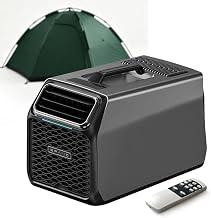
Cybertake’s portable camping air conditioner is purpose-built for off-grid use, with AC and DC compatibility plus both cooling and heating functions. The 5,100 BTU cooling output is more realistic for a tent, boat cabin, truck, or small RV than a large household unit, and the advertised eight-hour runtime on 1kWh is appealing for battery-based trips. Verify your power station’s continuous output before departure, since runtime claims vary with temperature, insulation, and operating mode.
Portable Tent Air Conditioner, 5200 BTU
This compact 5,200 BTU tent air conditioner emphasizes a relatively low 400W draw, quiet operation, and a small footprint. That combination makes it a sensible option for a truck, van, RV sleeping area, or properly enclosed tent where power conservation matters more than rapid whole-space cooling. It will work best when the cooled area is modest and the tent has a practical way to manage warm exhaust air.
Serantzon 4-in-1 Evaporative Air Cooler
The Serantzon is better understood as a personal evaporative cooler than a conventional air conditioner. Its 1,200ml reservoir, three fan speeds, timer, remote, and LED lighting make it handy beside a camp bed or in a bedroom, but it does not provide compressor-style cooling and is most effective in dry climates. It is quiet, lightweight, and easy to power, making it a useful comfort device when a hose and high-wattage appliance are impractical.
Garvee 14,000 BTU Portable AC
Garvee’s 14,000 BTU portable air conditioner is aimed primarily at rooms, but it can suit a large RV, enclosed trailer, or cabin with a suitable window kit. Cooling, dehumidifying, fan operation, sleep mode, and a timer cover the basics well, although its 750-square-foot claim should be treated as an optimistic indoor estimate rather than a camping guarantee. For mobile use, measure storage space and confirm that the campsite can supply its electrical load.
Frequently Asked Questions
Can a portable air conditioner cool a tent?
Yes, but only if the tent is reasonably enclosed and the unit’s hot-air exhaust is directed outside. A compressor AC will struggle in an open-sided shelter, and the hose connection may require a compatible tent seal or carefully managed opening.
What size portable AC is best for camping?
Small enclosed tents, truck cabins, and sleeping compartments generally pair better with roughly 5,000 to 6,000 BTU models. Larger RVs or cabins may justify a 10,000 BTU SACC-class unit or more, but insulation, direct sunlight, and ceiling height can change the result.
Are evaporative coolers as effective as air conditioners?
No. Evaporative coolers add moisture while lowering perceived temperature, so they perform best in dry air with some ventilation. A compressor air conditioner removes heat and humidity, making it the better choice for muggy conditions, provided power and exhaust are available.
Can a portable AC run from a power station?
Some can, particularly lower-wattage AC/DC camping models, but check continuous wattage, surge capacity, battery size, and connector compatibility. A power station may run a small unit for several hours, while a high-output household AC can drain it quickly or fail to start.
Final Thoughts
For serious cooling in a larger, powered camping space, the ZAFRO Smart Inverter Portable AC is the most capable pick. The Cybertake is more practical for off-grid trips, while the Serantzon makes sense when you want personal airflow, low power use, and simple setup rather than full air conditioning.