Key takeaways
- Printed resistance level in pounds or kilograms on the band itself, not just color, so you can track progression accurately.
- At least 4 resistance steps with no more than 8-10 lb jumps between levels in the middle range.
- If choosing tubes, reinforced triple-stitched handles and a wide foam door anchor that distributes pressure across at least 3 inches of door surface.
- Latex-free labeling with TPE or explicitly marked natural latex if allergy is a concern – marketed as non-latex should meet ASTM D6499 standards.
- A mesh carry bag and printed exercise guide with PT-specific moves (not just general fitness), which helps maintain correct form between appointments.
The best physical therapy resistance band sets for most rehabilitation needs are a loop band set with 3-5 graduated levels (light to heavy) plus a separate tube-with-handles set if you need shoulder, chest, and rowing exercises with a door anchor, with latex-free TPE or fabric as the right choice if you have a latex allergy or need more skin comfort.
How to Choose the Right Resistance Progression
For physical therapy, progression is more important than maximum resistance. You want small, predictable steps so you can increase load without re-injury. Most quality sets are color-coded, but the actual pound equivalent varies by brand and by how far you stretch the band.
Look for sets that offer 4 to 5 levels in the 3 to 50 lb range when stretched to 100% elongation (doubled length). That covers the typical PT sequence from early activation to strength rebuilding. Avoid sets that jump from 10 lb directly to 30 lb – the gap is too large for rehab.
| Level (TheraBand Equivalent) | Typical Color | Resistance at 100% Elongation | Band Width (Loop Style) | Best Use in Rehab |
|---|---|---|---|---|
| Extra Light | Tan / Yellow | 3 – 6 lbs | 0.5 – 0.75 inch | Early post-injury activation, finger/wrist rehab, elderly patients |
| Light | Red | 8 – 12 lbs | 1.0 inch | Rotator cuff external rotation, glute bridges, knee extensions |
| Medium | Green | 12 – 18 lbs | 1.25 inch | Seated rows, clamshells, shoulder abduction |
| Heavy | Blue | 18 – 26 lbs | 1.75 inch | Hip abduction walks, chest press, hamstring strengthening |
| Extra Heavy | Black | 26 – 40 lbs | 2.0 – 2.5 inch | Late-stage strength, squats, athletic return-to-play |
Sets like TheraBand Professional Non-Latex or SPRI Braided Xertubes follow this type of stepped system. If your therapist prescribes a specific color, match the pound range rather than the color, since colors are not standardized across brands.
Latex vs. Latex-Free vs. Fabric: Material Trade-Offs
The material affects allergy risk, feel, durability, and how the band grips skin and clothing.
| Material | Thickness & Stretch | Pros | Cons | Best For |
|---|---|---|---|---|
| Natural Latex Rubber | 0.35 – 0.65 mm thick, up to 250% elongation before snap point | Most elastic and smooth progression, lowest cost (usually $12 – $28 for 5-piece loop set), compact | Latex allergy risk, degrades with sun/heat/oils, can pinch skin and roll | General PT use when no allergy, maximum portability |
| TPE (Thermoplastic Elastomer) Latex-Free | 0.45 – 0.75 mm thick, up to 200% elongation | Latex-free, less odor, softer on skin, more UV resistant | Slightly less snap-back, 15-20% bulkier, usually $18 – $35 for 5-piece set | Latex allergy, sensitive skin, clinics needing hypoallergenic options |
| Fabric (Woven Elastic + Latex Core with Cotton/Poly Shell) | 2.5 – 3.5 inch wide, 50-80% elongation | Will not roll or pinch, stays in place on legs, very durable for hip/glute work | Not suitable for upper-body stretching or high-elongation exercises, not anchor-friendly, usually $20 – $40 for 3-piece set | Hip and glute rehab, patients who hate rolling latex |
For most home rehab in 2026, a latex set is the clinical standard for versatility, but clinics and home users with allergies should choose TPE types such as TheraBand CLX Non-Latex or Cando TPE bands. Fabric loops are a useful second set specifically for lower-body work, not a replacement for an all-around set.
Loop Bands vs. Tube Bands With Handles and Anchors
Your exercise prescription determines the form factor.
Closed Loop Bands (41-inch or 12-inch)
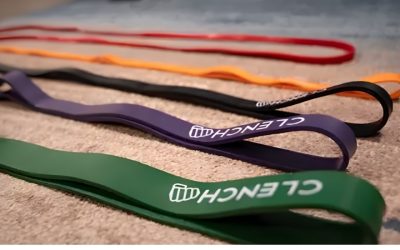
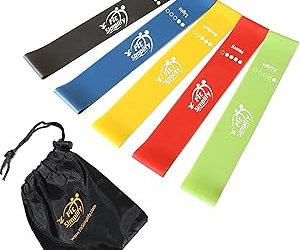
41-inch continuous loops (often called power loops) are placed around knees, ankles, or feet. 12-inch mini loops stay around the thighs without holding. They are best for lower-body and core rehab: monster walks, glute bridges, knee valgus correction, and ankle stabilization. They require no anchor and need only 4×6 feet of floor space, so they work in a bedroom or living room beside a bed or sofa.
Tube Bands With Handles and Door Anchor
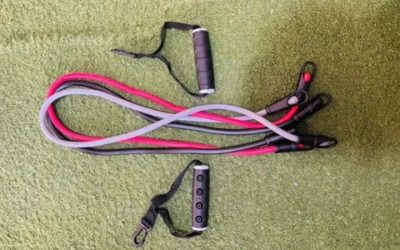
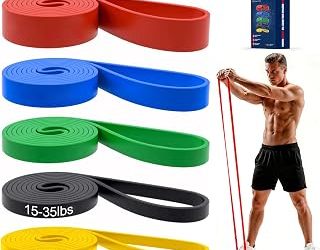
Tubes are 48 to 60 inches long including handles, with a foam or nylon door anchor and often ankle straps. They are best for upper-body PT: chest press, seated row, external rotation, bicep curls, and post-surgical shoulder mobility. You need a solid, hinge-side interior door with at least 28 inches of clear wall space on each side and 6 to 7 feet of clearance in front of the door to allow full arm extension. Renters should check that the anchor has a large foam stopper that will not damage paint or door trim, and avoid anchoring to glass-paneled doors.
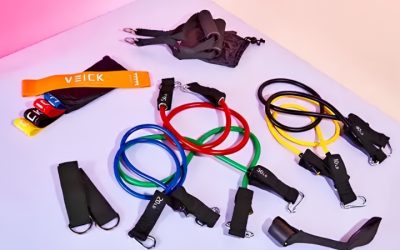
Many physical therapists recommend owning both: a mini-loop pack for hips/knees and a tube set for shoulders/back. Combination kits that bundle 3 loops + 3 tubes + 1 door anchor + 2 ankle straps usually run $25 – $55 and give the most complete progression without buying two separate systems.
Band Length, Fit, and Room-Size Realities
Length changes resistance more than most buyers expect. Stretching any band to 1.5x its resting length roughly doubles the listed resistance; at 2x length, resistance is 2.5 to 3x. A 5-foot tube that starts at 10 lbs will feel like 20-25 lbs when your arms are fully extended if you are 6 feet tall. Taller users or those doing wide chest presses should choose 5.5 to 6-foot tubes.
For loops, measure: if you are over 72 inches tall or have broad shoulders, 41-inch loops give a more comfortable squat and press than 12-inch mini loops, which can feel restrictive around large thighs. Mini loops are better if your rehab space is tight – they work in a 10×12 ft room with a chair and require no door setup. Tubes need a 7-foot straight line free of furniture corners and coffee tables to avoid tripping.
Portability is a real advantage over weights. A full 5-band latex set weighs 14 to 22 ounces total and packs into a 6×8 inch pouch, easily stored in a nightstand drawer or suitcase for travel rehab. Fabric sets are heavier at 1.5 to 2.5 lbs total.
Decision Matrix: Which Set Fits Your Situation
| Your Situation | Recommended Set Type | Why |
|---|---|---|
| Post-surgery shoulder or rotator cuff (limited load, high reps) | Tube set with handles, 3-15 lbs range + door anchor | Allows controlled rows and rotations with neutral wrist position; handles reduce grip strain |
| Knee or hip rehab, glute weakness, gait training | Mini-loop set (light to heavy) + optional 41-inch loop | Hands-free, targets abductors and external rotators without stressing the joint |
| Latex allergy, sensitive skin, or clinic shared use | TPE latex-free loops or tubes | Hypoallergenic and easier to clean with alcohol wipes |
| Small apartment or travel, no door anchor allowed | Loop-only set (5 levels) + 1 long flat band (5 ft x 4 inch) | Flat bands do the work of tubes for rows by wrapping around hands, no anchor needed |
| Need full-body progression from early to late rehab | Combo: 5 loops + 5 handled tubes + anchor + ankle straps | Smallest cost to cover both upper and lower body with incremental steps |
Durability, Care, and What Wears First
Latex and TPE bands fail most often at the handle connection point or where the band contacts a metal anchor. Check stitching on handles and the foam anchor for cracking every month. Latex bands develop small nicks and turn sticky or powdery before snapping – discard any band with a tear longer than 1/4 inch or faded, tacky sections.
To extend life: store out of direct sunlight and away from heaters, do not store stretched, wipe with mild soap and water (not oil-based cleaners), and lightly powder latex bands with talc if they stick. With 3x weekly use, expect latex loops to need replacement in 12 to 18 months, TPE in 18 to 24 months, and fabric loops in 2+ years, as the fabric shell protects the elastic core.
For safety, never anchor a loop band that is not designed for it, and always inspect the door anchor before loading. Keep bands away from sharp furniture edges, zippers, and rings that can puncture the material.
What to Look For Before Buying
- Printed resistance level in pounds or kilograms on the band itself, not just color, so you can track progression accurately.
- At least 4 resistance steps with no more than 8-10 lb jumps between levels in the middle range.
- If choosing tubes, reinforced triple-stitched handles and a wide foam door anchor that distributes pressure across at least 3 inches of door surface.
- Latex-free labeling with TPE or explicitly marked natural latex if allergy is a concern – marketed as non-latex should meet ASTM D6499 standards.
- A mesh carry bag and printed exercise guide with PT-specific moves (not just general fitness), which helps maintain correct form between appointments.
Brands with long clinical histories such as TheraBand, Cando, SPRI, and Perform Better consistently provide pound-labeled, stepped sets and replacement single bands, so you can replace just the level you outgrow instead of buying a whole new kit. General market pricing is usually $15 – $30 for loop-only sets, $20 – $40 for tube-with-anchors sets, and $35 – $60 for comprehensive combo kits in 2026.
FAQ
How do I know which resistance to start with after an injury?
Follow your physical therapist’s prescription, but a safe rule is to start where you can complete 12-15 slow, pain-free repetitions with good form. If you can do 15 reps without fatigue, move to the next level. For post-operative or acute conditions, most protocols start at 3-6 lbs.
Can I use a door anchor in any apartment?
Use only a solid-core interior door that latches securely and opens away from you, with the anchor placed on the hinge side above the latch. Avoid hollow-core, glass, or metal fire doors, and check your lease for restrictions on anchors that could mark trim.
Are fabric bands better than latex for knee rehab?
Fabric bands are more comfortable and do not roll for clamshells and lateral walks, but they do not stretch enough for pulling exercises where you need longer range of motion. Most knee programs still need a latex or TPE loop for full versatility; fabric is a comfort upgrade for hip work, not a full replacement.