Our Top Picks
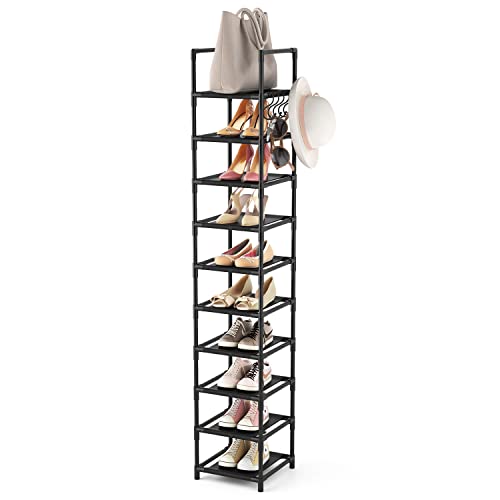 LANTEFUL Tall Narrow Shoe Rack for Entryway10 tiers10.63 x 10.63 x 66.93 inches1.6 poundsCheck on Amazon
 LANTEFUL 10 Tiers Tall Shoe Rack 20-25 Pairs10 Tier-68" High-17" Wide10 x 17 x 68 inches3 poundsCheck on Amazon
Pick a tilting shoe cabinet if the hallway is shallower than a foot and you want closed doors, a slim open tiered rack if you need quick access for daily pairs, and an over-the-door or wall-mounted organizer if you have no floor space at all. Narrow shoe racks trade capacity for footprint, so the right choice depends on how many pairs you own, how tall your shoes are and how much depth you can spare.
At a Glance: Narrow Shoe Rack Types
| Type | Best for | Typical stated depth | Main limit |
|---|---|---|---|
| Tilting shoe cabinet (for example the IKEA Hemnes or Trones style) | Tight entryways, hiding clutter | Makers commonly list roughly 7 to 10 inches | Compartments suit flats and sneakers, not boots |
| Open tiered metal rack | Daily-use pairs, garages, mudrooms | Often 8 to 12 inches | Shoes are visible; dust collects |
| Bamboo or wood slatted bench rack | Entryways where you also want a seat | Often 10 to 14 inches | Heavier, bulkier, lower capacity per footprint |
| Stackable modular shelves | Growing collections, odd spaces | Varies by module | Stability depends on assembly and wall anchoring |
| Over-the-door organizer | Rentals, closets, kids’ rooms | Zero floor footprint | Door clearance; pockets can crush heavy shoes |
| Wall-mounted shelf or ledge | Very small entries | Shallow, wall-dependent | Requires drilling and proper anchors |
Measure Before You Shop
Narrow racks fail most often because of measurement mistakes rather than product quality. Start with the usable depth of the space, not just the wall length. Door swings, baseboards, radiators and the shoes themselves all eat into the footprint. A rack listed at 9 inches deep may still stick out further once large sneakers are loaded, since many shoes are 11 to 12 inches long and need to sit at an angle or hang over the edge.

Nunsino Narrow Shoe Rack, 10-Tier Metal Shoe Organizer,Tall Shoe Shelf with Anti-Tip Strap, Max Holds 22 Pairs,Space Saving for Closet,Entryway,Black
Chosen because it specifies 10-Tier Metal Shoe Organizer and Tall Shoe Shelf with Anti-Tip Strap.
View on AmazonLANTEFUL Tall Narrow Shoe Rack for Entryway, 10-Tier Sturdy Metal Shoe Shelf Storage 10-15 Pairs of Shoes and Boots, Space Saving Corner Shoe Rack Organizer for Closet,Doorway,Garage,Living Room
Chosen because it specifies Space Saving Corner Shoe Rack Organizer for Closet and Doorway.
View on AmazonLANTEFUL 10 Tiers Tall Shoe Rack 20-25 Pairs Boots Organizer Storage Sturdy Narrow Shoe Shelf for Entryway, Closets with Hooks, Black
Chosen because it specifies Closets with Hooks and Black.
View on Amazon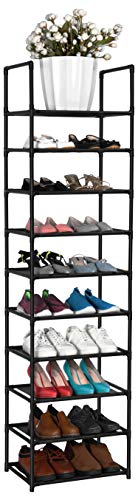
FIDUCIAL HOME 10 Tiers Shoe Rack Organizer 20 Pairs Tall Shoe Shelf | Tall Narrow Space Saving for Closet Entryway Dorm, Easy to Assemble, 17"L x 11"W x 68.8"H, Black
Chosen because it specifies Tall Narrow Space Saving for Closet Entryway Dorm and Easy to Assemble.
View on Amazon- Depth: Measure from the wall (including baseboard) to where a door or walkway begins.
- Height: Count the tallest shoe you own. Many cabinet compartments list a clearance of only a few inches, which suits flats and low sneakers but not ankle boots.
- Width per pair: Makers usually state a pair count that assumes average adult shoes. Men’s size 12 and wide fits often reduce that number.
- Pair count: Count the pairs you wear weekly, then add about a quarter for growth. Off-season pairs can live elsewhere.
Tilting Shoe Cabinets
Tilt-out cabinets are the usual answer for hallways where a conventional shelf would block traffic. Each drawer-like flap pivots forward so shoes lie at an angle, which is how a cabinet can stay slim and still hold several pairs. Makers such as IKEA list models in this style, and reviewers regularly mention them for apartment entries.
Strengths include closed fronts that hide mess, a flat top surface for keys or a small tray, and a clean look. Limits include compartment height, which is the most common complaint, and the way the flaps can jam if a heel sticks out. Check the stated per-compartment weight limit and the maker’s note on wall anchoring; tall narrow cabinets can tip, and anchoring to a wall stud with the supplied hardware is standard guidance, particularly in homes with children.
Budget versions are usually particleboard or thin laminate and can swell if the floor is damp. Mid-range options tend to add sturdier hinges and thicker panels. Premium versions are typically solid wood or metal with better finishing.
Open Tiered Racks
Open racks in powder-coated steel or plastic are the practical choice for people who kick shoes off many times a day. They are easy to ventilate, which matters for sports shoes and wet pairs. Models from brands such as Simplehouseware, Songmics and Rubbermaid are widely sold in this category, and makers typically list capacities by the number of pairs on each tier.
Look at the tier spacing. Adjustable shelves let you set higher gaps for boots. Some designs offer slanted shelves that tilt the shoe toe downward to squeeze in more pairs; these hold more but can make heels slide. Metal racks can scratch hardwood floors, so felt or rubber feet are worth having, and a tray underneath protects flooring from damp soles.
Bamboo and Wood Benches
Slatted bamboo racks and shoe benches suit entryways where you also want somewhere to sit and lace up. Bamboo is generally sold as a natural, water-tolerant material, though makers advise wiping up spills quickly and avoiding long exposure to standing water. These units are often a little deeper than metal racks, so measure carefully. If a bench is the goal, check the stated seat weight limit in the maker’s listing.
Stackable and Modular Units
Stackable shelves let you build up a narrow tower or spread it along a wall. Plastic cube-style modules and wire units both appear in this category. The advantage is flexibility, for instance starting with two levels and adding more later. The trade-off is stability: taller stacks should be secured to the wall, and mixed heavy loads on upper levels increase tipping risk. Follow the instructions for any included connectors or anti-tip straps.
Over-the-Door and Wall-Mounted Options
When the floor is entirely off-limits, an over-the-door organizer uses the back of a closet or bedroom door. Check the door thickness the maker states and whether the door still closes without rubbing. Fabric pockets suit light shoes and kids’ pairs, while metal-hook designs handle sturdier pairs. Wall-mounted shelves need proper anchors rated for the load; in rentals, confirm that drilling is allowed before buying.
Materials and Care
- Powder-coated steel: Wipe with a damp cloth. Chips in the coating can rust over time in humid spaces such as garages.
- Bamboo and solid wood: Dry cloth cleaning; avoid soaking.
- Laminated particleboard: Keep dry, and avoid placing wet shoes directly inside closed compartments.
- Plastic: Easy to rinse, but cheaper grades can flex under heavy loads and may become brittle in cold garages.
Let shoes dry before storing them in closed cabinets, which helps limit odor. If shoes are wet from rain, an open tier with a boot tray is usually the better spot.
Safety and Setup Notes
Tall, narrow furniture can tip over. Use the anti-tip hardware supplied, anchor into studs or use wall anchors suitable for your wall material, and do not let children climb on shelves. Keep walkways clear so a rack does not become a trip hazard in a narrow hall. Follow the maker’s assembly sequence and weight ratings.
Budget Tiers
| Tier | What to expect | Watch for |
|---|---|---|
| Budget | Plastic or thin metal tiers, fabric over-the-door pockets, basic laminate cabinets | Wobble, thin finishes, limited weight ratings |
| Mid-range | Thicker steel, adjustable shelves, better tilt hinges, bamboo benches | Assembly time, depth creep beyond the stated figure |
| Premium | Solid wood, heavy-gauge metal, custom or built-in style cabinets | Size is fixed; measure twice |
Pick X If…
| If you… | Pick |
|---|---|
| Have a hallway under a foot deep and want hidden storage | Tilting shoe cabinet |
| Wear several pairs daily and need airflow | Open tiered metal rack |
| Want a seat and storage in one | Bamboo or wood bench rack |
| Own tall boots | Adjustable-shelf rack or a dedicated boot tray |
| Rent and cannot drill | Over-the-door organizer or freestanding rack |
| Expect your collection to grow | Stackable modular shelves, anchored to the wall |
| Have small children in the home | Low, wide-footed rack, or any tall unit anchored securely |
Alternatives
- Entryway storage bench with cubbies: Works when you have more width than depth.
- Closet shoe shelves or a hanging shoe organizer: Keeps pairs out of sight if closet space is available.
- Boot tray plus wall hooks: A minimal setup for people who own only a few pairs.
- Under-bed shoe boxes: Good for off-season pairs, freeing the entry for current ones.
Frequently Asked Questions
How many pairs does a narrow shoe rack usually hold?
It depends on the design. Tilting cabinets are often listed for several pairs across two or three compartments, while tiered open racks may list anywhere from a handful to a dozen or more pairs. These counts assume average-size shoes, so larger sizes and bulky sneakers usually reduce the real number.
Will a narrow cabinet fit boots?
Usually not. Compartment heights on tilting cabinets are shallow and suit flats, sandals and low sneakers. For boots, choose an open rack with adjustable shelves, a dedicated boot tray or a closet solution.
Do I need to anchor a slim shoe rack to the wall?
Tall, narrow units can tip, so anchoring is sensible, especially in homes with children or pets. Use the hardware included by the maker and suitable wall anchors or studs. Low open racks are less of a concern but should still sit on a flat floor.
Can wet shoes go in a closed shoe cabinet?
It is better to let shoes dry first. Closed compartments trap moisture, which can encourage odor and may damage laminate panels. A boot tray or open tier near the door is better for wet pairs.
What is the best material for a humid entryway or garage?
Powder-coated steel, plastic and sealed bamboo cope better with damp conditions than raw particleboard. Wipe spills promptly and check the finish for chips, since exposed metal can rust.
How do I keep a narrow rack from looking cluttered?
Keep only current-season pairs in the entry and store the rest elsewhere. A closed cabinet front hides the pile, and a small tray on top gives keys and mail a place so the surface does not fill with loose items.
More from Amazon
Programs that pair well with the guide above. Offers and eligibility are set by Amazon and may change.
Collect the home and kitchen items you want in one registry that guests can shop from.
Create a wedding registrySet up recurring deliveries of everyday items on eligible products. Terms and savings are set by Amazon.
Explore Subscribe & SaveFree shipping on eligible items, Prime Video and more. Eligible new members can start with a free trial.
Start a Prime free trialAudiobooks and podcasts to listen to on the go. Eligible new members can start with a free trial.
Try Audible freeAs an Amazon Associate we earn from qualifying purchases.