Key takeaways
- Fence quality: A rigid, easy-to-lock fence is more important than a large RPM number because it keeps long cuts straight and repeatable.
- Stand and storage: A folding or rolling stand can make a heavy saw much easier to use at home, particularly when the workshop doubles as a garage or utility space.
- Rip capacity: Check the maximum width to the right of the blade. More capacity is helpful for plywood, shelving, and wide furniture panels.
- Cutting control: Look for smooth height and bevel adjustments, a readable scale, a miter gauge, and included push-stick protection.
- Dust and safety: A blade guard, riving knife, accessible power switch, and dust port help make routine work cleaner and safer. Always use appropriate eye and hearing protection.
What's inside
Buying an inexpensive table saw can feel like a gamble. Low prices may hide flimsy stands, inaccurate fences, awkward controls, or motors that struggle once a project moves beyond thin trim. For home furniture work, the best value is not necessarily the cheapest machine—it is the saw that feels predictable, stores reasonably well, and makes repeatable cuts without turning every board into a wrestling match.
This guide focuses on practical workshop comfort: setup, portability, cutting capacity, fence usability, and the features that matter when building shelves, cabinets, tables, and other DIY furniture. The selections below cover dependable jobsite models and budget-friendly alternatives, with realistic notes on where each saw fits best.
As an Amazon Associate we earn from qualifying purchases.



How to Choose an Inexpensive Table Saw (2026)
- Fence quality: A rigid, easy-to-lock fence is more important than a large RPM number because it keeps long cuts straight and repeatable.
- Stand and storage: A folding or rolling stand can make a heavy saw much easier to use at home, particularly when the workshop doubles as a garage or utility space.
- Rip capacity: Check the maximum width to the right of the blade. More capacity is helpful for plywood, shelving, and wide furniture panels.
- Cutting control: Look for smooth height and bevel adjustments, a readable scale, a miter gauge, and included push-stick protection.
- Dust and safety: A blade guard, riving knife, accessible power switch, and dust port help make routine work cleaner and safer. Always use appropriate eye and hearing protection.
The Best Inexpensive Table Saw (2026)s Reviewed
DEWALT DWE7491RS
The DEWALT 10-Inch Table Saw with Foldable Rolling Stand is the strongest all-around choice for serious home furniture projects. Its 15-amp motor, 4,800 RPM blade speed, and generous 32-1/2-inch rip capacity provide room for breaking down sheet goods, while the rolling stand makes setup and storage far less tiring than its jobsite-duty construction might suggest.
Compact 15-Amp Portable Table Saw
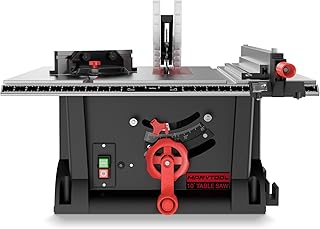
This compact 10-inch portable saw is aimed at occasional DIY work where bench space and storage are limited. Its 4,600 RPM motor, 36-tooth blade, crosscut capability, and 0-to-45-degree bevel range cover common furniture tasks, although buyers should be especially careful to verify fence alignment before making long, precision cuts.
DOVAMAN DTS10A
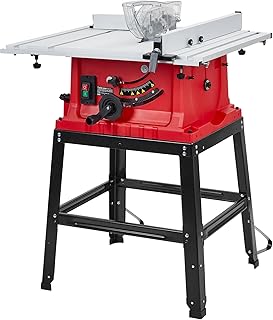
The DOVAMAN 10-inch table saw offers a useful blend of cutting capacity and included support at a budget-conscious price. Its 15-amp copper motor reaches 5,300 RPM, and the extendable table is practical for larger boards; the stand and broad feature set make it a sensible option for a developing home workshop.
10-Inch Portable Jobsite Table Saw with Stand
This 15-amp portable jobsite model is designed as a straightforward project saw, with a 5,000 RPM motor, stand, angle stop, and push stick included. The 0-to-45-degree bevel range and substantial maximum cut depth are useful for framing stock and furniture components, though its value depends on how smoothly the fence and adjustment wheels operate on the individual unit.
SKIL TS6307-00
The SKIL 15-Amp 10-Inch Portable Jobsite Table Saw is a particularly approachable choice for homeowners who want a folding stand without stepping into professional pricing. It is convenient to transport and store, and its familiar controls make it a comfortable starting point for shelves, trim, and small furniture builds; for large sheet goods, a separate support table is still a wise addition.
Frequently Asked Questions
Is a budget table saw suitable for furniture making?
Yes, provided the fence is aligned and the saw is used within its capacity. Budget models are well suited to dimensional lumber, plywood strips, shelving, and smaller panels, but a track saw or circular saw with a guide may be easier for breaking down full sheets.
What motor size should a home user choose?
A 15-amp motor is the practical standard for these portable saws. It provides enough power for common softwoods and many hardwood cuts, although feed rate, blade sharpness, and material thickness still determine how smoothly the saw performs.
Do I need a rolling or folding stand?
Not necessarily, but a stand is valuable when the saw must be stored between projects. Folding designs save floor space, while rolling stands are more comfortable if you regularly move the saw around a garage or workshop.
How can I improve cut accuracy on an inexpensive saw?
Check the blade-to-miter-slot alignment, square the fence to the table, and confirm that the fence remains parallel when locked. A quality combination blade, stable outfeed support, and measured test cuts will often make a larger difference than a higher advertised RPM.
Final Thoughts
The DEWALT DWE7491RS is the best overall pick for capacity, mobility, and dependable furniture work, while the SKIL TS6307-00 is a comfortable choice for homeowners who prioritize simple storage. For buyers seeking more features at a lower entry point, the DOVAMAN DTS10A is worth considering, provided its alignment and support components meet your expectations.