Key takeaways
- Speed control: Metal usually needs slower speeds than wood, especially with larger bits. Multiple pulley settings or variable-speed control make it easier to match the material and bit diameter.
- Rigidity: Cast iron tables, columns, and bases help limit vibration. A rigid machine produces cleaner holes and feels safer when a bit starts cutting into tougher stock.
- Capacity: Check swing, chuck range, spindle travel, and the stated drilling capacity. These figures determine whether the press suits thin sheet, angle iron, plate, or larger workpieces.
- Workholding: A stable table is useful, but metal should also be secured with clamps or a drill-press vise. Tilting tables add flexibility, though they require careful alignment.
- Portability: A benchtop press is best for repeated work at a fixed station. A magnetic drill is more practical for large steel beams, plates, and installed metal that cannot reach a tabletop.
What's inside
Buying a drill press for metal is less straightforward than choosing one for occasional woodwork. Metal rewards steady speed, a rigid frame, accurate depth control, and enough torque to prevent the bit from wandering or overheating. A lightweight machine may look convenient on a workbench but struggle with thicker steel, while an oversized magnetic drill can be excessive for small household projects.
This guide focuses on practical home use: furniture repairs, brackets, hardware, workshop fabrication, and general DIY. We compare benchtop models for repeatable drilling with portable magnetic drills for larger or awkward metal surfaces, while keeping setup, control, and everyday comfort in view.
As an Amazon Associate we earn from qualifying purchases.



How to Choose a Drill Press For Metal (2026)
- Speed control: Metal usually needs slower speeds than wood, especially with larger bits. Multiple pulley settings or variable-speed control make it easier to match the material and bit diameter.
- Rigidity: Cast iron tables, columns, and bases help limit vibration. A rigid machine produces cleaner holes and feels safer when a bit starts cutting into tougher stock.
- Capacity: Check swing, chuck range, spindle travel, and the stated drilling capacity. These figures determine whether the press suits thin sheet, angle iron, plate, or larger workpieces.
- Workholding: A stable table is useful, but metal should also be secured with clamps or a drill-press vise. Tilting tables add flexibility, though they require careful alignment.
- Portability: A benchtop press is best for repeated work at a fixed station. A magnetic drill is more practical for large steel beams, plates, and installed metal that cannot reach a tabletop.
The Best Drill Press For Metal (2026)s Reviewed
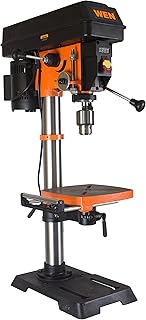
WEN 12-Inch Benchtop Drill Press
The WEN DP1263V is the most versatile choice here for a home workshop, combining cast iron construction with variable speed, a laser, and an LED work light. Its larger swing gives you useful room around brackets and plates, while the speed adjustment makes it easier to work sensibly across different metal thicknesses. It is a strong all-rounder for homeowners who expect to drill regularly rather than only once or twice a year.
VEVOR 1300W Portable Magnetic Drill
This VEVOR mag drill is designed for a different job: drilling directly into substantial ferrous metal surfaces where a benchtop press is impractical. Its magnetic base provides holding power on suitable steel, and the 1300W motor is aimed at demanding work. It is powerful and purpose-built, but less convenient for small parts, nonmagnetic materials, or a compact hobby bench.
WEN 8-Inch 5-Speed Benchtop Drill Press
The WEN 4206T is a sensible entry point for light metalwork and occasional household repairs. Its five-speed layout is less immediate than variable-speed control, but it gives useful flexibility without adding much complexity. The compact cast iron design suits smaller workshops, provided you stay within its capacity and use sharp, metal-rated bits.
VEVOR 10-Inch Benchtop Drill Press
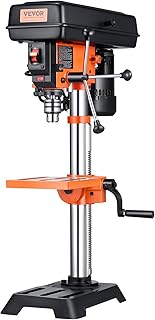
This VEVOR benchtop model offers a practical middle ground, with a cast iron frame, five speeds, and a table that tilts from 0 to 45 degrees. That adjustment is helpful for angled holes and small fabrication jobs, though it also means checking the table’s alignment before precision work. It makes sense for DIYers who want more workspace than a mini press but do not need a large professional machine.
Upgrade Mini Benchtop Drill Press
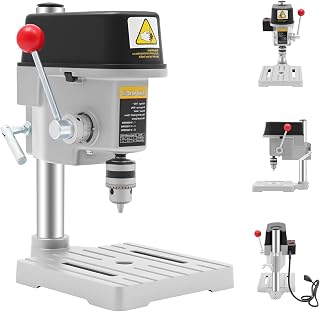
The Upgrade mini press is aimed at small-scale projects such as jewelry, crafts, thin stock, and light DIY drilling. Its compact size and three-level speed adjustment are convenient where bench space is limited, but the 340W motor and small format are not intended for thick steel or aggressive drilling. Treat it as a precision hobby tool rather than a substitute for a full-size metalworking press.
Frequently Asked Questions
Can a woodworking drill press drill metal?
Many drill presses can handle light metalwork if they offer suitable low speeds and the workpiece is securely clamped. Use cutting fluid where appropriate, choose bits designed for metal, and avoid forcing the feed when the motor begins to bog down.
Is a magnetic drill better than a benchtop drill press?
Neither is universally better. A magnetic drill excels on large, fixed steel surfaces and awkward locations, while a benchtop press is easier for small parts, repeated holes, and materials that cannot hold a magnet.
What speed should I use for drilling steel?
Use a slower setting for larger diameters and tougher materials, and follow the guidance supplied with the bit whenever available. Keeping the bit cool, applying controlled pressure, and using cutting lubricant generally matter as much as the exact speed.
Do I need a drill-press vise?
A vise or robust clamping arrangement is strongly recommended. It keeps metal from spinning or shifting when the bit catches, improving accuracy and reducing the chance of damaging the workpiece or injuring your hands.
Final Thoughts
For most home workshops, the WEN 12-Inch Benchtop Drill Press is the best overall balance of control, capacity, and useful features. Choose the WEN 8-Inch model for a compact budget setup, or the VEVOR 1300W Magnetic Drill when your projects involve large, fixed steel surfaces rather than small bench work.