Key takeaways
- Tooth Count & Cut Type: Lower tooth counts (24–32T) rip along the grain fast and clean; mid-range (40–50T) handle general crosscutting and combination work; higher counts (60–80T) deliver glassy-smooth finishes on veneer, plywood, and hardwood edges but move slower.
- Kerf Width: Full-kerf blades (around .125″) stay rigid and resist deflection, which matters if your saw has a powerful motor. Thin-kerf blades (roughly .090″–.100″) waste less wood and put less strain on underpowered jobsite saws, though they can wander slightly on thick stock.
- Arbor Size & Gullet Depth: Most benchtop and contractor table saws use a 5/8-inch arbor, so verify compatibility before ordering. Deeper gullets clear sawdust more efficiently during long rips and reduce the burning that plagues shallow-gullet blades on dense hardwoods.
- Coating & Heat Resistance: Non-stick or anti-friction coatings (like Perma-Shield or similar treatments) reduce pitch buildup and keep the blade cooler, extending sharpness and making cleanup less of a chore. This matters more than most people realize over the life of a blade.
- Carbide Quality & Sharpenability: Larger, thicker carbide teeth hold an edge longer and can be professionally resharpened two or three times. Micro-grind carbide tips cost more upfront but pay for themselves if you cut regularly rather than occasionally.
What's inside
Replacing a dull factory blade is the single fastest way to upgrade your table saw’s performance, yet most buyers stare at dozens of options and walk away with the wrong tooth count, wrong kerf, or a blade that gums up with resin after two weekends. The gap between a junk blade and the right one shows up in burned edges, tearout on crosscuts, and a motor that bogs down on material it should eat for lunch.
This guide cuts through the noise. We evaluated the most popular 10-inch table saw blades on Amazon in 2026 — from budget multi-packs to premium ultra-fine finish options — and ranked them on cut quality, durability, heat management, and real-world value for a home workshop.
As an Amazon Associate we earn from qualifying purchases.


How to Choose a 10in Table Saw Blade (2026)
- Tooth Count & Cut Type: Lower tooth counts (24–32T) rip along the grain fast and clean; mid-range (40–50T) handle general crosscutting and combination work; higher counts (60–80T) deliver glassy-smooth finishes on veneer, plywood, and hardwood edges but move slower.
- Kerf Width: Full-kerf blades (around .125″) stay rigid and resist deflection, which matters if your saw has a powerful motor. Thin-kerf blades (roughly .090″–.100″) waste less wood and put less strain on underpowered jobsite saws, though they can wander slightly on thick stock.
- Arbor Size & Gullet Depth: Most benchtop and contractor table saws use a 5/8-inch arbor, so verify compatibility before ordering. Deeper gullets clear sawdust more efficiently during long rips and reduce the burning that plagues shallow-gullet blades on dense hardwoods.
- Coating & Heat Resistance: Non-stick or anti-friction coatings (like Perma-Shield or similar treatments) reduce pitch buildup and keep the blade cooler, extending sharpness and making cleanup less of a chore. This matters more than most people realize over the life of a blade.
- Carbide Quality & Sharpenability: Larger, thicker carbide teeth hold an edge longer and can be professionally resharpened two or three times. Micro-grind carbide tips cost more upfront but pay for themselves if you cut regularly rather than occasionally.
The Best 10in Table Saw Blade (2026)s Reviewed
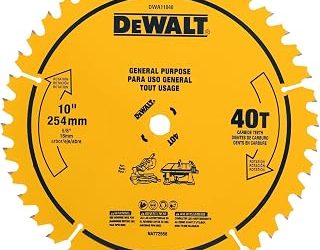
DEWALT DWA11040
A reliable 40-tooth general-purpose blade that punches above its price point. The ultra-sharp carbide tips produce clean crosscuts in plywood and dimensional lumber without bogging down mid-cut, and it ships ready to work straight out of the package. If you own one blade and need it to handle most tasks, this is the one to keep on the arbor.
Diablo D1050X Combination
The D1050X splits the difference between ripping and crosscutting with its 50-tooth ATB design, and the thin kerf means your motor barely notices it’s there. Perma-Shield coating keeps pitch from baking onto the teeth, so it stays sharp longer than comparably priced combo blades. It’s the best single-blade solution for hobbyists who don’t want to swap blades between cuts.
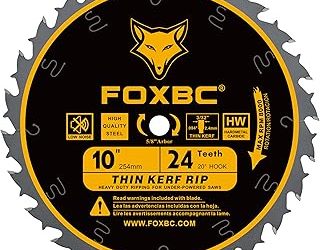
FOXBC 80-Tooth Ultra Finish
For the price, this 80-tooth blade delivers a finish that rivals blades costing three times as much — think furniture-grade edges on hardwood and zero tearout on melamine. The tradeoff is a slower feed rate and more heat buildup, so pair it with a steady push and let the blade do the work. Excellent second blade for finish-heavy projects.
WEN BL1080
WEN’s 80-tooth carbide-tipped blade is a workhorse for miter saws and table saws alike, producing near-glassy surfaces on crosscuts and end grain. The professional-grade carbide holds up surprisingly well across multiple resharpenings, which stretches the value even further. If you do a lot of finish carpentry or cabinet work on a budget, this blade earns its spot.
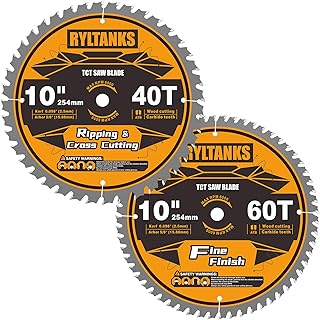
10 Inch 2-Pack (40T & 60T)
Buying blades in matched pairs simplifies the decision: mount the 40-tooth for ripping and general cutting, then swap in the 60-tooth whenever you need a cleaner surface. Both use standard 5/8-inch arbors and handle the same feed speeds, so the transition between them is seamless. It’s the most practical starter set for someone building out a workshop from scratch.
Frequently Asked Questions
What tooth count should I use for ripping hardwood?
For ripping with the grain, a 24-tooth to 40-tooth blade moves material quickly and clears sawdust through its deep gullets. Going higher than 40T on a rip cut slows your feed rate and increases friction without improving the cut surface, since the grain hides blade marks anyway.
Thin kerf or full kerf — which is better?
Thin kerf blades waste less material and require less horsepower, making them ideal for jobsite saws with 12- to 15-amp motors. Full kerf blades are stiffer and more resistant to vibration, so they shine on cabinet saws with powerful induction motors. Match the kerf to your saw’s capabilities and you’ll get better results either way.
How often should I replace or resharpen my blade?
Carbide-tipped blades typically last through 200 to 400 hours of cutting before edges noticeably dull, though pitch buildup can degrade cut quality much sooner if you don’t clean regularly. Professional resharpening costs roughly $15 to $25 per blade and can be done two or three times, so factor that into the value equation of higher-end blades.
Can I use a combination blade for everything?
A quality 50-tooth combination blade handles most home-shop tasks acceptably, but “acceptably” is the key word. Dedicated rip blades cut faster with less burning, and dedicated finish blades produce cleaner surfaces. If you cut fewer than a few dozen boards a week, a combo blade saves time and hassle; if precision matters on every cut, keep multiple blades on hand.
Final Thoughts
For most home workshop owners, the Diablo D1050X strikes the best balance of cut quality, versatility, and long-term value as an everyday blade. If you’re chasing the smoothest possible finish on hardwood and cabinetry, the WEN BL1080 or FOXBC 80-Tooth will impress you at their respective price points. And if you’re just getting started, the 40T/60T 2-Pack gives you two capable blades for less than what some single premium blades cost alone.