Key takeaways
- Lumen output: A standard garage benefits from at least 18,000 lumens per bulb. Anything below that risks dark corners, especially in spaces deeper than 20 feet. If your garage doubles as a workshop, push toward the 20,000–32,000 range.
- Panel count and adjustability: Six-panel designs with a central downlight (6+1 configuration) deliver the most uniform coverage. Three-panel units are more compact but can leave shadows along walls. Hinge stiffness matters too — panels that droop over time will ruin your beam angle.
- Color temperature: 6500K daylight is the garage standard because it renders colors accurately and keeps you alert. Warmer temperatures (3000K–4000K) feel cozier but make it harder to distinguish wire colors or paint shades.
- Socket compatibility and wattage: Most deformable garage bulbs use a standard E26 or E27 base, but verify your fixture can handle the heat output of a 200W-rated LED. In enclosed housings, derating may be necessary.
- Build quality and thermal management: Aluminum alloy housings dissipate heat far better than plastic. Look for listed operating-life figures above 50,000 hours — cheap units often skip this detail because the real number is unflattering.
What's inside
Walk into most garages and you’re squinting under a single, outdated fixture that makes it impossible to find the right socket wrench or spot a leak before it becomes a problem. The shift to deformable LED garage light bulbs has changed that calculus entirely — they screw into a standard E26 or E27 socket and fan out adjustable panels that wash a room in bright, even daylight. The catch is that the market is now flooded with options, and not every “20,000 lumen” claim holds up once the unit is actually mounted on your ceiling.
This guide distills what matters when picking a garage ceiling bulb — output, panel design, heat management, and real-world beam spread — and walks you through five standout products available now. Whether you’re lighting a two-car garage for weekend projects or a workshop where detail work matters, the picks below cover a range of budgets and wattage needs without burying you in filler specs.
As an Amazon Associate we earn from qualifying purchases.


How to Choose a Light Bulb For Garage Ceiling (2026)
- Lumen output: A standard garage benefits from at least 18,000 lumens per bulb. Anything below that risks dark corners, especially in spaces deeper than 20 feet. If your garage doubles as a workshop, push toward the 20,000–32,000 range.
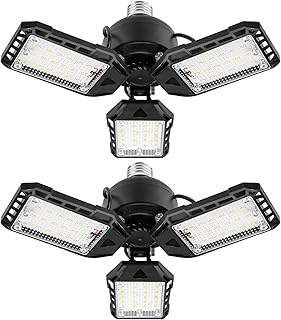
- Panel count and adjustability: Six-panel designs with a central downlight (6+1 configuration) deliver the most uniform coverage. Three-panel units are more compact but can leave shadows along walls. Hinge stiffness matters too — panels that droop over time will ruin your beam angle.
- Color temperature: 6500K daylight is the garage standard because it renders colors accurately and keeps you alert. Warmer temperatures (3000K–4000K) feel cozier but make it harder to distinguish wire colors or paint shades.
- Socket compatibility and wattage: Most deformable garage bulbs use a standard E26 or E27 base, but verify your fixture can handle the heat output of a 200W-rated LED. In enclosed housings, derating may be necessary.
- Build quality and thermal management: Aluminum alloy housings dissipate heat far better than plastic. Look for listed operating-life figures above 50,000 hours — cheap units often skip this detail because the real number is unflattering.
The Best Light Bulbs For Garage Ceiling (2026) Reviewed
Garage Lights 32000LM 6-Panel (2-Pack)
This is the brute-force option. At 32,000 lumens per bulb the pair floods even a large, cluttered garage with no dark spots to speak of. The six deformable panels are stiff enough to hold position, and the 6500K output feels genuinely daylight-bright rather than sterile. If you have a high ceiling or a deep bay, this is the one to reach for first.
TANBABY 30000LM 6+1 Panel (2-Pack)
TANBABY’s 6+1 layout — six outer panels plus a central LED — fills in the dead zone directly below the fixture that pure fan designs sometimes miss. At 30,000 lumens it sits just under the top-output pick but adds more even coverage, which matters when your workbench sits right under the light. The build feels solid and the panels click into position with reassuring resistance.
LED Garage Light 20000LM 6+1 (2-Pack)
A sensible middle ground. Twenty thousand lumens is plenty for a standard two-car garage, and the 6+1 panel arrangement distributes light efficiently without the premium price of higher-output models. It’s a particularly good fit for garages that are used primarily for parking and storage rather than detailed projects.
AUDLES 200W 20000LM 6+1 (2-Pack)
AUDLES matches the lumen count of cheaper options but backs it with a 200W draw and a metal housing that handles heat well during extended use. If your garage lacks ventilation or you tend to leave lights on for hours during projects, the thermal design here earns its keep. Panel articulation is smooth and stays put.
Aoretic 180W 3-Panel (2-Pack)
The most compact option on this list. With only three deformable panels, Aoretic’s unit is easier to install in tight ceiling spaces and lower-profile fixtures. At 18,000 lumens it’s the least powerful pick, but for smaller garages or supplemental lighting alongside an existing fixture it hits a practical sweet spot at a lower cost.
Frequently Asked Questions
How many lumens do I actually need for a garage?
A standard two-car garage (roughly 400 square feet) benefits from 20,000 to 30,000 total lumens spread across two or three fixtures. Workshops and detailing bays call for closer to 40,000. The key is distribution — a single ultra-bright point source creates harsh shadows, which is exactly why these multi-panel designs exist.
Will these screw into a regular light socket?
Yes — every bulb in this roundup uses a standard E26 or E27 base. You simply remove the old bulb and twist the new one in. No rewiring, no special fixture. Just make sure the existing socket and wiring can handle the wattage; most modern garage circuits are fine up to 200W per fixture.
Do deformable panel lights actually last?
Units from reputable brands typically list 50,000-hour lifespans, which translates to well over a decade of normal garage use. The weak point in cheaper models is usually the panel hinges — they can loosen and sag after a year or two. All five picks above use metal or reinforced hinges that hold up well in practice.
Can I use these in an enclosed outdoor fixture?
Most are rated for indoor or semi-enclosed spaces like garages and barns, but not for direct weather exposure. If you need lighting in an open carport or outdoor workspace, check for a specific IP rating (IP65 or higher) before installing. The units reviewed here are best kept under a roof.
Final Thoughts
For raw brightness, the Garage Lights 32000LM is hard to beat. If even coverage matters more than peak output, the TANBABY 6+1 delivers the best beam spread in this group. And for straightforward, well-built lighting at a lower price point, the AUDLES 200W is a reliable workhorse that won’t leave you shopping for replacements anytime soon.