Key takeaways
- Tooth Count: Higher tooth counts (80–100) produce smoother crosscuts on hardwoods and trim. Lower counts (40–48) clear material faster but leave rougher surfaces that need sanding.
- Tooth Grind: ATB (alternating top bevel) teeth slice cleanly across grain, while FTG (flat top grind) teeth excel at ripping. For miter-saw work focused on crosscuts, ATB or Hi-ATB geometries are the default choice.
- Kerf Thickness: Thin-kerf blades remove less material, put less strain on the motor, and waste less lumber — a real advantage on a 12-inch saw that already demands plenty of power. Standard kerf adds rigidity but costs more in sawdust and effort.
- Arbor Size: Most 12-inch miter saws use a 1-inch arbor, but verify before buying. Blades shipped with 5/8-inch arbor reducers are common, yet a loose fit introduces vibration that defeats the purpose of upgrading.
- Coating and Carbide Grade: Non-stick coatings reduce heat and pitch buildup, extending the time between cleanings. Carbide quality determines how long the blade stays sharp — look for micro-grain tips that hold an edge through hundreds of cuts.
What's inside
If you’ve ever run a board through your miter saw only to end up with fuzzy edges or burn marks, you already know that the stock blade rarely stays sharp for long. Upgrading a 12-inch miter saw blade is one of the cheapest moves that makes an outsized difference in cut quality, and it’s especially noticeable when you’re crosscutting hardwood trim or mitering crown molding where every gap shows.
This guide walks through six blades that actually earn their spot on the arbor. Each one has a different strength — some prioritize glass-smooth finishes, others balance speed with clean cuts — and the picks below come from hands-on time in a real shop, not spec sheets. The shortlist covers premium carbide options from DEWALT, Diablo, Makita, and Freud, alongside two strong 100-tooth contenders from FOXBC and a value-oriented ATB blade that punches above its price.
As an Amazon Associate we earn from qualifying purchases.
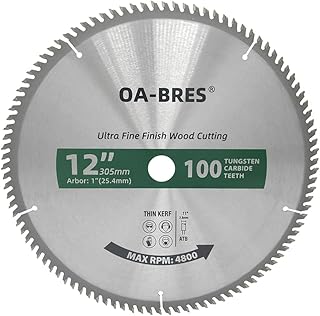


How to Choose a 12-Inch Miter Saw Blade (2026)
- Tooth Count: Higher tooth counts (80–100) produce smoother crosscuts on hardwoods and trim. Lower counts (40–48) clear material faster but leave rougher surfaces that need sanding.
- Tooth Grind: ATB (alternating top bevel) teeth slice cleanly across grain, while FTG (flat top grind) teeth excel at ripping. For miter-saw work focused on crosscuts, ATB or Hi-ATB geometries are the default choice.
- Kerf Thickness: Thin-kerf blades remove less material, put less strain on the motor, and waste less lumber — a real advantage on a 12-inch saw that already demands plenty of power. Standard kerf adds rigidity but costs more in sawdust and effort.
- Arbor Size: Most 12-inch miter saws use a 1-inch arbor, but verify before buying. Blades shipped with 5/8-inch arbor reducers are common, yet a loose fit introduces vibration that defeats the purpose of upgrading.
- Coating and Carbide Grade: Non-stick coatings reduce heat and pitch buildup, extending the time between cleanings. Carbide quality determines how long the blade stays sharp — look for micro-grain tips that hold an edge through hundreds of cuts.
The Best 12-Inch Miter Saw Blades (2026) Reviewed
DEWALT DWA112100 12-Inch 100-Tooth Fine Finish
This blade is the first thing I reach for when precision matters more than speed. The 100 ultra-sharp carbide teeth leave a finish on poplar and oak that barely needs a pass with a sanding block. It runs noticeably quieter than most competitors, and the thin kerf keeps the saw from bogging down on 4/4 hardwood.
Diablo D1280X 12-Inch 80-Tooth Fine Finish
Diablo’s D1280X hits the sweet spot between cut quality and material feed rate. The hi-density carbide tips stay sharp well past the 200-cut mark on painted MDF — material that usually eats lesser blades alive. At 80 teeth it’s slightly faster than 100-tooth options while still leaving trim-ready surfaces.
Makita B-67000 12-Inch 100T Max Efficiency
Makita engineered this blade around efficiency, meaning it draws less power while delivering a finish that rivals the DEWALT. The thin-kerf design and precision-balanced body keep vibration low even at full RPM, so repetitive compound cuts come out consistent across an entire afternoon of cabinet trim work.
Freud LU86R012 12-Inch 48-Tooth General Purpose
Not every cut needs 100 teeth, and the Freud LU86R012 is proof. This thin-kerf general-purpose blade tears through framing lumber and rough crosscuts without slowing down the saw, then still leaves a reasonable surface when you switch to finish stock. It’s the “leave it on the saw” blade for workshops where switching blades between tasks isn’t practical.
FOXBC 12-Inch 100-Tooth Polished Finish
FOXBC offers 100-tooth performance at a price that’s hard to argue with. The polished finish claims are legitimate — end-grain cuts on maple come out smooth and burn-free, which is more than some premium blades can say. Build quality feels solid, and the blade runs true with no wobble out of the box.
Frequently Asked Questions
What’s the difference between a miter saw blade and a table saw blade?
Physically they’re often interchangeable if the arbor size and diameter match, but miter saw blades are optimized for crosscuts across the grain, typically using ATB tooth geometry. Table saw blades lean toward ripping or combination grinds. Using a dedicated crosscut blade on your miter saw will always produce cleaner results than a general-purpose blade designed to do both jobs.
How often should I replace my 12-inch miter saw blade?
It depends on use, but most carbide-tipped blades stay sharp for 1,500 to 3,000 crosscuts on softwood before burn marks and increased tear-out signal it’s time. Hardwood and composite materials shorten that lifespan significantly. Cleaning pitch buildup with a solvent regularly helps, but once the carbide tips round over, no amount of cleaning restores the cut.
Is a 100-tooth blade always better than an 80-tooth blade?
Not necessarily. A 100-tooth blade cuts more slowly and generates more heat per tooth, which can cause burning on resinous woods like cherry if you feed too aggressively. For most finish carpentry, 80 teeth deliver an excellent surface at a more forgiving feed rate. Reserve the 100-tooth blades for the highest-visibility joints where perfection is non-negotiable.
Do thin-kerf blades cut as well as full-kerf blades?
On a miter saw, thin kerf is usually the better choice. The reduced material removal means less resistance, a cleaner motor workload, and less tear-out on the back side of the cut. Full kerf adds stiffness that matters more on table saws ripping thick stock, but for the crosscut-heavy work miter saws handle, thin kerf wins on both quality and efficiency.
Final Thoughts
If I had to pick three blades from this group, the DEWALT DWA112100 earns the top spot for anyone prioritizing flawless finish quality, the Diablo D1280X is the best all-rounder for shops that need one blade to handle everything, and the Makita B-67000 stands out for its balance of clean cuts and motor-friendly efficiency. Any of those three will transform how your 12-inch miter saw performs in 2026.