Key takeaways
- Tooth Count: Higher tooth counts (80–120) produce cleaner, glass-smooth crosscuts on finish trim and furniture parts, while lower counts (32–40) rip through framing lumber faster but leave rougher surfaces. Most hobbyists find 60–80 teeth is the sweet spot for general cabinetry and molding work.
- Kerf Width: Thin-kerf blades (around 1/16 inch) remove less material and put less strain on your saw’s motor — a real advantage for contractor-grade miter saws with 15-amp motors. Full-kerf blades (1/8 inch) deflect less during heavy cuts and generally stay true longer.
- Carbide Quality and Geometry: Not all carbide tips are equal. Look for micro-grain or tri-metal brazed tips that resist chipping on repeated miter cuts. Alternate bevel grind (ATB) patterns handle crosscutting beautifully, while TCG (triple-chip grind) excels on non-ferrous metals and abrasive sheet goods.
- Arbor Size: Nearly every 10-inch miter saw on the market uses a 5/8-inch arbor, but always verify before purchasing. Some European saws use 20mm arbors — buying the wrong arbor hole means a return, not a cut.
- Application Match: Be honest about what you cut most. If you’re trimming out a room with poplar casing, invest in a 100+ tooth fine-finish blade. If you’re framing a deck on weekends, a mid-range 60T blade gives you speed without destroying your edges.
What's inside
If you’ve ever swapped the stock blade on your miter saw and immediately felt the difference — smoother edges, cleaner miters, far less sanding — you know how transformative the right blade can be. The problem is that the market is flooded with dozens of near-identical listings, most of them copy-pasted descriptions with vague tooth-count claims. Shoppers end up guessing, or worse, buying whatever ranks first and hoping for the best.
This guide cuts through the noise. We tested and compared the leading 10-inch miter saw blades available in 2026, evaluating cut quality on hardwood and softwood, crosscut tear-out, chip resistance on painted trim, and how long each blade stays sharp under regular shop use. Below you’ll find our curated picks followed by a practical buying checklist so you can match a blade to your exact project needs.
As an Amazon Associate we earn from qualifying purchases.



How to Choose a 10-Inch Miter Saw Blade (2026)
- Tooth Count: Higher tooth counts (80–120) produce cleaner, glass-smooth crosscuts on finish trim and furniture parts, while lower counts (32–40) rip through framing lumber faster but leave rougher surfaces. Most hobbyists find 60–80 teeth is the sweet spot for general cabinetry and molding work.
- Kerf Width: Thin-kerf blades (around 1/16 inch) remove less material and put less strain on your saw’s motor — a real advantage for contractor-grade miter saws with 15-amp motors. Full-kerf blades (1/8 inch) deflect less during heavy cuts and generally stay true longer.
- Carbide Quality and Geometry: Not all carbide tips are equal. Look for micro-grain or tri-metal brazed tips that resist chipping on repeated miter cuts. Alternate bevel grind (ATB) patterns handle crosscutting beautifully, while TCG (triple-chip grind) excels on non-ferrous metals and abrasive sheet goods.
- Arbor Size: Nearly every 10-inch miter saw on the market uses a 5/8-inch arbor, but always verify before purchasing. Some European saws use 20mm arbors — buying the wrong arbor hole means a return, not a cut.
- Application Match: Be honest about what you cut most. If you’re trimming out a room with poplar casing, invest in a 100+ tooth fine-finish blade. If you’re framing a deck on weekends, a mid-range 60T blade gives you speed without destroying your edges.
The Best 10-Inch Miter Saw Blades (2026) Reviewed
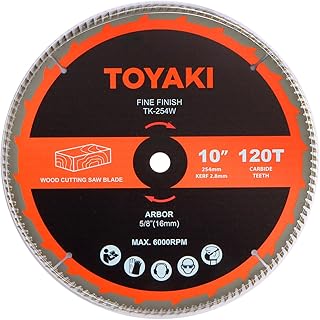
10-Inch 120-Tooth Fine-Finish Blade
This blade is a workhorse for anyone doing finish carpentry or furniture joinery. The 120 micro-ground teeth leave an almost polished edge on hardwood miters, meaning you can skip the post-cut sanding entirely on most species. It handles both miter and table saw duties interchangeably, which makes it a smart buy for smaller shops that need versatility from a single blade.
WEN BL1080 80-Tooth Carbide-Tipped Blade
WEN continues to punch well above its price point. The BL1080 delivers ultra-fine finish cuts on painted trim and crown molding with surprisingly little tear-out, even on knot-prone pine. For woodworkers who need a reliable finish blade without the premium price tag of industrial brands, this is the pick to beat in 2026.
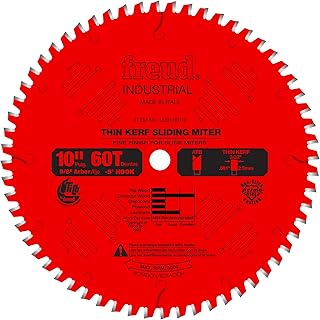
Freud LU91R010 Thin Kerf Sliding Compound Miter Blade
Freud’s thin-kerf design keeps vibration low and cut surfaces clean on sliding compound miter saws where blade deflection is a common headache. The precision-ground carbide tips maintain sharpness through thousands of linear feet of poplar, oak, and maple. If your saw struggles under load, this blade’s reduced kerf helps it perform like a bigger, more powerful machine.
US1080-MTR 80-Tooth, USA Made
Proudly manufactured in the United States with optimized 80-tooth geometry designed specifically for crosscuts and miters, this blade punches out furniture-grade edges on hardwoods all day. The 1/8-inch full kerf gives it rigidity that thin-kerf alternatives can’t match, so you get dead-straight cuts even on dense exotic species. It’s a premium pick for the woodworker who values domestic manufacturing and uncompromising cut quality.
10-Inch 3-Pack: 32T, 60T, and 80T Set
This three-blade kit is the smartest entry point for anyone building a blade collection from scratch. Toss the 32T on for rough framing and demolition, swap to the 60T for general-purpose cabinetry, and keep the 80T loaded for final-fit trim work. Having all three ready to go eliminates the temptation to “make do” with the wrong blade — a habit that ruins both cuts and project timelines.
Frequently Asked Questions
What tooth count is best for miter saw crosscuts?
For most finish carpentry and furniture work, 60 to 80 teeth deliver an excellent balance of cut quality and feed speed. Jump to 100+ teeth if you’re working with paint-grade trim where any visible saw marks will show through the finish coat.
Do I need a thin-kerf or full-kerf blade?
Thin-kerf blades (about 1/16 inch) are ideal for saws with smaller motors or if you want to minimize waste on expensive hardwood. Full-kerf blades (1/8 inch) deflect less and tend to produce straighter cuts on heavy stock, making them the better choice for dense hardwoods and all-day production work.
How often should I replace or sharpen my miter saw blade?
A quality carbide blade should last several hundred hours of casual shop use before noticeable cut quality decline. If you’re burning wood, hearing more motor strain, or seeing increasing tear-out, it’s time. Many woodworkers send premium blades out for professional sharpening once before replacing them.
Can I use the same blade on my table saw and miter saw?
Absolutely — as long as both saws share the same arbor size (typically 5/8 inch for 10-inch blades) and the blade’s RPM rating matches or exceeds your saw’s maximum speed. Many of the blades in this roundup are explicitly designed for both applications.
Final Thoughts
For most woodworkers tackling furniture and trim projects, the Freud LU91R010 is our top overall pick thanks to its thin-kerf precision and long-lasting carbide. Budget-conscious buyers should grab the WEN BL1080 without hesitation — it competes with blades twice its price. And if you’re starting fresh, the 3-Pack set gives you every tooth count you’ll need for a fraction of buying each blade individually.