Key takeaways
- Reach height vs. folded size: A 22-foot extension ladder handles almost anything on a residential property, but consider where you’ll store it. If closet space is tight, a 17-foot multi-position or a compact step stool may serve you better ninety percent of the time.
- Material — aluminum or fiberglass: Fiberglass models weigh more but won’t conduct electricity, making them essential around service panels, overhead wiring, or anything near live circuits. Aluminum trims pounds off for easier carrying but should stay away from electrical work.
- Weight capacity rating: Little Giant labels its models with OSHA classifications — Type IA (300 lbs) or higher. If you routinely carry heavy paint buckets or tools, that number matters. Factor in your body weight plus everything you’re hauling up.
- Specific safety features: Look for ground-level locking indicators, rotating handrails, rubber anti-slip treads, and integrated tool trays. These aren’t luxury add-ons; they’re the details that keep you focused on the job instead of on your footing.
- Intended use pattern: A homeowner who changes light bulbs twice a year has totally different needs than a contractor running drywall daily. Match build quality and weight to how often you’ll actually climb.
What's inside
Shopping for a ladder is one of those tasks where most people end up overbuying, underbuying, or picking a model that wobbles when they actually need it most. The Little Giant brand solves part of that confusion by engineering multi-position designs that do the work of several ladders in one — but their lineup has grown enough that choosing between models can feel its own kind of overwhelming.
This guide breaks down the strongest Little Giant options available right now in 2026, compares what each one does best, and helps you match the right ladder to your actual projects — whether that means painting a two-story hallway, swapping recessed lights, or just reaching the top shelf in the garage without staging a balancing act.
As an Amazon Associate we earn from qualifying purchases.


How to Choose a Little Giant Ladder (2026)
- Reach height vs. folded size: A 22-foot extension ladder handles almost anything on a residential property, but consider where you’ll store it. If closet space is tight, a 17-foot multi-position or a compact step stool may serve you better ninety percent of the time.
- Material — aluminum or fiberglass: Fiberglass models weigh more but won’t conduct electricity, making them essential around service panels, overhead wiring, or anything near live circuits. Aluminum trims pounds off for easier carrying but should stay away from electrical work.
- Weight capacity rating: Little Giant labels its models with OSHA classifications — Type IA (300 lbs) or higher. If you routinely carry heavy paint buckets or tools, that number matters. Factor in your body weight plus everything you’re hauling up.
- Specific safety features: Look for ground-level locking indicators, rotating handrails, rubber anti-slip treads, and integrated tool trays. These aren’t luxury add-ons; they’re the details that keep you focused on the job instead of on your footing.
- Intended use pattern: A homeowner who changes light bulbs twice a year has totally different needs than a contractor running drywall daily. Match build quality and weight to how often you’ll actually climb.
The Best Little Giant Ladder (2026) Reviews
Little Giant Jumbo Step (11904)
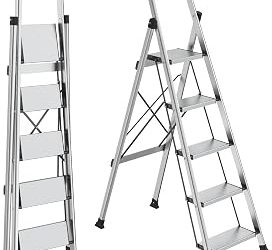
This four-step foldable aluminum stool punches above its weight thanks to extra-wide stair-like treads and a rotating handrail that gives real stability when you’re perched up reaching for crown molding. It folds flat for sliding behind a couch or into a pantry, and the integrated tool tray keeps your drill or screwdriver within arm’s reach instead of balanced on the edge of a paint can. At 375 pounds of capacity and under five pounds of fully-loaded feel, it’s the kind of grab-and-go solution that earns a permanent spot in the utility closet.
Little Giant Conquest 2.0 (17122-001)
The Conquest 2.0 is the serious homeowner’s do-everything ladder. Stretching to 22 feet in extension mode, switching to a 90-degree configuration against walls, or splitting into a trestle scaffold — it covers ground that would normally require two or three separate purchases. The hi-viz green fiberglass keeps you safe around wiring, and the tip-and-glide wheels mean you’re rolling it between the house and the shed rather than dragging it. Three hundred pounds of capacity rounds out a package that feels built to outlast your to-do list.
Little Giant Dark Horse 2.0 (16117-001)
Think of the Dark Horse as the Conquest’s slightly more portable sibling. At 17 feet it still reaches most second-story gutters and tall interior walls, but the reduced footprint makes it noticeably easier to maneuver in tight spaces like stairwells and narrow hallways. The same hi-viz green fiberglass construction and 300-pound Type IA rating carry over, along with multi-position capability that lets you convert between stepladder, extension, and wall-bench modes without tools.
Little Giant Safety Step (10410BA)
Where the Jumbo Step leans toward simplicity, the Safety Step adds a fold-up safety bar that genuinely changes how confident you feel working at modest heights. The rubber anti-slip treads are aggressive enough to grip with wet sneakers, and the extra-heavy-duty aluminum frame keeps the whole unit rigid under full load. Four steps with two-by-eleven-inch platforms give you enough standing room to actually work — not just balance — which makes this an underrated pick for anyone who spends extended time on a ladder doing detail painting or hardware installation.
Little Giant MightyLite (15408-001)
The MightyLite earns its name: at eight feet of reach it’s the lightest full-size fiberglass stepladder Little Giant offers, yet it still supports 375 pounds thanks to clever slim-profile engineering. The Ground Cue system gives an audible and tactile click when every lock is fully engaged, so you know you’re secure before your first step up. Wide anti-slip steps and a full-size standing platform make it feel like a much larger ladder, and the tool top cap holds small items without wobble — ideal for quick household tasks where hauling out a full multi-position ladder would be overkill.
Frequently Asked Questions
Can I use a fiberglass Little Giant ladder for electrical work?
Yes. Fiberglass is non-conductive, which is exactly why models like the Conquest 2.0 and Dark Horse 2.0 are rated for work near electrical circuits. Always inspect the fiberglass for cracks before each use, and never substitute an aluminum ladder when electricity is a factor.
How much weight can Little Giant ladders typically hold?
Most models in this roundup carry a Type IA rating of 300 pounds, while the Jumbo Step and MightyLite step up to 375 pounds. Those ratings include your body weight plus tools and materials, so plan accordingly when you’re loading up for a big job.
Which Little Giant ladder is best for interior painting?
For most interior rooms, the Conquest 2.0 or Dark Horse 2.0 in 90-degree wall mode gives you a stable platform right against the wall without constantly repositioning. Smaller jobs — trim, doors, touch-ups — are handled easily by the Jumbo Step or Safety Step.
Are multi-position ladders hard to convert between modes?
Not with Little Giant’s locking systems. A quick pull on the hinge locks collapses or expands the ladder, and the mechanisms are designed to be operated one-handed. There’s a short learning curve the first time, but most owners report switching modes in under fifteen seconds after that.
Final Thoughts
For homeowners who want maximum versatility, the Little Giant Conquest 2.0 covers the widest range of projects in a single purchase. If you need a compact indoor solution without sacrificing stability, the Jumbo Step 11904 is hard to beat. And for lightweight everyday use with serious weight capacity, the MightyLite 15408-001 strikes an impressive balance between portability and performance. Any of these five models will serve you well — the right choice just comes down to where and how often you climb.