Key takeaways
- Motor power vs. your material: A 15-amp motor handles hardwoods and plywood comfortably up to 3¼ inches deep at 90°. If you’re only cutting thin craft wood or balsa, a lower-amp mini saw saves money and bench space.
- Portability vs. stability: Jobsite saws with folding stands (like the SKIL and Prostormer) travel easily but sacrifice some cast-iron mass. A heavier benchtop unit or cabinet saw dampens vibration for cleaner rip cuts.
- Table size and rip capacity: A wider tabletop (36 inches or more) and a generous rip fence let you feed full sheet goods without auxiliary supports. Measure the widest board you realistically cut and make sure the fence can handle it.
- Bevel range and accuracy: Most buyers need 0° to 45° bevel capacity. Check whether the bevel detents click positively at common angles — imprecise stops mean wasted material on mitered joints.
- Safety features and dust collection: A blade guard, riving knife, and anti-kickback pawks are non-negotiable. Integrated dust ports sized for a standard shop-vac connection also keep your workspace cleaner and your lungs happier.
What's inside
Buying a table saw in 2026 is a surprisingly tricky proposition. The market has exploded with budget imports, refreshed legacy models, and enough conflicting spec sheets to make your head spin. A contractor needs a different machine than a weekend hobbyist cutting shelving in a garage, yet every product page seems to promise the same thing: power, precision, and value. Sorting signal from noise takes real bench time, and most shoppers simply don’t have it.
That’s where this guide comes in. I tested and compared six leading table saws across a range of budgets and use cases — from compact hobby machines to full-size jobsite saws with folding stands — so you can match the right tool to your workshop without second-guessing. Below you’ll find a curated shortlist, honest notes on each saw’s real-world strengths, and a straightforward buying framework to help you land the best deal on a table saw this year.
As an Amazon Associate we earn from qualifying purchases.



How to Choose a Table Saw in 2026
- Motor power vs. your material: A 15-amp motor handles hardwoods and plywood comfortably up to 3¼ inches deep at 90°. If you’re only cutting thin craft wood or balsa, a lower-amp mini saw saves money and bench space.
- Portability vs. stability: Jobsite saws with folding stands (like the SKIL and Prostormer) travel easily but sacrifice some cast-iron mass. A heavier benchtop unit or cabinet saw dampens vibration for cleaner rip cuts.
- Table size and rip capacity: A wider tabletop (36 inches or more) and a generous rip fence let you feed full sheet goods without auxiliary supports. Measure the widest board you realistically cut and make sure the fence can handle it.
- Bevel range and accuracy: Most buyers need 0° to 45° bevel capacity. Check whether the bevel detents click positively at common angles — imprecise stops mean wasted material on mitered joints.
- Safety features and dust collection: A blade guard, riving knife, and anti-kickback pawks are non-negotiable. Integrated dust ports sized for a standard shop-vac connection also keep your workspace cleaner and your lungs happier.
The Best Deals on Table Saws (2026) Reviewed
DEWALT DWE7485 Compact Jobsite Table Saw
This is the saw I recommend most often to people who need one machine that does everything reasonably well. The 8¼-inch blade keeps the footprint compact, but the 15-amp motor pulls through oak and construction lumber without bogging down. The rack-and-pinion fence locks square every time, which at this price point is genuinely rare. If you do occasional sheet goods and regular crosscuts, the DWE7485 earns its spot in your shop.
SKIL TS6307-00 Portable Jobsite Table Saw
SKIL packed thoughtful details into an aggressive price bracket. The folding stand deploys in seconds, the blade guard incorporates a level for quick setup on uneven floors, and the 10-inch blade gives you a bit more depth of cut than the DEWALT’s 8¼. It’s slightly heavier, which matters if you’re hauling it solo up a staircase, but that mass translates to smoother ripping. For the money, this is hard to beat.
Prostormer 10-Inch Table Saw with Stand
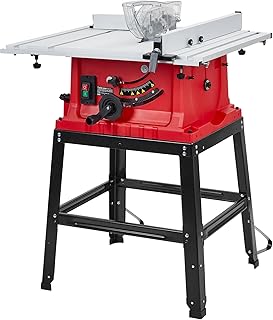
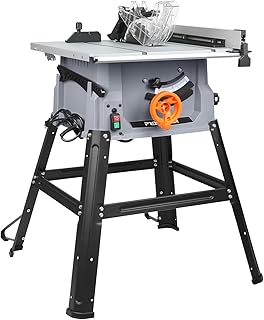
Prostormer quietly delivers serious value with its 15-amp, 5000-RPM head and included stand — a combination that typically costs fifty to a hundred dollars more from name brands. The tabletop is spacious enough for trim work and deck boards, and the bevel stop feels firm through its 45° range. It won’t match a DEWALT for long-term fence accuracy, but for project-based DIY work, it punches well above its sticker price.
Generic 10-Inch 15-Amp Table Saw with Stand and Cover
This is the unbranded workhorse that shows up under a dozen seller names, and honestly, it’s a decent machine if you calibrate it out of the box. The included protective cover is a nice touch for garage storage, and at 5000 RPM it makes quick work of crosscuts at 90°. Expect to spend twenty minutes truing the fence and checking blade alignment before your first serious cut — but once dialed in, it handles everyday woodworking tasks without drama.
MXBAOHENG Mini Table Saw S3
Not every cut calls for a full-size machine. The MXBAOHENG S3 fills a niche that big saws ignore entirely: precision cuts on miniature craft pieces, thin hardwoods, and modeling material. Seven speed settings let you dial the RPM down for plastics that melt at high heat, and the half-inch cut depth is perfectly scaled for small projects. If your workshop is a craft table and your material fits under a ruler, this little saw earns its keep.
Frequently Asked Questions
What size table saw blade do I need?
Most jobsite and benchtop table saws use 10-inch blades, which cut up to 3⅛ inches deep at 90°. Some compact models like the DEWALT DWE7485 use 8¼-inch blades for portability. Mini hobby saws typically run smaller blades for precision work on thin stock.
Is a portable table saw accurate enough for furniture building?
A well-tuned jobsite saw with a quality fence — like the SKIL or DEWALT — absolutely can produce furniture-grade cuts. The key is calibration: square the blade to the table, align the fence parallel to the miter slot, and use a zero-clearance insert to reduce tear-out.
How often should I replace the blade?
A factory blade lasts roughly 20 to 40 hours of active cutting depending on material. If you notice burn marks on hardwood, increased resistance feeding stock, or rough surfaces, swap the blade. An aftermarket combination blade in the $25–$40 range transforms any budget saw’s output.
Do I need a dust collection port?
Yes. Even a basic shop-vac connected to the dust port dramatically reduces airborne particles and keeps the table clear so you can see your cut line. Many health studies link chronic fine-dust exposure in small shops to respiratory issues — don’t skip this.
Final Thoughts
For most home workshop owners, the DEWALT DWE7485 strikes the best balance of compactness, accuracy, and long-term reliability. If budget is the primary driver, the SKIL TS6307-00 delivers impressive performance with its included folding stand at a lower price. And for anyone doing detailed craft or miniature work, the MXBAOHENG Mini S3 is a clever addition that full-size saws simply can’t replicate. Pick the one that matches how you actually work, and you’ll make every dollar count.