Key takeaways
- Wattage and Garage Size: A standard two-car garage (roughly 400–500 sq ft) typically needs at least 5,000W of output. Smaller single-car shops can get by with 1,500–2,500W, while larger workshops or warehouses benefit from 7,500W units that push serious heat without running nonstop.
- Voltage Compatibility: Most high-output garage heaters require a 240V dedicated circuit. Verify your existing wiring before committing — a 5,000W+ unit plugged into a standard 120V outlet simply won’t deliver rated performance and could trip breakers. If you only have 120V availability, look at lower-wattage or infrared models.
- Mounting Style: Ceiling-mount units save floor space and distribute heat more evenly across a room, which matters when your garage doubles as a workshop. Portable floor heaters offer flexibility if you work in different zones. Wall-mounted oscillating units are ideal for smaller attached garages where ceiling access is limited.
- Thermostat and Timer Controls: A built-in digital thermostat with remote access prevents you from overheating the space and wasting energy. Timer functions let you pre-warm the garage before you head out — a genuine convenience on early-morning project days.
- Safety Certifications: Look for ETL or UL listing, overheat auto-shutoff, and tip-over protection. Ceiling-mounted units should include thermal cutoff switches. These aren’t optional nice-to-haves; they’re essential in a space where you’re storing fuel, chemicals, and wood dust.
What's inside
Turning a cold garage into a usable workspace during winter is one of those home upgrades that sounds simple until you start shopping. You’re met with dozens of wattage claims, confusing voltage requirements, and heaters that promise to warm 500 square feet but barely take the edge off near a workbench. The wrong pick means wasted electricity, uneven heat, and a space you still avoid from November through March.
This guide breaks down the strongest electric garage heaters available in 2026 — covering hardwired ceiling-mount units, portable floor models, and wall-mounted options — so you can match the right heater to your garage size, wiring setup, and daily routine without second-guessing the purchase.
As an Amazon Associate we earn from qualifying purchases.


How to Choose a Garage Electric Space Heater (2026)
- Wattage and Garage Size: A standard two-car garage (roughly 400–500 sq ft) typically needs at least 5,000W of output. Smaller single-car shops can get by with 1,500–2,500W, while larger workshops or warehouses benefit from 7,500W units that push serious heat without running nonstop.
- Voltage Compatibility: Most high-output garage heaters require a 240V dedicated circuit. Verify your existing wiring before committing — a 5,000W+ unit plugged into a standard 120V outlet simply won’t deliver rated performance and could trip breakers. If you only have 120V availability, look at lower-wattage or infrared models.
- Mounting Style: Ceiling-mount units save floor space and distribute heat more evenly across a room, which matters when your garage doubles as a workshop. Portable floor heaters offer flexibility if you work in different zones. Wall-mounted oscillating units are ideal for smaller attached garages where ceiling access is limited.
- Thermostat and Timer Controls: A built-in digital thermostat with remote access prevents you from overheating the space and wasting energy. Timer functions let you pre-warm the garage before you head out — a genuine convenience on early-morning project days.
- Safety Certifications: Look for ETL or UL listing, overheat auto-shutoff, and tip-over protection. Ceiling-mounted units should include thermal cutoff switches. These aren’t optional nice-to-haves; they’re essential in a space where you’re storing fuel, chemicals, and wood dust.
The Best Garage Electric Space Heaters (2026) Reviewed
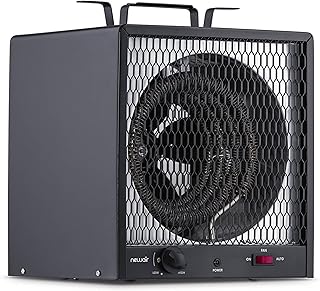
NewAir Portable Electric Garage Heater
The NewAir 240V portable heater is a solid choice for anyone who wants plug-in convenience without a permanent ceiling installation. Its compact industrial design sits flat on a concrete floor and throws heat directionally, making it particularly effective for spot-warming a workbench or charging station. It runs on a dedicated 240V outlet and handles shop and shed duty without fuss.
Comfort Zone 5000W Ceiling-Mounted Garage Heater
Comfort Zone’s 5000W ceiling unit is a no-nonsense hardwired workhorse with three heat settings and reliable overheat protection. Its grey steel housing disappears against an unfinished ceiling, and ETL listing gives peace of mind for year-round installation. If you want a “set it and forget it” heater that stays out of your way, this one earns its reputation.
Fan-Forced 5000W Garage Heater with Remote
This fan-forced 5000W model stands out by pairing a digital thermostat with a full remote control and a 1–9 hour programmable timer — features often missing from ceiling-mount units in this price range. It covers roughly 500 square feet with consistent warmth, and its wall or ceiling mounting flexibility makes it adaptable to irregular garage layouts.
TEMPWARE 7500W Hardwired Garage Heater
When you need maximum output, the TEMPWARE 7500W delivers serious BTUs for larger shops and warehouses. The remote-controlled digital thermostat, 12-hour timer, and overheat protection round out a feature set that punches above its price point. It requires a robust 240V hardwired connection, but for spaces over 500 square feet it’s one of the most effective options available.
Shinic Radiant Quartz Ceiling Heater
The Shinic 1500W/750W quartz heater takes a different approach: infrared radiant heat that warms objects and people directly rather than heating all the air. The integrated work light and 90° rotation add genuine utility, and five mode settings let you dial intensity from a gentle glow to focused warmth. It’s best suited for garages under 300 square feet where directional heating makes sense.
Frequently Asked Questions
Can I run a 5000W garage heater on a regular household outlet?
No. A 5000W heater at 240V draws roughly 21 amps and requires a dedicated 240V circuit with appropriate breaker and wiring. Attempting to use an adapter on a 120V outlet risks tripping the breaker, damaging the heater, or creating a fire hazard. Always have a licensed electrician install the circuit if your garage isn’t already equipped.
How long does it take to heat a two-car garage in winter?
It depends on insulation, ambient temperature, and heater wattage. A well-insulated two-car garage with a 5000W heater can reach comfortable working temperatures (around 60°F) from near-freezing in approximately 30–45 minutes. Poorly insulated garages with exposed studs and no weatherstripping will take significantly longer and cost more to maintain.
Are ceiling-mounted garage heaters safe to leave running unattended?
Most ETL-listed ceiling-mount units include overheat auto-shutoff and thermal cutoff switches designed for unattended operation. That said, standard practice is to pair the heater with a programmable timer and avoid running it overnight or when the space is completely unoccupied for extended periods.
What’s the difference between fan-forced and radiant quartz garage heaters?
Fan-forced heaters blow heated air throughout a space, warming the room’s volume uniformly but taking longer to reach target temperature. Radiant quartz heaters emit infrared energy that heats surfaces and people directly — faster perceived warmth, but less effective at conditioning an entire large garage. Choose radiant for spot heating at a workstation; choose fan-forced for whole-room warmth.
Final Thoughts
For most two-car garages, the Comfort Zone 5000W ceiling-mount heater hits the sweet spot of reliable output, clean installation, and set-and-forget simplicity. Shoppers with larger workshops should look closely at the TEMPWARE 7500W for its raw heating power and well-implemented remote controls. If a permanent installation isn’t in the cards, the NewAir Portable delivers real 240V performance without ceiling mounting — just plug it in and aim it where you work.